
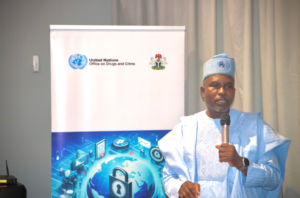
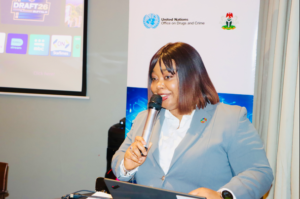
The United Nations Office on Drugs and Crime (UNODC) recently in Lagos launched a campaign on Tackling Online Intimate Image Abuse in the country, an engagement which brought together national authorities, law enforcement, and civil society to:
Advance a Nigerian model of response; Strengthen victim support systems; Improve criminal justice and policy frameworks; and Launch public awareness efforts and partnerships.
This report brings keep issues discussed and agreed on.
For decades, technology has been celebrated as one of humanity’s greatest equalisers, breaking geographical barriers, creating new economic opportunities and giving millions a voice in the digital public square. Yet, the same technology has also created one of the fastest-growing frontiers of abuse, particularly against women and girls.
Across the world, intimate images are increasingly being weaponised to shame, blackmail, intimidate, extort and silence victims. What was once confined to “revenge porn” has evolved into a much broader and more sinister phenomenon known as Non-Consensual Intimate Images (NCII)—the creation, sharing or threatened dissemination of intimate images without the consent of the person depicted.
Artificial intelligence has dramatically escalated the crisis.
Today, sophisticated software can generate realistic explicit images of virtually anyone using only publicly available photographs from social media. Unlike traditional image manipulation, modern AI tools require little technical expertise, making digital sexual abuse accessible to virtually anyone with a smartphone or personal computer.
The scale of the problem is staggering.
International research indicates that between 96 and 98 per cent of all deepfake videos circulating online are pornographic, while about 99 per cent feature women and girls as victims. Since 2019, the volume of deepfake content available online has grown by an estimated 550 per cent, reflecting the explosive spread of generative artificial intelligence.
Recent academic research has also identified almost 35,000 publicly downloadable deepfake AI models, which have collectively been downloaded nearly 15 million times since late 2022. The findings illustrate how technology once reserved for highly skilled programmers has become widely available to ordinary internet users.
Behind these statistics are devastating human stories.
Victims frequently suffer depression, anxiety, social isolation, job loss, educational disruption and reputational damage. Some endure persistent online harassment for years after the initial publication of intimate images, while others continue to live under constant fear that explicit material—real or artificially generated—may resurface indefinitely.
Women occupying public spaces face even greater risks.
According to UNESCO, 73 per cent of women journalists globally have experienced online violence, including harassment, threats, coordinated abuse campaigns and image-based attacks intended to intimidate or silence them. The report highlights how digital violence increasingly threatens freedom of expression, democratic participation and women’s leadership.
These disturbing global trends underscore why governments can no longer treat online image abuse as merely another cybercrime.
Instead, experts increasingly recognise NCII as a serious human rights issue that intersects with gender equality, privacy, digital governance, justice, mental health and public safety.
It is against this backdrop that Nigeria has developed a National Model of Response aimed at creating a coordinated national strategy for preventing and responding to non-consensual intimate images.
Unlike traditional approaches that focus primarily on prosecution, the Nigerian framework seeks to build an integrated ecosystem involving government institutions, law enforcement agencies, technology companies, educational institutions, civil society organisations, researchers, media organisations and survivors themselves.
The model is founded on six guiding principles: a rights-based approach, survivor-centred services, evidence-informed policymaking, integrated institutional responses, universal standards adaptable to local realities and a whole-of-society partnership. These principles recognise that online abuse cannot be effectively addressed by one institution acting alone but requires coordinated action across every sector of society.
Why Existing Laws Are No Longer Enough
One of the strongest messages emerging from Nigeria’s proposed framework is that legal systems must evolve as rapidly as technology.
Historically, legislation dealing with intimate image abuse was drafted before the emergence of sophisticated artificial intelligence. Consequently, many legal systems struggle to prosecute perpetrators who fabricate explicit images using AI rather than distributing authentic photographs.
The National Model of Response directly addresses this gap.
It recommends that Nigeria establish and maintain a comprehensive legal framework explicitly recognising the creation, sharing and facilitation of NCII, including synthetic or manipulated content generated through artificial intelligence.
More significantly, the framework proposes shifting away from legal approaches that depend largely on proving malicious intent. Instead, it argues that consent should become the defining legal principle.
This represents a profound change in legal philosophy.
Whether an intimate image is genuine or artificially generated should become secondary. What matters is whether the individual depicted consented to its creation, possession or dissemination.
The framework also recommends introducing criminal and civil penalties not only for the actual distribution of intimate images but also for threats to create or circulate them, recognising that threats alone often inflict severe psychological trauma on victims.
Equally important is the recommendation that Nigeria develop legislation capable of adapting to future technological innovations rather than requiring constant amendments every time artificial intelligence evolves.
Technology companies also come under scrutiny.
The framework advocates stronger industry accountability through implementation guidelines requiring transparency, privacy-by-design safeguards and safety mechanisms capable of preventing the creation, circulation and monetisation of abusive content before it spreads online.
Prevention Begins Long Before Images Are Shared

Laws alone cannot solve the problem.
One of the most innovative aspects of Nigeria’s proposed response is its recognition that prevention must begin with changing social attitudes toward consent, privacy and respectful digital behaviour.
The framework recommends integrating digital citizenship, consent education, healthy relationships and online safety into school curricula and cybersecurity programmes rather than treating them as isolated topics.
This reflects growing international evidence that prevention is most effective when young people understand not only how to protect themselves online but also why sharing intimate images without consent constitutes abuse.
The model further recommends nationwide public awareness campaigns communicating clearly that NCII is illegal, harmful and unacceptable.
Importantly, such campaigns should also publicise available victim support services through multiple languages and accessible formats to ensure that survivors know where to seek help.
The media equally has a critical responsibility.
Rather than sensationalising cases involving intimate images, journalists are encouraged to adopt responsible reporting practices that reduce stigma, protect survivor identities and avoid inadvertently amplifying harmful content.
By reshaping public attitudes, the framework seeks to replace victim-blaming with accountability for perpetrators, a cultural shift that many experts consider essential to reducing technology-facilitated abuse.

Putting Survivors Before Systems
Perhaps the most important shift proposed by the National Model of Response is its insistence that survivors—not institutions—must become the primary focus of intervention.
Too often, victims encounter fragmented systems requiring them to report repeatedly to multiple agencies while simultaneously attempting to remove intimate images from numerous online platforms.
The framework seeks to reverse that experience.
It recommends dedicated national helplines, specialised victim support services and sustained government funding to ensure these services remain available regardless of location or financial circumstances.
Recognising that removing harmful images quickly is often as important as prosecuting offenders, the framework also encourages partnerships between government, civil society and technology companies to accelerate takedown requests using image-hashing technologies such as StopNCII.org.
The recommendations extend beyond emotional support.
The framework advocates closer collaboration between organisations specialising in NCII, legal aid providers, pro bono lawyers and prosecution services to improve survivors’ access to justice.
It also recommends stronger referral systems linking adult support organisations with child-focused services to ensure age-appropriate responses for younger victims.
This integrated approach reflects an understanding that image-based abuse is rarely a single incident but often part of wider patterns of coercion, domestic violence, sextortion, cyberstalking and gender-based violence.
Rather than expecting survivors to navigate complex bureaucracies independently, the framework envisions a coordinated response in which institutions work together to minimise trauma while maximising protection and access to justice.