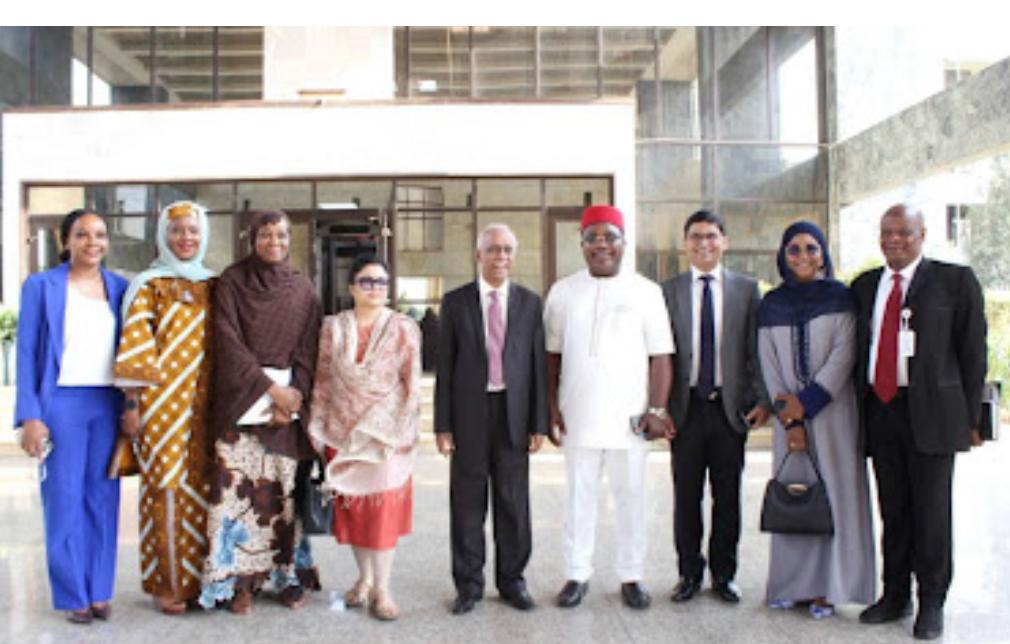
Nigeria and India have signed a landmark bilateral agreement to strengthen human rights protection, institutional capacity and access to justice, with Attorney-General of the Federation and Minister of Justice, Prince Lateef Fagbemi, SAN, pledging the Federal Government’s support for its implementation.
Fagbemi said the agreement, signed between the National Human Rights Commission (NHRC) of Nigeria and its Indian counterpart, represented a strategic partnership that would deepen institutional cooperation, promote knowledge sharing and improve mechanisms for addressing human rights violations.
The Attorney-General spoke on Tuesday in Abuja when he received a joint delegation from the two commissions at the Federal Ministry of Justice. He described the partnership as timely, given the growing human rights challenges associated with technological advancement, security concerns and the increasing interconnectedness of societies.
He stressed that the success of the agreement would be measured by its practical impact on ordinary citizens, particularly vulnerable and marginalised groups seeking justice.
The Nigerian delegation was led by the NHRC Executive Secretary, Chief Tony Ojukwu, SAN, OFR, while the Indian delegation was headed by the Chairperson of India’s NHRC, Justice V. Ramasubramanian, accompanied by the Commission’s Joint Secretary, Mr Samir Kumar.
Fagbemi identified access to justice and digital rights as critical areas of cooperation, warning that emerging technologies, particularly Artificial Intelligence (AI), were creating new human rights concerns requiring urgent legal and institutional responses.
He called for effective safeguards to protect personal data, prevent algorithmic discrimination and preserve civic space, insisting that technological advancement must not come at the expense of fundamental freedoms.
He urged both commissions to develop actionable research findings and policy recommendations to address these emerging challenges.
The Attorney-General also emphasised that Nigeria’s commitment to human rights must extend beyond constitutional provisions and international obligations to their effective implementation.
He cited the African Charter on Human and Peoples’ Rights, domesticated through the African Charter on Human and Peoples’ Rights (Ratification and Enforcement) Act, Cap. A9, Laws of the Federation of Nigeria 2004, as a key instrument supporting the country’s human rights framework.
According to him, the Charter reinforces constitutional guarantees on human dignity, non-discrimination, fair trial and personal liberty.
Fagbemi maintained that genuine commitment to human rights was demonstrated through accessible justice institutions, accountable public authorities and an independent judiciary.
He assured the Indian delegation that the Federal Ministry of Justice would support the implementation of the agreement through technical engagements, joint legal reviews and policy consultations aimed at strengthening the justice sector.
He also reaffirmed the Federal Government’s commitment to protecting the institutional independence of the NHRC, describing its autonomy as essential to its credibility and effectiveness.
Specifically, he referenced Section 6(3) of the National Human Rights Commission (Amendment) Act, 2010, which stipulates that the commission shall not be subject to the direction or control of any other authority or person in the discharge of its statutory responsibilities.
He said the administration remained committed to respecting the commission’s statutory independence, adding that its relationship with the Ministry of Justice had been characterised by constructive collaboration, mutual respect and a shared commitment to human rights advancement.
The Attorney-General commended Ojukwu and the Nigerian commission for initiating the bilateral partnership and appreciated the Indian delegation for bringing its institutional experience and expertise to the collaboration.
Earlier, during a meeting with the Chief Justice of Nigeria (CJN) at the Supreme Court Complex in Abuja on Monday, Ojukwu highlighted the complementary roles of the judiciary and national human rights institutions in protecting fundamental freedoms, upholding the rule of law and ensuring access to justice.
He identified complaint management, Alternative Dispute Resolution, security sector accountability, comparative legal research, digital rights, AI ethics and environmental justice as priority areas for cooperation.
The Chief Justice reaffirmed the judiciary’s commitment to human rights protection and encouraged both commissions to exchange experiences and adopt best practices, particularly in strengthening safeguards for women, children, persons with disabilities and other vulnerable groups.
The Indian delegation described the engagement as significant to bilateral relations, noting that the memorandum of understanding represented a first-of-its-kind institutional partnership for India’s National Human Rights Commission.
The agreement is expected to facilitate sustained institutional exchanges, strengthen complaint-handling mechanisms, improve professional capacity and promote comparative research into legal and policy approaches to human rights protection.
The partnership comes amid growing demands on national human rights institutions to address abuses associated with security operations, discrimination, environmental degradation, digital surveillance and the misuse of emerging technologies.
Fagbemi, however, emphasised that the ultimate success of the agreement would depend not on official meetings and institutional exchanges alone, but on tangible improvements in the protection of citizens’ rights and access to justice, particularly for those most vulnerable to abuse.