
Nigeria’s pension industry is seeking to mobilise about $600 million from domestic pension funds for a proposed $750 million infrastructure investment platform, with 19 Nigerian pension funds already expressing interest in the initiative.
The proposed Pension Industry Infrastructure Platform (PIIP) is being developed by the Pension Industry Leadership Council (PILC) in partnership with FSD Africa, a United Kingdom-funded development agency, to finance critical infrastructure projects in Nigeria and selected markets across the region.
The partnership was formalised through the signing of a memorandum of understanding to support the development and establishment of the proposed investment platform.
Under the agreement, FSD Africa will provide technical expertise and advisory support to PILC, including assistance with the competitive selection of a fund manager, engagement with potential investors and Development Finance Institutions (DFIs), capacity building and support for relevant regulatory reforms.
The initiative, driven by Nigerian Pension Fund Administrators (PFAs), with support from the National Pension Commission (PenCom) and FSD Africa, is designed to channel long-term pension savings into infrastructure development while maintaining appropriate safeguards for contributors’ retirement funds.

Speaking on the partnership, the UK Deputy High Commissioner in Lagos, Jonny Baxter, said the initiative reflected the shared commitment of Nigeria and the United Kingdom to strengthening Nigeria’s capital market, attracting domestic investments and directing long-term capital towards productive sectors of the economy.
He said the UK was pleased to partner with Nigeria’s pension industry and PenCom to translate investment ambitions into tangible economic opportunities.
“Both our countries are prioritising tackling the challenge of attracting more domestic capital, including from pension funds, into the real economy. It is great to see Nigeria making concrete progress on its efforts and be a part of those opportunities to turn this ambition into investment, jobs, and economic growth,” Baxter said.
Chairman of PILC and Director-General of PenCom, Omolola Oloworaran, described the initiative as a timely intervention that would enable the pension industry to contribute more significantly to national infrastructure development.
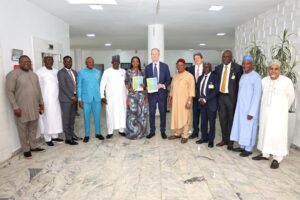
She said the industry controlled the country’s largest pool of long-term savings and was committed to deploying part of the funds into productive investments without compromising the financial security of pension contributors.
“The pension industry holds the largest pool of long-term savings capital in the country, and we are committed to mobilising it to deepen infrastructure development, while safeguarding the retirement savings of contributors. This MoU is the first step we are taking as an industry, and it is just the beginning,” she said.
Similarly, Chief Executive Officer of FSD Africa, Mark Napier, said the platform offered an opportunity to address the contradiction between Africa’s substantial institutional investment resources and its persistent infrastructure financing gaps.
He expressed the agency’s commitment to working with PenCom and Nigeria’s pension industry to unlock institutional capital for priority infrastructure projects.
The proposed fund is targeting an initial capital mobilisation of $350 million at its first close, scheduled for 2027, before expanding to its ultimate target of $750 million.
At full capacity, the platform is expected to attract approximately $600 million from Nigerian pension funds and at least $150 million from development finance institutions.
An initial assessment of Nigeria’s infrastructure project pipeline has identified 39 potential projects suitable for consideration by the platform, with estimated investment requirements of about $20 billion.
The fund will focus on equity and quasi-equity investments, with at least 60 per cent of its portfolio earmarked for projects in Nigeria, while the remaining allocation will support selected infrastructure investments across the region.
Its proposed investment structure will comprise a naira-denominated core fund and a separate co-investment vehicle through which participating pension funds can invest alongside the main fund in selected projects.
A parallel foreign-currency investment vehicle may also be established to accommodate international investors.
The initiative is expected to provide institutional investors with access to professionally managed, long-term investment opportunities while expanding financing for critical infrastructure in the energy, transportation and digital sectors.
The platform is also expected to improve connectivity, stimulate private sector growth, create employment opportunities and support Nigeria’s broader economic development objectives.