A review of 30 high-profile corruption cases pending before Nigerian courts has exposed systemic weaknesses in the country’s justice system, including prolonged trials, opaque plea bargaining, unaccountable asset recovery and failed prosecutions.
The findings have prompted the Nigerian Bar Association (NBA), Code of Conduct Bureau (CCB) and Nigerian Law Reform Commission to call for urgent reforms to strengthen accountability and restore public confidence in the administration of justice.
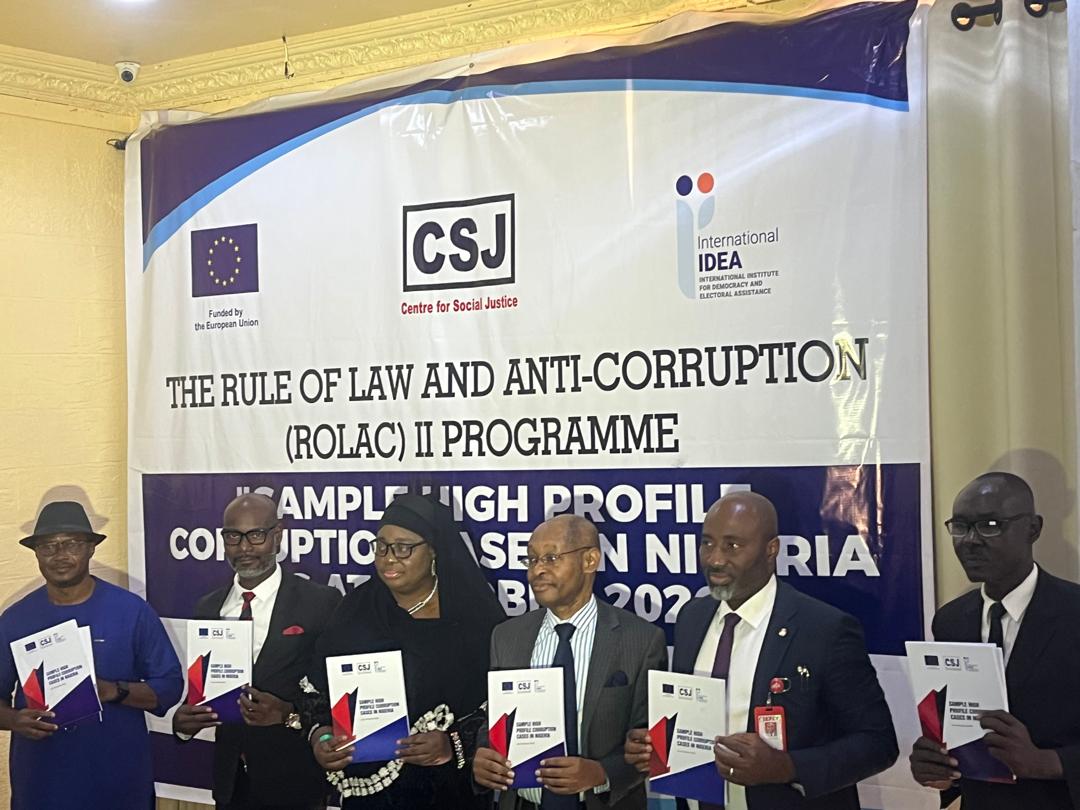
The findings are contained in a publication titled Sample High Profile Corruption Cases in Nigeria (As at October 2026), produced by the Centre for Social Justice (CSJ), which examines the progress of corruption trials across Nigerian courts and cases before the Code of Conduct Tribunal.
The review identified delays, interlocutory appeals, inadequate investigations and weak prosecution as recurring challenges undermining the country’s anti-corruption campaign.
It also raised concerns over plea bargaining arrangements lacking transparency and asset recovery processes without adequate accountability, calling for a more comprehensive approach to tackling corruption.
The findings were presented at a public event in Abuja on Thursday, where stakeholders stressed that the success of the anti-corruption campaign should be measured not by the number of investigations, arrests or charges filed, but by the delivery of credible, timely and fair judicial outcomes.
Speaking at the event, Chairman of the Nigerian Law Reform Commission, Prof. Dakas C.J. Dakas, SAN, described the publication as an important tool for exposing institutional weaknesses and providing an empirical basis for reviewing Nigeria’s anti-corruption laws.
He said the documentation of corruption cases was particularly important because trials could be filed, repeatedly adjourned and eventually abandoned without the public having a clear record of their progress.
Dakas identified documentation, public education, exposure of systemic gaps and accountability as four major contributions of the publication to Nigeria’s anti-corruption efforts.
He said recording the defendants, allegations, courts handling the cases, proceedings and current status would provide a permanent public record from which institutions could learn.
According to him, the review demonstrated that the challenges confronting corruption prosecutions were not isolated incidents but systemic failures requiring comprehensive reforms.
“These are not isolated failures. They are systemic failures, and systemic failures require systemic reform,” he said.
The commission chairman questioned the effectiveness of Nigeria’s extensive anti-corruption legislation, noting that the existence of several laws did not necessarily translate into effective enforcement.
“Having many laws is not the same as having an effective legal framework. Our challenge is not the absence of law. It is fragmentation, overlap, delay, weak enforcement, and a gap between the law on paper and the law in practice,” he said.
He cited the ICPC Act 2000, EFCC Act 2004, Criminal Code, Penal Code, Money Laundering (Prevention and Prohibition) Act 2022, Public Procurement Act 2007 and constitutional provisions on the Code of Conduct for Public Officers as existing legal instruments addressing corruption.
Dakas said the commission would study the publication and incorporate its findings into its law reform programme, particularly in the areas of investigation, prosecution, asset recovery, sentencing, whistleblower protection and corruption prevention.
He added that identified gaps in substantive laws would be considered for legislative intervention, while procedural shortcomings would inform efforts to simplify and expedite legal processes.
The NBA, represented by its Second Vice-President, Nuhu J. Egya, said prolonged corruption trials were weakening public confidence in the justice system and diminishing the deterrent effect of anti-corruption laws.
Egya, who represented the NBA President, Mrs Oyinkansola Badejo-Okusanya, SAN, said the effectiveness of anti-corruption efforts should be assessed by the fairness, credibility and ultimate outcomes of judicial proceedings.
Citing Section 36(1) of the 1999 Constitution, as amended, the association stressed that the right to a fair hearing within a reasonable time must remain central to the administration of justice.
It called for improved judicial and prosecutorial case management, adequate funding of justice-sector institutions, technology-driven case tracking and documentation, and stronger coordination among agencies responsible for investigating, prosecuting and adjudicating corruption cases.
The NBA also identified the Administration of Criminal Justice Act 2015 as an important framework for improving criminal justice delivery, but stressed that its effectiveness depended on proper implementation, institutional cooperation and adequate resources.
In a related intervention, the CCB identified delays in determining corruption-related cases as a major challenge and supported reforms to strengthen the Code of Conduct Tribunal.
The bureau’s Director of Legal Service Department, Mrs Sambo Sa’adat Omotayo, who delivered a goodwill message on behalf of its chairman, said the publication provided useful material for institutional reflection and constructive engagement.
She said the bureau was responsible for receiving and examining asset declarations by public officers, investigating breaches of the Code of Conduct and referring appropriate cases to the tribunal.
Omotayo welcomed the proposed legislative memorandum for strengthening the tribunal, expressing the bureau’s readiness to examine its recommendations and engage stakeholders on measures to improve its effectiveness, independence and operational capacity.
She also called for stronger case management systems, improved investigative and legal capacities, and greater deployment of technology in the administration of justice.
However, she cautioned that public monitoring of corruption cases must respect the presumption of innocence, the rights of parties and the sub judice rule.
“The pursuit of accountability and the protection of fundamental rights are not competing objectives. Rather, they are complementary pillars of the rule of law,” she said.
Beyond the immediate challenges of prosecution, Dakas said corruption was also a moral, cultural, institutional and leadership problem requiring a broader national response.
He advocated the introduction of anti-corruption education in primary and secondary schools, universities, professional training institutions and the public service.
“If we do not teach integrity early, we will spend a lifetime punishing its absence,” he said.
The three institutions called on government agencies, the judiciary, legislature, civil society, the legal profession, development partners and the media to take ownership of the reform process.
They also urged the Centre for Social Justice to ensure that the publication’s findings and recommendations reached relevant government institutions and policymakers for consideration and implementation.
The institutions maintained that the review should serve as a catalyst for reforms that would ensure corruption allegations were properly investigated, effectively prosecuted and determined without unnecessary delay.
They stressed that strengthening the justice system was essential to ensuring that accountability was not undermined by procedural delays, weak investigations or institutional shortcomings.