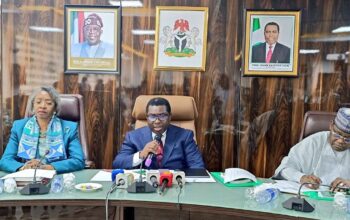
The Federal Government has called for increased accountability and transparency in global climate funding, emphasizing that Nigeria and other developing nations are frustrated with empty promises and pledges that fail to address the urgent challenges of global warming and climate change.
During the first International Anti-Corruption and Climate Change Conference held in Abuja, organized by the Human and Environmental Development Agenda (HEDA Resource Centre) in collaboration with Hawkmoth and supported by the MacArthur Foundation, the Minister of State for Environment, Dr. Ishaq Salako, stressed the need for climate accountability and transparency. In his keynote address, Dr. Salako stated, “Climate accountability and transparency are critical elements in building trust, credibility, accessing funding, and mobilizing mass participation.”
Represented by Mrs. Iniobong Abiola-Awe, Director of the Department of Climate Change at the Ministry of Environment, Dr. Salako urged developed countries, the primary contributors to global warming, to lead by example through greater transparency and accountability in their climate funding efforts. He remarked, “The developing world, the most impacted victims of climate change, are growing weary of rhetoric and pledges that are often not at scale to the problem and remain largely unfulfilled.”
Highlighting the need for the Global South to strengthen its climate action frameworks, Dr. Salako said, “For us in the Global South, we need to put more structures in place to prioritize climate actions and enhance climate accountability and transparency.”
He also emphasized the importance of ethical governance in tackling climate change and energy transition, noting, “Transparency and accountability are the bedrock of sustainable development, and it is through collaborative efforts like this conference that we can achieve a more just and sustainable future.”
Dr. Salako further pointed out that climate change requires a comprehensive, cross-sectoral approach and acknowledged the competitive nature of securing funding for climate initiatives alongside other critical sectors. He underscored the need for robust transparency and accountability frameworks to support sustainable climate actions, including improved decision-making, monitoring, and evaluation against established climate goals.
Mr. Olanrewaju Suraju, Chairman of HEDA Resource Centre, highlighted the importance of learning from past mistakes as Nigeria shifts from oil and gas to renewable energy sources like lithium and solar. He cautioned against repeating the exploitation and mismanagement that plagued the oil sector, advocating for sustainable development that benefits all regions of the country and calling for the establishment of accountability mechanisms to ensure a responsible transition.