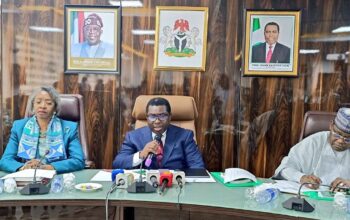
The Minister of Women Affairs, Imaan Sulaiman-Ibrahim, has called for increased representation of women in senior command roles within Nigeria’s military and security agencies, describing the current level of inclusion as inadequate.
Speaking at the 5th Annual Forum of the Women, Peace, and Security Sector Reference Group in Abuja on Tuesday, the Minister emphasized that despite their proven competencies, women remain underrepresented in operational roles and strategic decision-making positions within the security sector.
While acknowledging some progress, particularly in the Nigeria Police Force and paramilitary institutions like the Nigeria Immigration Service, she stressed that the achievements so far were not sufficient.
“Women continue to bear the brunt of insecurity—whether as victims of gender-based violence, internally displaced persons, or those facing structural barriers within our security institutions. We must dismantle institutional and structural obstacles that hinder their full participation,” Sulaiman-Ibrahim stated.
She urged key stakeholders to bridge the gap between policy commitments and implementation, ensuring tangible progress in advancing the Women, Peace, and Security (WPS) agenda.
UN Women Reaffirms Commitment to Gender Inclusion
In her remarks, Beatrice Eyong, UN Women Representative to Nigeria and ECOWAS, highlighted the forum’s theme: “Enhancing Implementation: The Role of the Security Sector in Nigeria’s 3rd National Action Plan on Women, Peace, and Security.” She described it as a reflection of the collective commitment to gender equality and women’s participation in security affairs.
Eyong announced Nigeria’s imminent launch of its 3rd National Action Plan (NAP) on UNSCR 1325, a roadmap aimed at strengthening gender inclusion in peace and security processes. She emphasized the security sector’s pivotal role in translating this plan into actionable outcomes.
“The security sector must take the lead in institutionalizing gender equality, strengthening policies, and ensuring women’s meaningful participation in decision-making processes,” Eyong stated.
She noted significant milestones in gender inclusion within Nigeria’s security institutions:
Nigeria’s Armed Forces achieved 27.9% female participation in peacekeeping operations in 2023, surpassing the UN benchmark of 17%.
The Nigeria Security and Civil Defence Corps (NSCDC) now has 35% female representation among its staff.
Gender policies have been adopted by the Armed Forces, Nigeria Police Force, NSCDC, and the Department of State Services (DSS) to institutionalize gender inclusion.
The Standard Training Manual on Gender has been integrated into the training curricula of the Nigeria Police, NSCDC, and Nigerian Navy, ensuring long-term impact.
Eyong also highlighted the Leadership and Mentoring Programme for Women in the Security Sector, launched in collaboration with the National Defence College (NDC). She called on security agencies to adopt and institutionalize the initiative to sustain progress.
The forum reinforced the urgency of closing gender gaps in Nigeria’s security institutions, ensuring that women are not only protected but also empowered to contribute meaningfully to national security and peacebuilding.