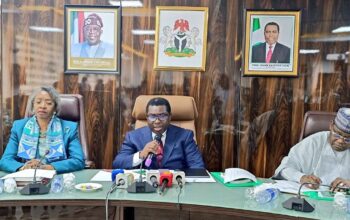
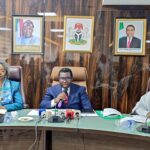
The Economic Community of West African States (ECOWAS) Commission has intensified efforts to actualise free movement across the region, beginning a tour of major border points with a high-level visit to the Seme border between Nigeria and Benin on Wednesday.
Leading the delegation, ECOWAS Commission President Dr. Omar Touray described the Seme border as one of West Africa’s busiest and most strategic crossings but lamented decaying infrastructure and operational inefficiencies threatening the bloc’s free movement agenda.
“We are faced with expensive facilities—scanners, lighting systems, and bridges—that are simply not working. That is unacceptable,” Touray said after meeting with Nigerian and Beninese officials at the border. “We cannot justify millions spent on equipment that lies idle. Our citizens expect results—not excuses.”
Touray criticised the proliferation of checkpoints along regional corridors, arguing they frustrate travellers, hinder trade, and open avenues for corruption. “Why do we have multiple customs and immigration posts for the same corridor? It delays trade and undermines the spirit of ECOWAS protocols,” he stated, calling for transparency and the elimination of unofficial payments.
While reaffirming that free movement requires valid identification and travel documents, Touray expressed optimism over Nigeria and Benin’s joint commitment to improving cooperation. He pledged that ECOWAS would compile a comprehensive report with recommendations to address infrastructure failures and operational bottlenecks.
The Controller of Nigerian Customs at Seme, Ben Oramalugo, echoed concerns, revealing that critical scanners have been non-functional since February. “These scanners can detect things human eyes cannot. Without them, our ability to intercept dangerous goods is compromised,” he said. Oramalugo added that the border post lacks electricity and depends entirely on Benin’s power supply, calling for urgent upgrades and connection to Nigeria’s national grid.
He also highlighted challenges of double taxation on goods in transit and advocated for strict adherence to international transit rules to encourage trade. “Importers are avoiding this corridor due to multiple levies. Both countries must align their policies,” Oramalugo stressed.
Nigeria’s Permanent Representative to ECOWAS, Ambassador Musa Nuhu, described the Seme border as critical to the bloc’s free movement aspirations. “If free movement is working anywhere in West Africa, it is at this border,” Nuhu said. He noted that infrastructural decay, overlapping security checks, and policy gaps hinder smooth operations.
Nuhu disclosed that Nigeria has already initiated reforms to streamline operations. “President Bola Tinubu recently approved a Presidential Task Force to dismantle multiple checkpoints nationwide, starting with the Seme-Badagry corridor. The committee is under the Secretary to the Government of the Federation and will soon begin work,” he revealed.
Meanwhile, immigration officials along the Seme border called for intensified public awareness campaigns to clarify the rights and limitations under the ECOWAS free movement protocol, citing widespread misunderstandings among travellers and transport operators.