The National Human Rights Commission (NHRC) and the ECOWAS Court of Justice have reaffirmed their commitment to strengthening collaboration on the enforcement of court judgments, as part of activities marking the Court’s golden jubilee celebrations.
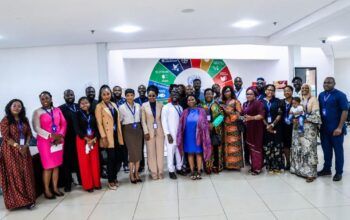
The renewed partnership was underscored during a courtesy visit by the Court’s delegation to the Commission in Abuja, where both institutions pledged closer cooperation to enhance compliance with regional human rights decisions.
Welcoming the delegation, the Executive Secretary of the Commission, Tony Ojukwu, described the NHRC as a “natural ally” of the Court. He noted that the Commission regularly relies on decisions of the ECOWAS Court in resolving human rights complaints, including cases involving children’s right to education and protection against terrorism-related violations.
“We do not wait for government directives. Once we are satisfied that a decision aligns with constitutional and international human rights standards, we enforce it. The NHRC remains committed to ensuring justice for victims of rights violations,” he said.
In his remarks, the President of the Court, Ricardo C.M. Goncalves, highlighted persistent challenges confronting the enforcement of the Court’s judgments across member states. He disclosed that approximately 80 per cent of the Court’s decisions remain unenforced, a development he described as deeply frustrating for victims seeking redress.
“Non-execution of judgments breeds frustration. We are counting on the Commission’s support to improve enforcement in Nigeria,” he stated.
Justice Goncalves identified lack of political will, inconsistent enforcement mechanisms, and institutional weaknesses as key impediments to compliance. He explained that ongoing stakeholder engagements in Nigeria are aimed at developing a collaborative framework, sharing best practices, and addressing structural barriers to enforcement.
He expressed optimism that the strengthened partnership with the NHRC would reinforce the rule of law and advance human rights protection across the West African sub-region.
The ECOWAS Court of Justice was established pursuant to Articles 6 and 15 of the 1993 Revised Treaty of the Economic Community of West African States (ECOWAS). Its mandate is to ensure the observance of law, principles of equity, and human rights within the Community.
The Court operates with four distinct mandates: as a Community Court, an Administrative Court, a Human Rights Court, and an Arbitration Tribunal.