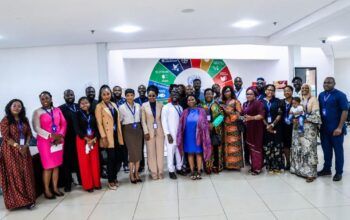
Governor of the Central Bank of Nigeria, Olayemi Cardoso, has called for coordinated reforms in digital cross-border payment systems to promote inclusive growth, enhance financial stability, and deepen global financial integration among developing economies.
Cardoso made the call on Thursday while addressing participants at the G-24 Technical Group Meetings (TGM) 2026 held in Abuja. He stressed that efficient, interoperable payment infrastructure remains fundamental to broad-based economic inclusion.
According to him, high remittance costs, prolonged settlement timelines, fragmented regulatory frameworks, and heavy compliance requirements continue to constrain households and Micro, Small and Medium Enterprises (MSMEs) from effectively participating in global trade. He noted that average remittance costs across major corridors remain above six per cent, with settlement delays often stretching several days, thereby excluding millions from modern financial systems.
While acknowledging the transformative potential of digital payment systems, the CBN governor cautioned that they also pose macro-financial risks, including currency substitution, weakened monetary policy transmission, heightened foreign exchange volatility, capital flow pressures, and regulatory fragmentation.
Highlighting Nigeria’s reform measures, Cardoso said the apex bank has strengthened its Anti-Money Laundering and Countering the Financing of Terrorism (AML/CFT) frameworks in alignment with Financial Action Task Force guidelines. He explained that the CBN now mandates strict dual-screening protocols for cross-border transactions to mitigate systemic and compliance risks.

To deepen regional financial integration, he added, the CBN has introduced simplified Know-Your-Customer (KYC) and AML requirements for low-value cross-border transactions to encourage greater participation in the Pan-African Payment and Settlement System (PAPSS). The move, he said, is designed to ease transaction processes for Nigerian SMEs and accelerate intra-African trade settlements.
Cardoso further noted that the bank has leveraged its Regulatory Sandbox framework to enable payment-focused fintech firms to test secure, instant cross-border solutions under regulatory oversight.
He reaffirmed Nigeria’s commitment to collaboration with G-24 member states, the International Monetary Fund, the World Bank Group, and other development partners in advancing a more inclusive, resilient, and development-oriented global financial architecture.
The G-24 TGM 2026, themed “Mobilising finance for sustainable, inclusive, and job-rich transformation,” brought together global financial stakeholders to deliberate on modernising financial systems in support of emerging and developing economies.