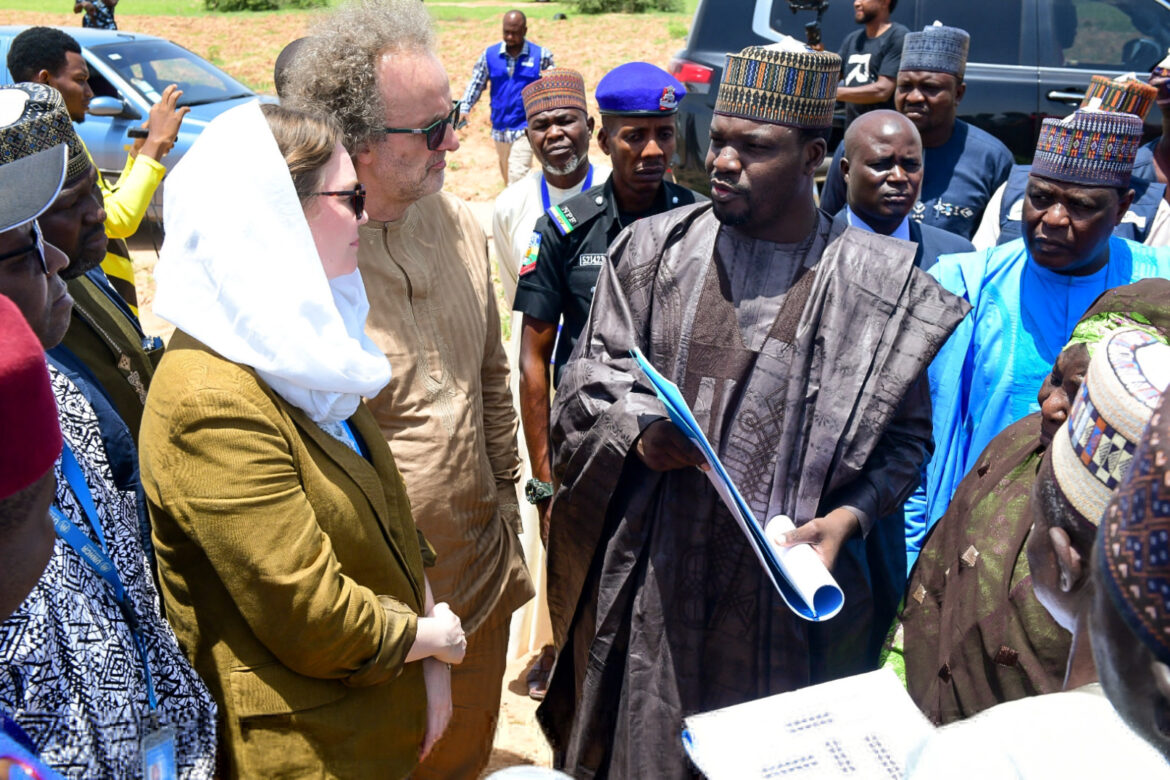
The European Union (EU), the governments of Switzerland and France, alongside Germany’s development agency (GIZ), the United Nations and other international development partners, have reaffirmed their commitment to supporting Yobe State’s transition from emergency humanitarian assistance to long-term recovery, resilience and sustainable development.
The renewed commitment followed a two-day technical mission to Yobe State, where the delegation reviewed donor-funded interventions, engaged government officials and community leaders, and assessed projects designed to provide durable solutions for internally displaced persons (IDPs), strengthen livelihoods and improve water resource management in communities affected by conflict, displacement and climate change.
The mission formed part of a broader joint assessment visit to Yobe and Adamawa states from July 5 to 10. Participants included representatives of the European Union Delegation to Nigeria and ECOWAS, the Embassy of Switzerland, the French Development Agency (AFD), Deutsche Gesellschaft für Internationale Zusammenarbeit (GIZ), United Nations agencies and implementing partners.
During the visit, the delegation held strategic discussions with the Yobe State Emergency Management Agency (YOSEMA), the Durable Solutions Secretariat and other state institutions to evaluate implementation progress, ensure sustainability and strengthen alignment between donor-supported interventions and the state’s long-term recovery agenda.
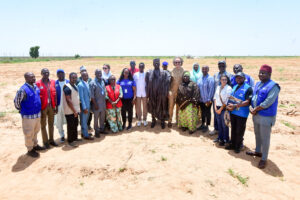
A major highlight of the mission was the inspection of the proposed site for the EU-funded Support for Internally Displaced Persons in Nigeria (SIDPIN) project in Maisandari Community. The initiative, jointly implemented by the International Organization for Migration (IOM), the United Nations High Commissioner for Refugees (UNHCR) and UN-Habitat, aims to promote sustainable integration of displaced persons and host communities through improved housing, healthcare, education and social infrastructure.
The delegation also visited Swiss-funded durable solutions projects implemented by Save the Children in Maisandari and Sumsumma communities, where members interacted with peace ambassadors, farmers, livestock beneficiaries and early warning committees working to strengthen livelihoods and enhance community resilience.
At primary healthcare centres, the team engaged Mother-to-Mother Support Groups and nutrition volunteers implementing community-based interventions to improve maternal and child health outcomes.
The visit also featured the official launch workshop for the Inclusive Economic and Social Recovery in the Lake Chad Region (RESILAC II) project, bringing together the EU, AFD, Action Against Hunger, CARE International, government officials and local partners to coordinate efforts aimed at accelerating economic recovery and building resilience in conflict-affected communities.
Water security also featured prominently during the mission, with the delegation visiting the Hadejia-Jama’are Komadugu Yobe Trust Fund to review progress under the LACHAWAMA project implemented by GIZ to strengthen sustainable water resource management across the state.
Speaking during the visit, Massimo De Luca, Head of Cooperation at the EU Delegation to Nigeria and ECOWAS, said the mission demonstrated the bloc’s enduring commitment to supporting Yobe’s recovery journey.
According to him, the progress recorded underscores the value of coordinated, locally driven approaches that integrate livelihoods, essential services, peacebuilding and sustainable management of natural resources.
Representing the Swiss Government, Humanitarian Adviser at the Embassy of Switzerland in Nigeria, Mrs. Aline Bürki, said lasting peace depends on enabling displaced persons to rebuild their lives with dignity.
She noted that integrating livelihood support, water and sanitation services, climate preparedness and peacebuilding demonstrates the impact that can be achieved when governments, humanitarian agencies and development partners work collaboratively with affected communities.
AFD Programme Manager for Nigeria, ECOWAS and the Lake Chad Region, Mrs. Sally Ibrahim, reaffirmed the agency’s commitment to strengthening resilience and supporting economic recovery in communities affected by insecurity and climate-related challenges.
She described the launch of the RESILAC II project in Yobe as a significant milestone in aligning government and development partners around shared recovery priorities.
Similarly, GIZ Nigeria Regional Project Manager, Mr. Boubakar Abdou Boko, stressed that sustainable water management remains critical to livelihoods, public health and peaceful coexistence.
He said GIZ would continue supporting institutional capacity, strategic coordination and community-led management of water resources through the LACHAWAMA project and its partnership with the Hadejia-Jama’are Komadugu Yobe Trust Fund.
On behalf of Governor Mai Mala Buni, the Secretary to the Yobe State Government, Dr. Goje Muhammed, welcomed the continued support from development partners, emphasizing that government leadership remains essential to achieving lasting solutions for displaced populations.
He said durable solutions are most effective when governments lead, communities actively participate and development partners align their interventions with national and state priorities, adding that Yobe is steadily transitioning from humanitarian response to sustainable recovery and inclusive development.
At the conclusion of the mission, the delegation commended the Yobe State Government, community leaders and implementing organisations for their collaboration and agreed to deepen investments in durable solutions, livelihood restoration, water resource management and essential public services.
Yobe remains one of the states most affected by the Boko Haram insurgency, with years of conflict displacing hundreds of thousands of residents. Although security has improved significantly across many parts of the state, development partners acknowledged that sustained investments in economic recovery, climate resilience and improved access to basic services remain critical to helping displaced families rebuild their lives and securing lasting peace across Nigeria’s North-East.