The National Office for Technology Acquisition and Promotion (NOTAP) has unveiled an ambitious strategy to transform research findings from Nigerian universities and research institutions into commercially viable products, a move aimed at reducing dependence on imported technologies, creating jobs and accelerating industrial growth.
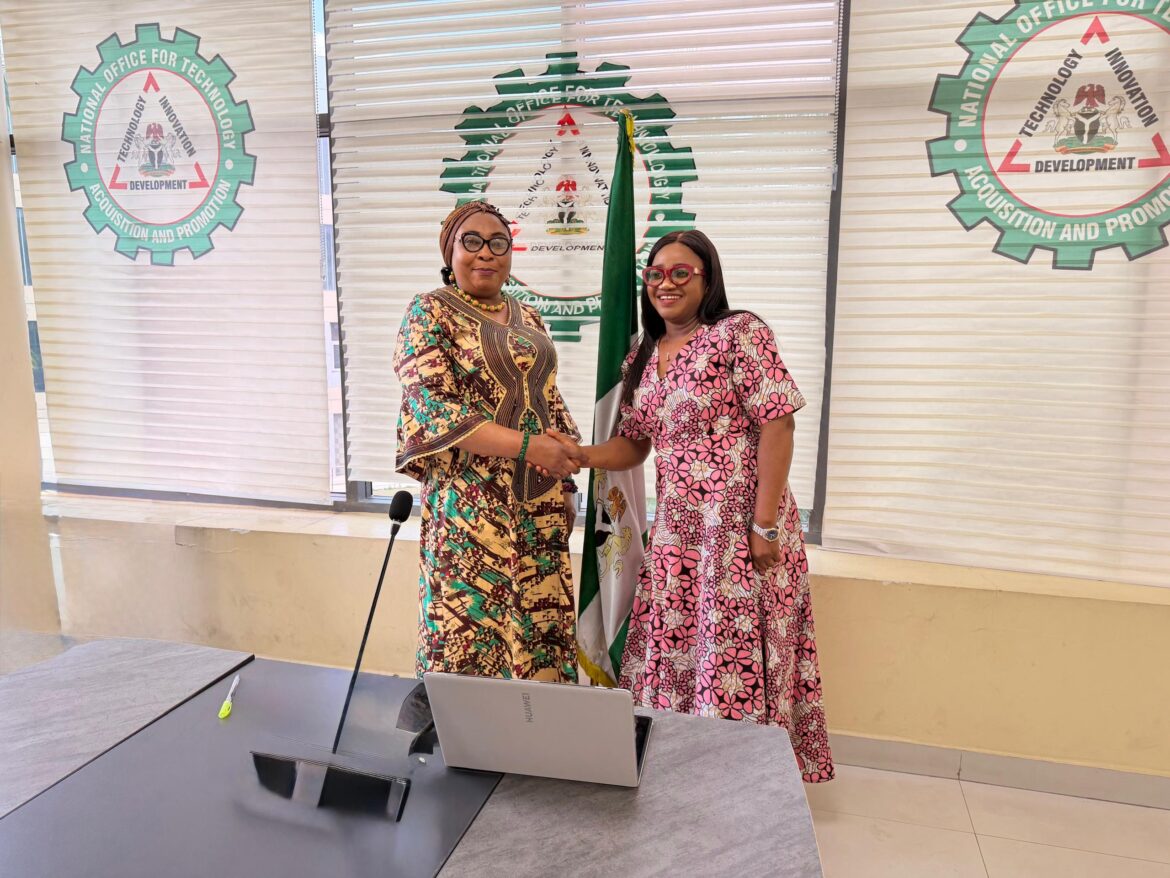
The initiative, which centres on forging partnerships between researchers, investors and industry players, was announced by the Director-General of NOTAP, Dr. Obiageli Amadiobi, during a courtesy visit by the leadership of the Nigeria Union of Journalists (NUJ), FCT Council, to the agency’s headquarters in Abuja.
As part of the strategy, NOTAP will host the National Technology and Innovation Summit on October 7 and 8, 2026, at the Civic Centre, Lagos, bringing together researchers, innovators, manufacturers, financial institutions, the Bank of Industry and investors to facilitate the commercialisation of locally developed technologies through strategic business matchmaking.
Amadiobi said the summit is designed to bridge the long-standing disconnect between research institutions and industry by connecting innovators with investors capable of transforming scientific discoveries into market-ready products and services.
She lamented that despite the abundance of groundbreaking research produced by Nigerian universities and research institutes, many innovations have remained confined to laboratories due to inadequate funding, weak industry collaboration and limited commercialisation opportunities.
According to her, NOTAP is determined to reverse the trend by creating pathways for indigenous technologies to attract investment, reach the market and contribute significantly to economic growth, employment generation and increased government revenue.
She explained that the initiative aligns with the agency’s mandate to promote technology acquisition, encourage indigenous innovation and facilitate technology transfer capable of strengthening Nigeria’s industrial competitiveness.
Amadiobi also underscored the critical role of the media in advancing Nigeria’s innovation agenda, urging journalists to sustain accurate and impactful reporting on science, technology and innovation.
She noted that NOTAP has continued to champion the adaptation and domestication of imported technologies to suit Nigeria’s development priorities, stressing that building local technical capacity remains essential to the country’s long-term technological independence.
The Director-General observed that Nigeria had for decades functioned largely as a consumer of foreign technologies but said the agency’s Local Vendor Policy was gradually changing the narrative, particularly within the Information and Communications Technology (ICT) sector.
According to her, the policy compels Original Equipment Manufacturers (OEMs) to invest in developing Nigerian talent through specialised training programmes, resulting in a growing pool of indigenous software developers and ICT professionals making significant contributions both locally and internationally.
She disclosed that NOTAP intends to replicate the successful technology transfer model across other strategic sectors, including manufacturing and engineering, to deepen local industrial capacity.
Amadiobi further revealed that the agency is establishing a Technology and Innovation Hub that will provide practical demonstrations of emerging technologies such as Artificial Intelligence (AI), while strengthening research, innovation and technology education.
She added that NOTAP has entered into partnerships with leading technology companies, including Huawei, MTN and Airtel, to build technical capacity within the agency and enhance Nigeria’s ability to evaluate, adapt and domesticate imported technologies.
In a bid to address youth unemployment, the Director-General announced the National Outsourcing Value Acceleration (NOVA) Programme, designed to equip young Nigerians with industry-ready skills through simulation-based training before exposing them to practical experience in engineering, manufacturing, maritime and other critical sectors.
She expressed confidence that the programme would help bridge the country’s skills gap while positioning Nigerian youths for employment opportunities in both domestic and international markets.
Amadiobi also disclosed that several state governments, including Niger State, have indicated interest in partnering with NOTAP to establish innovation centres aimed at promoting technology development, entrepreneurship and sub-national industrial growth.

Earlier, Chairman of the NUJ FCT Council, Comrade Grace Ike, described NOTAP as a strategic institution driving technology acquisition, innovation and intellectual property development in Nigeria.
She said stronger collaboration between the media and technology agencies would enhance public awareness of government policies on technology transfer and research commercialisation while boosting confidence in indigenous innovations.
Ike stressed that journalists have a responsibility not only to report scientific breakthroughs but also to explain their economic and developmental significance to Nigerians.
She advocated regular capacity-building programmes for journalists covering science and technology as well as joint public awareness campaigns on intellectual property rights, patents, technology transfer and research commercialisation targeting researchers, innovators, startups and technology entrepreneurs.
Nigeria invests billions of naira annually in research through universities, polytechnics and government-funded research institutions, yet only a fraction of research outputs are successfully commercialised.
Analysts believe that NOTAP’s renewed commercialisation drive, if effectively implemented, could unlock the country’s vast research potential, strengthen local manufacturing, stimulate innovation-driven enterprises and advance the Federal Government’s vision of building a knowledge-based economy.