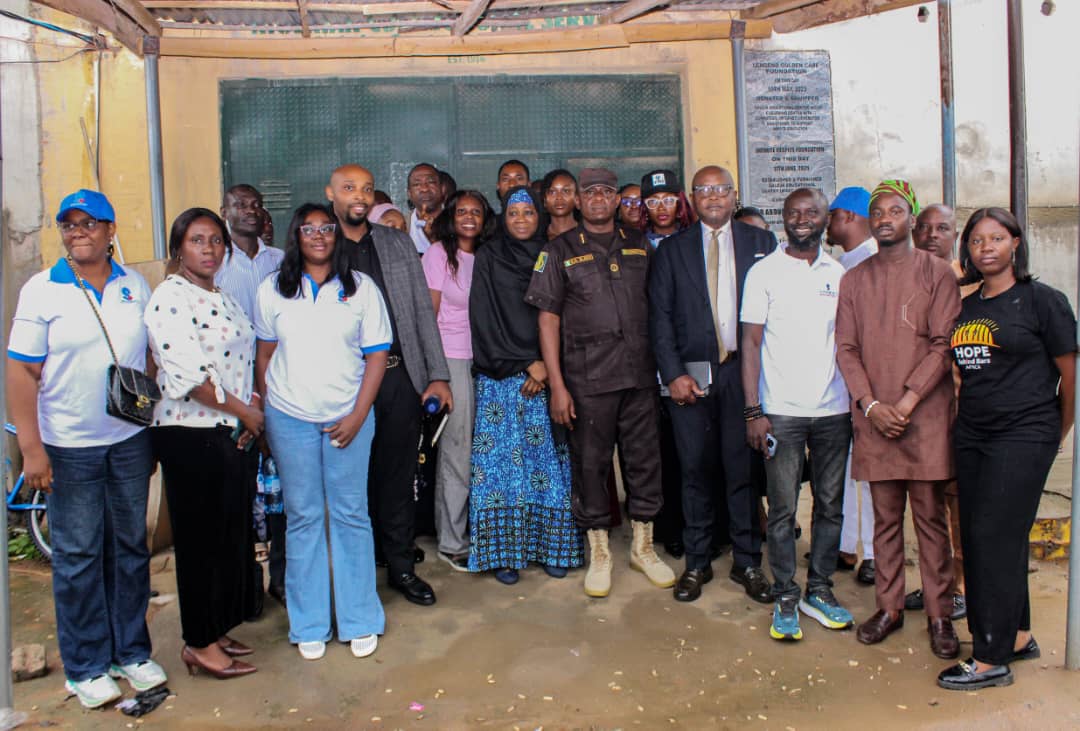
The National Human Rights Commission (NHRC), in collaboration with Hope Behind Bars Africa and other partners, has secured the release of eight indigent inmates from the Suleja Medium Security Custodial Centre in Niger State as part of activities marking the 2026 Nelson Mandela Day.
The intervention, which involved the payment of court-imposed fines totalling between N800,000 and N900,000, also featured the donation of hygiene materials to inmates and the sensitisation of correctional officers on international standards governing the treatment of persons deprived of liberty.
The organisers said the initiative was designed to uphold the enduring legacy of the late South African icon, Nelson Mandela, whose life symbolised justice, equality, human dignity and the defence of fundamental rights.
Speaking during the event, the Executive Secretary of the NHRC, Dr. Tony Ojukwu (SAN), said Mandela Day serves as a reminder that justice, compassion and respect for human dignity must extend to all members of society, including those in correctional facilities.
Represented by his Special Assistant and Head of the Commission’s Monitoring Department, Dr. Benedict Agu, Ojukwu explained that the United Nations General Assembly expanded the observance of Mandela Day in 2015 to promote humane prison conditions, recognise inmates as continuing members of society and acknowledge correctional officers as providers of an essential public service.
He noted that the adoption of the United Nations Standard Minimum Rules for the Treatment of Prisoners, popularly known as the Nelson Mandela Rules, remains a lasting tribute to Mandela, who spent 27 years in prison in the struggle against apartheid.
“Today’s commemoration is not about the calendar but about the principles Mandela stood for. For us, it is not just a memorial but a reaffirmation of a life lived for the human person, for the values of human dignity and for the principles of freedom,” he said.
Ojukwu said the 2026 Mandela Day theme, “It’s Still in Our Hands to Combat Poverty and Inequity,” resonates strongly with the realities confronting Nigeria’s correctional system.
According to him, poverty remains one of the leading drivers of crime and prolonged detention, especially for low-risk offenders unable to pay relatively modest court fines.
“Most crimes that bring people into custody are often rooted in poverty, and when you look at the fines that continue to keep low-risk inmates behind bars, you can see how poverty and inequity sustain overcrowding in our correctional facilities,” he stated.
He called on governments, institutions and well-meaning Nigerians to support reforms that address inequality while expanding rehabilitation and reintegration opportunities for inmates.
Ojukwu said the Commission had moved beyond monitoring detention facilities by directly supporting vulnerable inmates through the payment of fines, welfare assistance and rehabilitation programmes.
“For people of means, it is an invitation to join hands in supporting these efforts, so that custodial centres are not overwhelmed and society can benefit from the values and contributions of rehabilitated inmates because they still have something to offer,” he added.
The NHRC boss recalled that during the 2025 Mandela Day celebration, the Commission facilitated the release of four indigent inmates at the Suleja custodial centre, donated welfare materials and trained correctional officers on the Mandela Rules and the Bangkok Rules.
He said this year’s intervention built on those efforts by securing the freedom of more inmates while reinforcing the message that imprisonment should promote rehabilitation rather than permanent exclusion.
“By these actions we are simply saying that those in custody remain part of our society and deserve opportunities to rebuild their lives. Custody must be a turning point, leading to correction and ultimately reintegration,” he said.
Also speaking, Executive Director of Hope Behind Bars Africa, Pauline Oloreomi, stressed that justice should not be viewed solely as punishment but as a process of reform, rehabilitation and restoration.
She called for greater attention to the unique challenges confronting women in custodial centres, including access to healthcare, dignity during searches and wider use of non-custodial measures for pregnant women and nursing mothers.
While acknowledging existing legal protections for female inmates, Oloreomi said weak implementation continued to undermine their effectiveness and urged stronger collaboration among stakeholders to improve correctional conditions.
Programme Supervisor of Hope Behind Bars Africa, Hassan Nurudeen, said the organisation focuses on expanding access to justice, protecting human rights and promoting education and rehabilitation to reduce recidivism.
He disclosed that the organisation paid N400,000 in fines to secure the release of four inmates at the Suleja facility, while the NHRC facilitated the release of seven others.
Nurudeen added that Hope Behind Bars Africa partners with correctional centres nationwide to provide vocational training and educational opportunities, including establishing a National Open University of Nigeria study centre at the Keffi custodial facility.
In a goodwill message, Executive Director of Shamies Unusual Heart Foundation, Dr. Sera Abdul, represented by Programme Officer Shedrack Okah, said Mandela’s life demonstrated that no individual should be permanently defined by their mistakes.
She argued that correctional centres should serve as institutions of hope, rehabilitation and transformation through education, skills acquisition, counselling and second chances.
Abdul also maintained that government alone could not solve the challenges confronting Nigeria’s correctional system, including overcrowding, inadequate resources, rehabilitation deficits and reintegration barriers, calling for sustained partnerships with civil society and the private sector.
She encouraged inmates to maximise available educational, vocational, agricultural and counselling opportunities to prepare for productive lives after release.
The Officer-in-Charge of the Suleja Medium Security Custodial Centre, Sunday Ejeh, urged inmates to draw inspiration from Nelson Mandela’s remarkable journey from prisoner to President of South Africa.
He said Mandela’s story demonstrates that incarceration does not determine a person’s future and encouraged inmates to embrace rehabilitation and emerge as responsible, law-abiding citizens.
The NHRC and its partners said the Mandela Day intervention reflects their broader commitment to repositioning Nigeria’s correctional system from one centred primarily on punishment to a model that prioritises rehabilitation, human dignity, restorative justice and successful reintegration into society.