A €108 million investment by the European Union (EU) and European Investment Bank (EIB) through the Boost Africa initiative has leveraged an additional €400 million in private and institutional capital for African businesses, reinforcing the role of entrepreneurship and development finance in driving job creation and economic transformation across the continent.
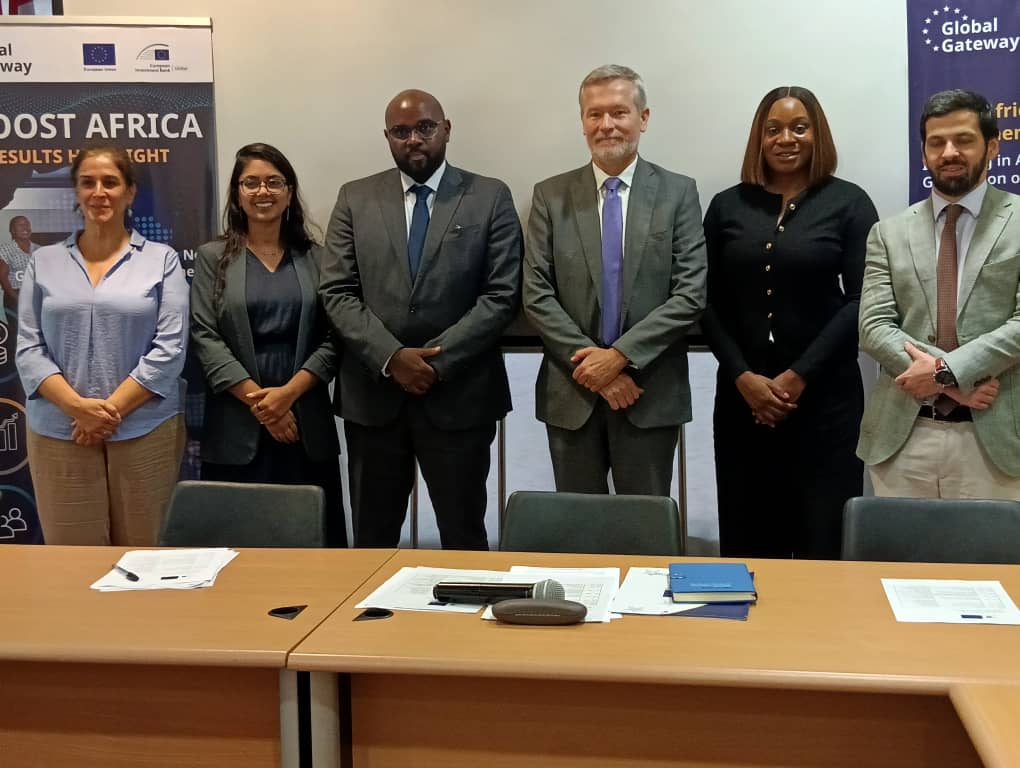
The achievement was disclosed in Abuja on Wednesday by EU Ambassador to Nigeria and ECOWAS, Gautier Mignot, during a media briefing ahead of the Boost Africa Impact Forum, themed, “Investing in Africa’s Next Generation of Entrepreneurs: From Investment to Impact.”
Mignot said the significance of the initiative extended beyond the funds directly committed, noting that its ability to attract additional investment demonstrated how development finance could help unlock much larger pools of capital for African entrepreneurs.
The programme, he said, was helping to convert investment into businesses, employment and economic opportunities for Africa’s rapidly expanding young population.
EIB Country Relationship Manager for Nigeria, Moussa Nakoulima, said the initiative had generated a strong leverage effect by using public and institutional capital to attract private investment.
“For every single euro that was invested through Boost Africa, we were able to attract additional three euros through different investors,” Nakoulima said.
The leverage means that the €108 million deployed through Boost Africa has helped mobilise approximately €400 million in additional capital, substantially increasing the resources available to startups and emerging businesses across Africa.
Beyond financing, the initiative has supported job creation, strengthened venture capital markets and helped promising African companies build the capacity required to expand beyond their domestic markets.
Nakoulima said Africa had a deep pool of talented entrepreneurs capable of developing solutions to some of the continent’s most pressing challenges, but many promising businesses struggled to achieve scale because they could not secure financing during the earliest and riskiest stages of development.
He identified financial services, healthcare, digital technology and renewable energy among sectors where the funding gap remained particularly significant, as innovative businesses often require considerable capital before becoming attractive to conventional lenders.
Boost Africa was established in 2016 by the EIB and African Development Bank, with backing from the EU and the Organisation of African, Caribbean and Pacific States (OACPS), to address the financing constraints facing emerging African businesses.
Unlike conventional lending institutions that provide loans directly to individual businesses, the initiative invests through venture capital funds and financial intermediaries that identify and support high-potential startups and small businesses.
According to Nakoulima, the model is designed to make development finance catalytic rather than substitutive, using public and institutional capital to absorb part of the risks that could otherwise discourage private investors.
The initiative combines three major components: investment capital, technical assistance and ecosystem development.
Technical assistance supports beneficiaries in areas including accounting, legal structuring, market analysis, governance and business strategy, while ecosystem development connects entrepreneurs with incubators, accelerators, investors and other institutions capable of supporting their growth.
The impact of the model is already evident across several African markets.
Investment Director at Cathay AfricInvest Innovation Fund, Lavanya Anand, said the €110 million fund had invested in 15 Series A technology companies across Africa, with the EIB serving as one of its anchor investors.
She said the supported companies operate across healthcare, financial services, logistics, e-commerce and education technology.
According to Anand, the fund’s portfolio has created about 7,600 direct jobs and 272,000 indirect jobs, reached more than 46 million people through improved financial services and trained over 13,000 students.
Among the companies supported is Turaco, a technology-driven insurance company that has provided coverage to more than two million previously uninsured people across Kenya, Uganda, Nigeria, Ghana and Zambia.
Another beneficiary, OZE, received support in developing its banking partnership strategy, enabling it to establish relationships with financial institutions, including Ecobank.
In Nigeria, the initiative has also delivered measurable impact in the power sector.
Chief Strategy Officer of Beacon Power Services (BPS), Christine Adejorooluwa, said investment and technical assistance had enabled the energy technology company to expand from serving one utility to 12 utilities across seven African countries.
She said BPS’s technology helps electricity distribution companies improve network visibility, reduce outages and minimise energy losses and revenue leakages.
Adejorooluwa said an independent study commissioned through Boost Africa found that BPS’s intervention at one utility prevented approximately 78,000 megawatt-hours of lost load.
At another utility, she said, the intervention contributed to a $191 million increase in revenue, through measures including identifying new customers and reducing outage hours.
She said the results demonstrated that the value of development finance should ultimately be measured by its impact beyond the initial investment. “For me, that is what investment to impact really looks like,” she said.
For Nigeria, Mignot said the opportunity was particularly significant given the country’s large youthful population and dynamic entrepreneurial ecosystem.
“Nigeria is one of Africa’s most dynamic entrepreneurial ecosystems, and we believe that supporting innovation and enterprise is essential for sustainable economic growth and job creation,” he said.
He added that the EU’s approach under its Global Gateway strategy was to work with member states, development banks and private-sector partners as “Team Europe” to build investment partnerships capable of generating sustainable economic opportunities.
A key objective, he said, was to support businesses capable of moving beyond national markets and developing into companies with regional and continental reach.
Nakoulima said the ultimate ambition was to enable entrepreneurs to transform successful local solutions into businesses operating across several African markets.
“When an entrepreneur in Lagos develops a solution that can be subsequently operating in Ghana, in Côte d’Ivoire, in South Africa, in Kenya, we are beginning to see the real creation, value creation, creation of genuine Pan-African champions,” he said.
With Africa continuing to confront significant youth employment pressures and a substantial financing gap for small and emerging businesses, the EU-EIB-backed Boost Africa model illustrates how targeted development capital can de-risk investments, crowd in private finance and help African entrepreneurs transform innovative ideas into scalable businesses, jobs and broader economic opportunities.