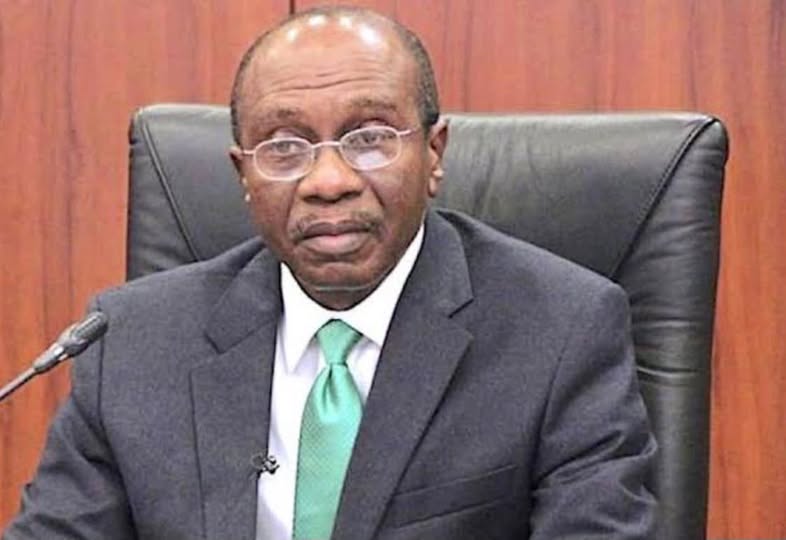
A prosecution witness in the ongoing alleged $4.5 billion fraud trial involving former Central Bank of Nigeria (CBN) Governor, Godwin Emefiele, has told a Lagos Special Offences Court how the former apex bank chief allegedly used associates to acquire properties across Nigeria valued far beyond his legitimate earnings.
The witness, Alvan Gurumnaan, an investigator and team leader of the special operations team that handled aspects of the investigation, made the disclosure on Thursday, November 12, 2026, while testifying before Justice Rahman Oshodi of the Special Offences Court in Ikeja, Lagos.
Emefiele and his co-defendant, Henry Omoile, are being prosecuted by the Economic and Financial Crimes Commission (EFCC), Lagos Zonal Directorate 1, on a 19-count charge bordering on alleged receipt of gratification and corrupt demands during Emefiele’s tenure as CBN governor.
Testifying as the eighth prosecution witness (PW8), Gurumnaan, under examination by the Director of Public Prosecutions of the Federation, Rotimi Oyedepo, SAN, said investigations revealed that Emefiele allegedly deployed associates to acquire several high-value properties whose worth could not be justified by his legitimate income.
He explained that Emefiele’s statement was recorded following intelligence received by the special operations team under his supervision.
Among the properties identified by the witness were two adjoining duplexes in Lekki Phase 1, two mansions on Queens Drive, Ikoyi, an unfinished factory in Agbor, Delta State, and a printing and minting company property on Adekunle Lawal Street, Ikoyi, Lagos.
Others included a warehouse in Ogun State containing containers reportedly worth hundreds of billions of naira, two-storey buildings comprising 94 luxury flats under construction, an industrial park and an Abuja estate with more than 700 duplexes under construction.
Gurumnaan told the court that the properties had been forfeited to the Federal Government through various court judgments.
He further alleged that Emefiele had acknowledged ownership of some of the properties during previous forfeiture proceedings.
The witness specifically alleged that the former CBN governor acquired a property on Adekunle Lawal Street, Ikoyi, which previously belonged to the Nigerian Security Printing and Minting Company, where he had served as chairman of the board.
According to him, the property, comprising a block of eight flats, was allegedly purchased by Emefiele and subsequently forfeited to the Federal Government.
He also informed the court that investigators recovered an additional warehouse allegedly belonging to the former CBN governor in Ogun State, on the outskirts of Lagos.
However, counsel to the first defendant, Olalekan Ojo, SAN, challenged aspects of the testimony, urging the court to disregard evidence relating to the alleged properties in Agbor and Adekunle Lawal Street, Ikoyi.
Ojo argued that the properties were not included in the charges currently before the court, raising questions about their relevance to the specific allegations under consideration.
In response, prosecution counsel Oyedepo, who appeared alongside B. Bilkisu C. C. Okezie and Z. B. Atiku, tendered a document containing a Supreme Court judgment as an exhibit.
The admissibility of the document became a matter for the court’s determination.
Justice Oshodi adjourned the proceedings until November 13, 2026, for a ruling on the admissibility of the exhibit and continuation of the trial.
The testimony highlights the scale and complexity of the EFCC’s investigation into alleged corruption and asset accumulation during Emefiele’s tenure at the CBN. The properties listed by the witness, spanning residential estates, commercial buildings, industrial facilities and warehouses, underscore the prosecution’s attempt to establish a connection between alleged corrupt proceeds and assets acquired through associates.
However, the defence’s objection over properties not specifically listed in the charges also raises an important question about the boundaries of admissible evidence in criminal proceedings.
Ultimately, the prosecution must establish the allegations against the defendants through admissible evidence and satisfy the requirements of proof beyond reasonable doubt. Previous forfeiture orders, while relevant to the history of the assets, do not by themselves determine criminal liability in the ongoing trial.
Emefiele and Omoile remain defendants in the case, and the allegations against them are yet to be established by the court.