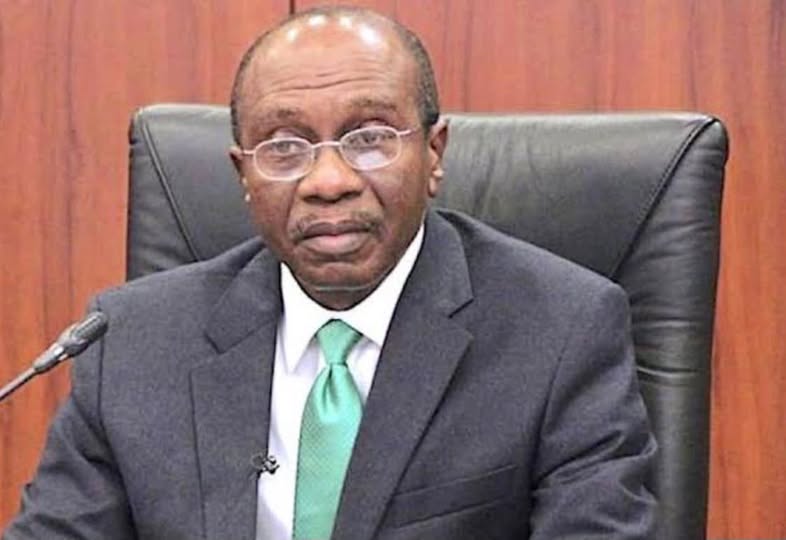
The Special Offences Court sitting in Ikeja, Lagos, has admitted a Certified True Copy (CTC) of a Supreme Court judgment as an exhibit in the ongoing trial of former Central Bank of Nigeria (CBN) Governor, Godwin Emefiele, over an alleged $4.5 billion fraud.
Justice Rahman Oshodi admitted the document on Friday, November 13, 2026, during proceedings involving Emefiele and his co-defendant, Henry Omoile, who are being prosecuted by the Lagos Zonal Directorate 1 of the Economic and Financial Crimes Commission (EFCC).
Emefiele is facing a 19-count charge bordering on alleged receipt of gratification and corrupt demands while serving as CBN Governor.
At the resumed hearing, the prosecution’s seventh witness, Gurumnaan, continued his evidence-in-chief under examination by the Director of Public Prosecutions of the Federation, Rotimi Oyedepo, SAN.
Oyedepo, who appeared alongside other prosecution lawyers, tendered the certified Supreme Court judgment for admission as evidence.
However, defence counsel, Olalekan Ojo, SAN, opposed its admissibility, arguing that the document could not be regarded as a valid Supreme Court judgment because it was signed by only four justices, whereas decisions of the apex court are ordinarily delivered by a panel of five or seven justices.
Ojo also argued that, based on the testimony of the seventh prosecution witness, the judgment arose from non-conviction proceedings and was therefore irrelevant to the prosecution’s case.
Another defence counsel, Adeyinka Kotoye, SAN, supported the objection, contending that the prosecution’s attempt to introduce the document after proceedings had commenced was an additional reason for rejecting it.
Responding, Oyedepo maintained that the document was a duly certified copy of a Supreme Court decision and satisfied the admissibility requirements under Sections 102 and 104 of the Evidence Act.
He further argued that the presence of a lead judgment did not invalidate the document or affect its admissibility, urging the court to admit it in evidence.
In a brief ruling, Justice Oshodi held that a Supreme Court judgment constituted a public document and that the necessary certification requirements had been satisfied.
The judge consequently admitted the document as Exhibit 10.
The court adjourned the case until December 17 and 18, 2026, and January 11, 14 and 19, 2027, for continuation of trial.