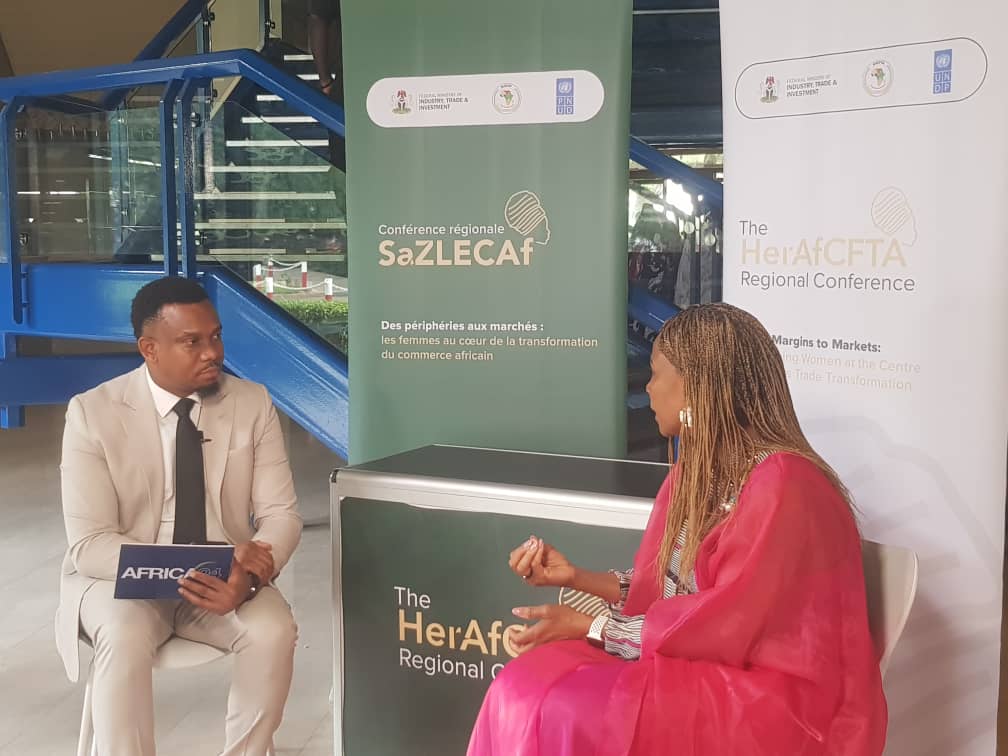
African leaders have called for urgent reforms to place women at the centre of the African Continental Free Trade Area (AfCFTA), warning that the continent’s ambition to build the world’s largest single market cannot be realised while female entrepreneurs continue to face barriers to finance, trade and cross-border commerce.
The call was made on Monday at the 2026 HerAfCFTA Regional Conference in Abuja, where the Secretary-General of the AfCFTA Secretariat, Wamkele Mene, Nigeria’s Minister of Industry, Trade and Investment, Dr. Jumoke Oduwole, and the United Nations Assistant Secretary-General and Director of the Regional Bureau for Africa, Ahunna Eziakonwa, urged African governments to accelerate reforms that would enable women-owned businesses to thrive under the continental free trade agreement.
The conference, themed “Women Advancing Africa’s Economic Transformation through Intra-African Trade: Scaling Impact,” brought together ministers, trade commissioners, development partners, business leaders and women entrepreneurs from across the continent.
The speakers maintained that Africa’s economic transformation, industrialisation and long-term competitiveness would depend largely on how effectively governments convert the AfCFTA from a legal framework into a practical platform that allows women-led enterprises to trade seamlessly across borders.
Eziakonwa described the current global economic landscape as one marked by fractured supply chains, rising protectionism and weakening multilateral cooperation, arguing that Africa could no longer depend on external markets to drive its development.
“We do not have time for a slow lane,” she said. “Every day we delay is a day of lost opportunity, lost trade, lost jobs and lost potential.”
She described the AfCFTA as a strategic vehicle for strengthening regional value chains, reducing dependence on raw material exports and building more resilient African economies.
Although 49 African countries have ratified the agreement, Eziakonwa noted that implementation remains slow, stressing that agreements alone would not create jobs or improve livelihoods.
She called on governments to harmonise trade regulations, simplify customs procedures, modernise transport and logistics infrastructure, establish interoperable digital payment systems and remove bottlenecks restricting the movement of goods and services across the continent.
“In a world that is disintegrating, Africa chooses integration. In a world that is building walls, Africa chooses bridges,” she said.
She argued that women must remain central to that vision, noting that they dominate informal cross-border trade despite operating under difficult conditions.
Referencing the Aba Women’s Revolt of 1929, Queen Nzinga of Angola and generations of market women across West Africa, Eziakonwa said African women had historically played a defining role in commerce and economic development.
“If women cannot navigate the AfCFTA market, then Africa has built a market for only half of its people,” she warned.
She advocated simplified trade regulations for women traders, increased investment in digital and physical trade infrastructure, and stronger representation of women in trade negotiations and policy-making.
Earlier, Mene said African women continue to demonstrate remarkable entrepreneurial resilience despite longstanding structural constraints.
He disclosed that 83 per cent of Nigerian women identify as entrepreneurs, significantly above the continental average of 51 per cent, while women account for more than 40 per cent of employment in Africa’s micro, small and medium-sized enterprises.
According to him, women also make up about 74 per cent of informal cross-border traders in West Africa and facilitate between $2.5 billion and $6.5 billion in annual trade within the ECOWAS region.
Despite their economic contribution, Mene noted that women traders continue to contend with harassment, extortion and an estimated $49 billion financing gap.
“These are not merely statistics,” he said. “They represent millions of women creating businesses, generating employment and driving economic transformation.”
The AfCFTA Secretary-General highlighted the African Union Protocol on Women and Youth in Trade as the world’s first legally binding trade instrument dedicated to promoting women’s participation in continental trade.
He said the protocol commits member states to eliminating barriers to finance, expanding women’s participation in higher-value sectors such as manufacturing, logistics, technology and mining, and building a more inclusive continental trading system.
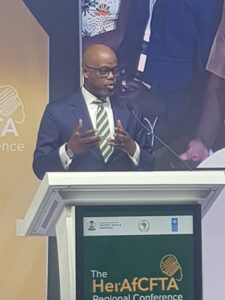
Mene, however, stressed that achieving those objectives would require stronger collaboration among governments, development partners and the private sector.
He identified access to affordable finance, export readiness, market intelligence, digital trade skills, legal support, infrastructure and mentorship as key priorities for women-owned enterprises seeking to compete across Africa.
Speaking as host, Oduwole reaffirmed Nigeria’s commitment to ensuring that women become major beneficiaries of the AfCFTA.
She described the conference as evidence of growing continental cooperation on inclusive trade and said placing women at the centre of the AfCFTA was not only an economic imperative but “an existential one.”
According to the minister, women own more than half of Africa’s micro, small and medium-sized enterprises, making them indispensable to the continent’s industrialisation and economic future.
She cautioned against treating women entrepreneurs as a homogeneous group, noting that they operate across agriculture, manufacturing, services, technology and the creative industries, each requiring tailored policy interventions.
“Our task is to ensure that women are not confined to the lower rungs of the AfCFTA market,” she said.
Oduwole pledged Nigeria’s commitment to implementing policies that would enable women-owned businesses to expand beyond domestic markets and fully benefit from the continental free trade agreement.
She also commended women entrepreneurs exhibiting products from several African countries at the conference, describing their participation as evidence that the AfCFTA was already delivering practical benefits beyond policy commitments.
The three leaders agreed that the success of Africa’s economic integration would ultimately be measured not by the number of agreements signed but by the extent to which women entrepreneurs can move goods freely, access finance, grow competitive businesses and create jobs across the continent.
They urged African governments to fast-track implementation of the Protocol on Women and Youth in Trade, dismantle structural barriers confronting women-owned enterprises and ensure that Africa’s emerging $3.4 trillion single market becomes genuinely inclusive.