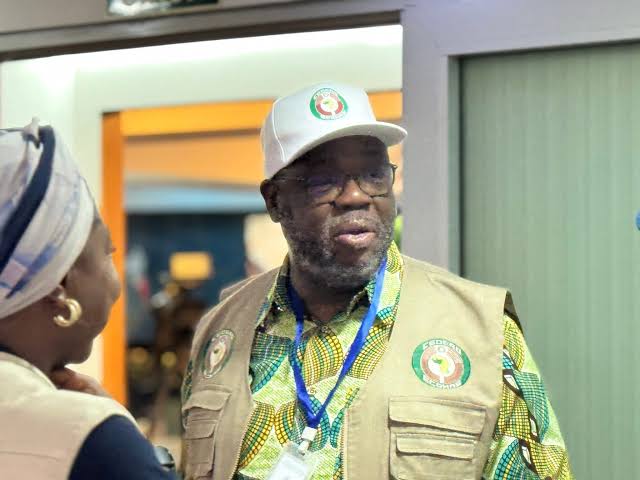
The Economic Community of West African States (ECOWAS) has deployed election observers across all nine inhabited islands of Cabo Verde to monitor Saturday’s presidential election, expressing confidence in the peaceful conduct of the electoral process.
The regional organisation said its pre-election assessment had identified no significant security threat capable of undermining the credibility and peaceful conduct of the poll, describing Cabo Verde as a model of democratic stability in a West African region confronted by political instability and unconstitutional changes of government.
The ECOWAS Election Observation Mission, led by former Gambian Vice-President, Fatoumatta Jallow-Tambajang, concluded its pre-election engagements in Praia, the country’s capital, with the deployment of observers, consultations with international partners and meetings with presidential candidates.
The deployment, which began on November 13, included an engagement with the United Nations Special Representative for West Africa and the Sahel, Leonardo Santos Simão, who reaffirmed ECOWAS’s leadership role in addressing political and security challenges across the region.
On November 14, Jallow-Tambajang met presidential candidate José Maria Neves and convened a meeting of heads of international election observation missions at the ECOWAS Situation Room in Praia.
The meeting brought together representatives of the African Union (AU), the Community of Portuguese Language Countries (CPLP), the ECOWAS Network of Electoral Commissions (ECONEC), the Network of Jurisdictional and Electoral Administration Bodies of the CPLP (ROJAE-CPLP) and the International Organisation of La Francophonie (OIF).
The mission’s technical team is being led by ECOWAS Commissioner for Political Affairs, Peace and Security, Francess Piagie Alghali.
Presenting the pre-election assessment, Alghali said ECOWAS had not identified any major security concern that could threaten the peaceful conduct of the election.
“At this stage, ECOWAS sees no significant threat to the peaceful conduct of the presidential election. Cabo Verde remains a strong democratic example within the West African region,” she said.
She explained that the coordination among international observation missions was designed to strengthen cooperation, information-sharing and a common understanding of developments surrounding the electoral process.
During Saturday’s voting, Jallow-Tambajang was scheduled to observe the opening of polls in Palmarejo, Praia, visit polling stations in Tira Chapéu, Várzea and Achadinha, and monitor the closing and counting of votes. Other ECOWAS observers were deployed across the country’s nine inhabited islands.
The mission is expected to issue its preliminary statement on the election on November 17.
The presidential election is particularly significant given Cabo Verde’s longstanding reputation for political stability and peaceful democratic transitions, despite growing instability in parts of West Africa.
The country transitioned from a one-party system to multiparty democracy in 1991, when the opposition Movement for Democracy (MpD) defeated the long-ruling African Party for the Independence of Cabo Verde (PAICV) in the country’s first multiparty elections.
Since then, the two major political parties have alternated in power through democratic elections.
The November 15 presidential contest is the sixth since the introduction of multiparty democracy and features six candidates, including incumbent President Neves, who is seeking a second five-year term, and former Justice Minister Joana Rosa, the country’s first female presidential candidate.
Neves won the October 2021 presidential election with approximately 51.7 per cent of the votes, defeating his main challenger, Carlos Veiga, who secured about 42.4 per cent.
Under Cabo Verde’s semi-presidential system, the president is directly elected and has constitutional responsibilities that include signing or vetoing legislation, while the prime minister exercises most executive powers.
ECOWAS said its observation mission forms part of its broader commitment to promoting democratic governance, credible elections and political stability across member states.
The organisation’s nationwide monitoring and collaboration with political stakeholders and international partners are expected to contribute to transparency, public confidence and the peaceful conduct of the electoral process.