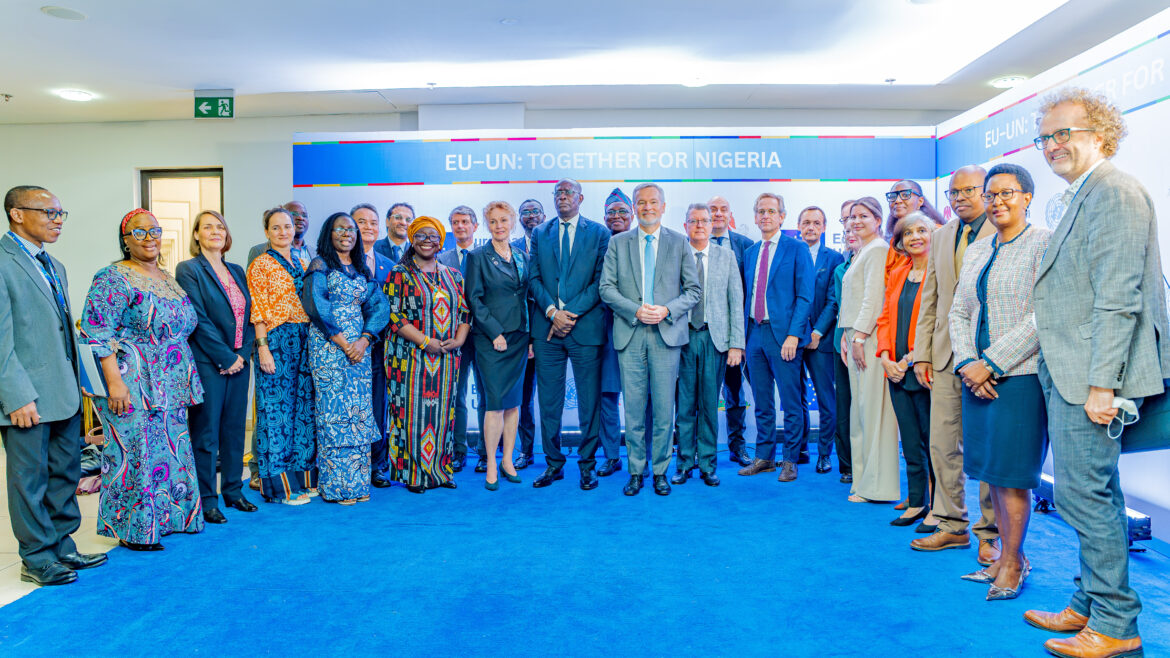
The European Union (EU) and the United Nations (UN) have reaffirmed their strategic partnership to support Nigeria’s economic transformation, strengthen peace and security, and advance nationally led development and humanitarian action amid growing global challenges to multilateralism.
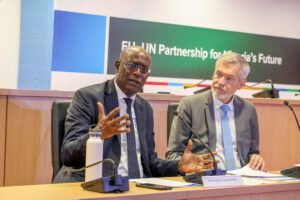
The commitment was renewed at a high-level EU-UN strategic engagement in Abuja, attended by ambassadors of EU member states and heads of UN agencies in Nigeria, where participants reviewed existing cooperation and explored new opportunities to promote inclusive economic growth and sustainable development.
Ambassador of the European Union to Nigeria and ECOWAS, Gautier Mignot, said the meeting provided an opportunity to strengthen collaboration between the two institutions, reaffirm support for the United Nations and identify areas for expanded cooperation in Nigeria.
Mignot disclosed that EU-funded projects implemented by UN agencies in Nigeria, including several regional initiatives managed from the country, had reached €475 million across 32 ongoing projects, including humanitarian interventions.
He described the scale of cooperation as substantial, underscoring the EU’s role in supporting development and humanitarian programmes through the UN system.
The EU envoy also expressed concern over mounting pressure on multilateralism and international law, noting that the United Nations remained a central platform for countries seeking collective solutions to global challenges.
However, he argued that defending multilateralism should not amount to preserving the status quo, stressing the need for reforms that respond to the evolving priorities of member states and international partners.
According to him, demands for greater representation, improved access to financing, stronger development outcomes, climate resilience and tangible results must be addressed to sustain confidence in the multilateral system.
Mignot emphasised that UN reform must strike a balance between operational efficiency, equitable representation, national ownership and effective delivery, while strengthening the legitimacy of international cooperation.
The United Nations Resident and Humanitarian Coordinator in Nigeria, Mohamed Malick Fall, described the EU and its member states as indispensable partners at a time when multilateralism, international solidarity and the founding principles of the UN are facing increasing pressure.
Fall said the strategic engagement reflected a shared determination to deepen consultations and coordination not only at the global level but also in addressing country-specific priorities.
He stressed that stronger collaboration between the EU and the UN was essential to supporting Nigeria’s development ambitions, addressing humanitarian needs and ensuring that economic progress translated into improved living conditions for citizens.
Economic gains must benefit vulnerable Nigerians
Assessing Nigeria’s economic outlook, Fall acknowledged improvements in some macroeconomic indicators and the difficult reforms undertaken by the Federal Government.
He noted that the Nigerian economy recorded broader growth in the first half of 2026, supported by agriculture and manufacturing, while inflation declined compared with early 2025.
Improved fiscal revenues and increased allocations to state governments, he added, offered opportunities to expand investment in development priorities and strengthen the delivery of public services.
However, the UN coordinator cautioned that these improvements had yet to translate sufficiently into better living conditions for vulnerable households, highlighting the gap between macroeconomic stabilisation and the everyday realities of many Nigerians.
“The central challenge is to translate economic stabilisation into jobs, increased productivity, stronger public services and reduced poverty,” Fall said.
He maintained that Nigeria possessed enormous development potential, citing its natural resources, resilient population, vibrant private sector, creative industries and expanding innovation ecosystem.
The challenge, he said, was to harness these strengths to deliver measurable and inclusive benefits across the population.
To achieve this, Fall called for stronger domestic resource mobilisation, productive private-sector investment, effective institutions and increased investment in human capital, particularly to meet the needs of Nigeria’s rapidly growing youth population.
He stressed that sustainable economic transformation would require policies that generate employment, raise productivity, improve access to essential services and reduce poverty.
UN backs nationally led humanitarian transition
The UN coordinator also highlighted the organisation’s support for Nigeria’s transition towards greater government leadership and domestic financing of humanitarian interventions.
He cautioned, however, that the shift towards nationally led humanitarian action should not be interpreted as evidence that humanitarian needs had disappeared.
“A humanitarian transition does not mean that humanitarian needs have disappeared,” Fall said. “It means progressively strengthening government leadership, national systems and domestic financing while ensuring that vulnerable people continue to receive the protection and assistance they need.”
He underscored the importance of maintaining protection and assistance for vulnerable populations while progressively strengthening national institutions and domestic capacity to respond to emergencies.
Fall further identified the domestication of the Kampala Convention as an important step towards strengthening the legal framework for the protection and assistance of internally displaced persons in Nigeria.
He said sustained cooperation would be necessary to translate the legal framework into effective implementation, ensuring that displaced people could access appropriate protection and support.
The convention provides an African regional framework for preventing internal displacement, protecting internally displaced persons and supporting durable solutions to displacement.
Renewed commitment to international cooperation
The engagement brought together ambassadors of EU member states and heads of UN agencies operating in Nigeria, providing a platform to review progress, align priorities and explore opportunities for deeper cooperation.
The annual dialogue mirrors engagement at the global level between the UN Secretary-General and the President of the European Commission, reflecting the institutional importance both organisations attach to their strategic partnership.
The EU remains a leading donor supporting UN programmes in Nigeria, with its funding contributing to development and humanitarian interventions across the country.
The renewed commitment comes as Nigeria confronts the twin demands of sustaining economic reforms and addressing persistent poverty, insecurity and humanitarian vulnerabilities.
For both institutions, the priority is to ensure that international cooperation produces measurable results, strengthens national ownership and supports a development pathway in which economic growth translates into jobs, stronger public services, improved resilience and better living conditions for Nigerians.
The Abuja engagement therefore reinforced a shared message: effective multilateralism must go beyond declarations of solidarity to deliver practical solutions to the development and humanitarian challenges facing Nigeria and the wider international community.