Nigeria’s ambitious plan to transform its agricultural sector over the next decade is facing a major funding challenge, despite the Federal Government’s commitment to achieving food sovereignty, reducing poverty and driving inclusive economic growth.
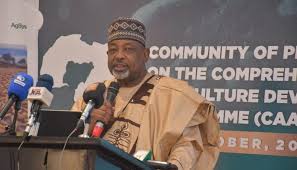
The Minister of Agriculture and Food Security, Senator Abubakar Kyari, on Thursday unveiled Nigeria’s 10-year Agrifood System Strategy and Action Plan at the meeting of the Agrifood System Working Group (ASWG) in Abuja, describing it as a comprehensive roadmap designed to move the country beyond fragmented agricultural interventions toward a resilient and integrated agrifood system.
Kyari said the strategy, developed under the Comprehensive Africa Agriculture Development Programme (CAADP) Kampala Declaration (2026–2035), covers the entire agricultural value chain—from production and processing to markets, nutrition, governance, resilience and investment.
He disclosed that President Bola Ahmed Tinubu had directed the development of a bankable, measurable and implementable roadmap capable of fundamentally transforming Nigeria’s food system, adding that the document would be presented to stakeholders before being forwarded to the Federal Executive Council (FEC) for approval.
According to the minister, FEC approval would ensure that Ministries, Departments and Agencies align their policies, programmes and budgets with the country’s long-term agrifood transformation agenda. He noted that agriculture remains the backbone of Nigeria’s economy, supporting more than 70 per cent of the population while creating opportunities for employment, industrialisation and foreign exchange earnings.
However, concerns over inadequate funding overshadowed the ambitious blueprint.
ActionAid Nigeria’s Food Systems Specialist, Azubike Nwokoye, warned that poor investment in agriculture by both the federal and state governments could derail implementation of the strategy.
Presenting findings from the organisation’s agricultural expenditure dashboard, Nwokoye said many states had consistently underperformed in agricultural capital spending between 2023 and 2025.
He revealed that only 10 states recorded high performance in agricultural capital expenditure in 2025, while 16 states posted very low performance. He added that Nigeria’s combined agricultural allocation by the 36 states and the Federal Capital Territory for 2026 stood at just 4.58 per cent—well below the 10 per cent benchmark agreed under the Maputo, Malabo and Kampala Declarations.
According to him, many states currently devote only about three per cent of their capital budgets to agriculture, a trend he described as unsustainable if Nigeria hopes to meet its continental commitments.
Despite the gloomy assessment, Nwokoye said increased investment could unlock significant employment opportunities.
He estimated that full implementation of state agricultural budgets could create about 1.4 million direct jobs, while projected federal government spending could generate an additional 2.1 million jobs, bringing the national total to approximately 3.5 million direct employment opportunities.
Also speaking, the Minister of Budget and Economic Planning, Senator Atiku Bagudu, stressed that Nigeria’s food security ambitions would depend largely on strengthening the country’s more than 42 million farming households.
Bagudu said agriculture remained a shared responsibility of all tiers of government, the private sector, researchers and development partners, insisting that family-based producers must be empowered to increase productivity and lift millions out of poverty.
He highlighted ongoing reforms, including the establishment of the Ministry of Livestock Development, the National Agricultural Development Fund and expanded support for agricultural land development, while emphasising the importance of science, technology and innovation in boosting productivity.
The Minister of Women Affairs, Hajiya Imaan Sulaiman-Ibrahim, said Nigeria would struggle to meet the targets of the CAADP Kampala Declaration unless barriers confronting women farmers were removed.
She noted that millions of women remained disadvantaged by limited access to land, credit, agricultural inputs, extension services and mechanisation, stressing that closing the gender productivity gap was not optional but a commitment Nigeria had already undertaken under the continental declaration.
She called for measurable gender targets, improved sex-disaggregated agricultural data and stronger inclusion of women in government agricultural support programmes.
The Minister of Livestock Development also advocated increased investment in livestock, describing the sector as a strategic driver of food security, rural development and economic growth. He urged greater investment in animal health, veterinary infrastructure, disease surveillance, feed development and climate-smart production systems.
Earlier, the Permanent Secretary of the Federal Ministry of Agriculture and Food Security, Dr. Marcus Ogunbiyi, described the Agrifood System Working Group as the central technical platform for coordinating policies, monitoring implementation and ensuring accountability.
He said collaboration among government, the private sector, development partners, researchers and farmers would be critical to overcoming challenges such as climate change, insecurity, inadequate infrastructure, post-harvest losses and limited financing.
According to Ogunbiyi, the ultimate objective of the reform agenda is food sovereignty—ensuring that Nigerians grow what they eat and eat what they grow through a resilient agricultural system capable of providing safe, nutritious and affordable food for all citizens.