- Patient recently arrived from Uganda; 44 contacts identified as NCDC activates emergency response and health authorities intensify containment measures
Nigeria has confirmed an imported case of Ebola Bundibugyo virus disease in the Federal Capital Territory (FCT), raising fresh concerns about the country’s preparedness to contain cross-border infectious disease threats as an outbreak in the Democratic Republic of the Congo (DRC) continues to evolve.
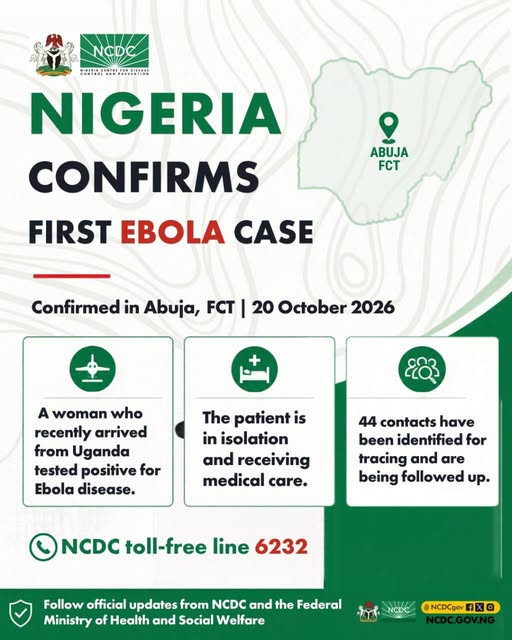
The Federal Ministry of Health and Social Welfare announced the confirmation, stating that the patient is a woman with a recent travel history to Uganda. Her diagnosis, confirmed by laboratory testing on October 20, 2026, makes Nigeria the fifth country to detect the virus since the outbreak was declared in the DRC on May 15, 2026.
The development places Nigeria’s disease surveillance system, emergency response coordination and infection prevention protocols under renewed scrutiny, particularly given the risk of imported infections spreading through undetected contacts and healthcare settings.
According to the ministry, the woman developed symptoms on October 7, four days after arriving in Nigeria, and sought medical attention at a private health facility in Abuja on October 11. She is currently in isolation and receiving medical care.
Authorities are investigating the likely source of the infection while reconstructing the patient’s travel and exposure history to determine where and how she may have contracted the virus and identify people who could have been exposed.
Contact tracing becomes critical to containment
The immediate priority for Nigerian health authorities is to prevent the imported case from triggering local transmission.
The ministry said 44 contacts had been identified and were being monitored, with efforts continuing to trace additional people who may have come into contact with the patient.
Contact tracing is particularly important in Ebola responses because infected individuals may expose others before their illness is recognised and appropriate isolation measures are implemented. Identifying and monitoring contacts enables health authorities to detect potential secondary cases early and interrupt chains of transmission.
The reported timeline also highlights the importance of early clinical recognition. The patient sought care four days after the reported onset of symptoms, while laboratory confirmation came later, on October 20. However, the available information does not establish whether any transmission occurred during that period or whether the private facility experienced occupational or patient exposures.
Infection prevention and control measures are being strengthened at the facility where the patient initially sought treatment. This is essential because healthcare workers and other patients can face additional risks when a serious infectious disease is not immediately recognised.
The effectiveness of the response will therefore depend not only on the patient’s isolation but also on the completeness of contact tracing, the speed of laboratory investigations and the ability of health facilities to implement appropriate protective measures.
NCDC activates incident management system
The Nigeria Centre for Disease Control and Prevention (NCDC) has activated its incident management system to coordinate the national response.
The mechanism is intended to strengthen coordination among relevant agencies, support case investigations, track contacts and ensure that the necessary public health interventions are implemented promptly.
The World Health Organization (WHO) and its partners are also working with Nigerian authorities to reinforce containment measures, including epidemiological investigations, contact tracing, infection prevention and control, and the provision of essential supplies such as personal protective equipment for healthcare workers.
These measures are especially important in a disease outbreak where early detection, safe clinical management and strict adherence to infection prevention protocols can determine whether an imported case remains isolated or develops into a wider public health emergency.
For Nigeria, the incident also underscores the need for private healthcare facilities to maintain effective systems for recognising suspected high-risk infections, promptly notifying public health authorities and protecting staff and patients while diagnostic investigations are conducted.
Regional outbreak raises cross-border concerns
Nigeria’s confirmation comes amid continuing concerns over the regional spread of Ebola Bundibugyo virus disease.
The WHO reported that Kenya had recorded nine cases linked to an imported case in recent weeks, illustrating how international travel can connect outbreaks across national borders.
The emergence of cases in multiple countries reinforces the importance of coordinated surveillance, rapid information-sharing and preparedness beyond the locations where an outbreak was initially detected.
Nigeria’s position as a major regional travel and commercial hub makes vigilance at points of entry and within communities important components of its response. However, border screening alone cannot prevent all imported infections, particularly where symptoms develop after arrival. Effective surveillance must therefore extend to hospitals, clinics, laboratories and community-based reporting systems.
The WHO has urged countries across the region to sustain a high level of readiness as developments in the DRC continue to unfold.
Its recommendations include maintaining strong disease surveillance, investigating alerts rapidly, ensuring laboratories can safely test suspected cases, keeping clinical and rapid-response teams ready for deployment, reinforcing infection prevention and control in public and private health facilities, and pre-positioning essential medical supplies.
Countries have also been advised to strengthen community engagement and ensure that contingency plans are in place at points of entry.
The emphasis on community engagement is significant. Public understanding of symptoms, prompt reporting and confidence in health authorities can support early detection, while misinformation and fear may discourage people from seeking care or cooperating with contact-tracing teams.
Preparedness must go beyond emergency declarations
Although the confirmed case is imported, the incident demonstrates why preparedness must be maintained before an outbreak reaches a country.
The activation of the NCDC’s incident management system and the identification of 44 contacts are important initial response measures. Nevertheless, the available information does not yet establish the full extent of possible exposure, the source of the patient’s infection or whether any secondary cases have emerged.
The next phase of the response will require transparent public health communication, consistent monitoring of identified contacts, rapid investigation of new alerts and adequate protection for healthcare workers.
Laboratory capacity is another critical consideration. Suspected cases must be assessed and tested safely, with results communicated promptly enough to guide isolation, clinical management and contact tracing. Delays at any stage can complicate efforts to contain an infectious disease.
The response must also ensure that health facilities outside the immediate investigation area remain alert to relevant travel histories and symptoms without resorting to indiscriminate screening or stigmatisation of travellers.
For policymakers, the incident provides an opportunity to assess the resilience of Nigeria’s health emergency infrastructure, including coordination between federal and state authorities, access to protective equipment, laboratory readiness and the operational capacity of rapid-response teams.
WHO advises against travel and trade restrictions
Despite the regional concerns, the WHO has advised against imposing restrictions on travel to or trade with affected countries.
The organisation said it continues to monitor and, where necessary, verify travel and trade measures introduced in response to the outbreak. Its risk assessment is also being reviewed regularly as new information becomes available.
The position reflects the distinction between evidence-based public health precautions and broad restrictions that may disrupt economic activity without providing a proportionate public health benefit.
For Nigeria, the priority is to apply targeted, science-based interventions that can identify infections early, protect health workers and prevent onward transmission while maintaining essential travel and commercial links.
The road ahead
Nigeria’s confirmation of Ebola Bundibugyo virus disease is a serious public health development, but an imported case does not automatically mean that a wider outbreak will follow.
The immediate test is whether authorities can complete contact tracing, maintain effective isolation and infection prevention measures, and rapidly identify any additional cases.
The evolving situation in the DRC and reports of cases elsewhere in the region make sustained vigilance necessary. For Nigeria, success will depend on the speed and quality of the response, the readiness of public and private health facilities, and the cooperation of communities.
The coming days will be crucial in determining whether the case remains contained. Until investigations provide a clearer picture, authorities must maintain a high level of preparedness, communicate verified information and ensure that every suspected exposure receives timely attention.
The central lesson is clear: in an interconnected region, effective outbreak control begins with early detection, but it depends on a coordinated health system capable of translating surveillance findings into swift, sustained action.