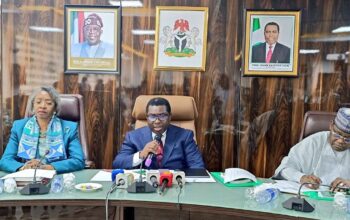
The United Nations Office on Drugs and Crime (UNODC), the National Agency for the Prohibition of Trafficking in Persons (NAPTIP), the European Union (EU), and the Economic Community of West African States (ECOWAS) have committed to developing a stronger framework to combat human trafficking in Nigeria.
This pledge was made during the 1st policy-level meeting on human trafficking in Abuja on Monday, where key stakeholders gathered to discuss the next steps in the fight against this crime.
The meeting is part of the project “From Policy to Action: Implementation of the National Action Plan on Human Trafficking in Nigeria (2022-2026),” funded by the Swiss government and jointly led by NAPTIP and UNODC. The initiative aims to ensure stricter enforcement of anti-trafficking laws.
Binta Adamu Bello, Director-General of NAPTIP, described human trafficking as a severe human rights violation threatening the very fabric of Nigerian society. She stressed the need for a coordinated response involving government agencies, law enforcement, international partners, civil society, and the public. Bello further emphasized the importance of data collection and analysis to effectively prevent and combat trafficking crimes, noting that NAPTIP is now engaging all 774 local governments in Nigeria to track traffickers at the grassroots level.
Danilo Campiso, Deputy Country Representative of UNODC Nigeria, called for collaboration to ensure the effective implementation of the National Action Plan (NAP) on Human Trafficking, stressing that a human trafficking-free Nigeria is achievable with strong coordination and commitment.
Representatives from ECOWAS, Switzerland, and the United States also echoed the need for enhanced cooperation to tackle the complex and evolving nature of human trafficking. Dr. Omar Alieu Touray, President of the ECOWAS Commission, highlighted the need for collective efforts to create a safer Africa for women and children.
Swiss Ambassador’s representative, Miss Ojoma Ali, reaffirmed Switzerland’s support for the project, while U.S. Embassy representative, Mr. Micheal Berenton, emphasized the importance of translating policies into impactful actions that address the root causes of trafficking.
The meeting concluded with a review of ongoing counter-trafficking efforts and discussions on priority actions for 2025.