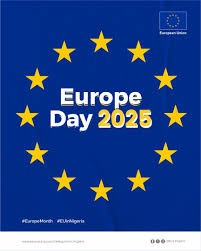
The European Union and Nigeria have reaffirmed their growing strategic partnership, with both sides highlighting expanding cooperation in trade, security, governance reforms, democracy support and investment during the commemoration of Europe Day 2026 in Abuja.
Ambassador of the European Union to Nigeria and ECOWAS, Gautier Mignot, described relations between the EU and Nigeria over the past year as “very productive,” noting that bilateral engagement had continued to deepen despite growing global geopolitical uncertainties.
Speaking at the event marking 76 years since the 1950 Schuman Declaration, Mignot said this year’s Europe Day celebration placed significant emphasis on the EU’s strategic partnership with Nigeria.
“We are much more than a donor or development partner. We are a strategic political partner for Nigeria, and Nigeria is a strategic partner for us too,” the envoy stated.
According to the ambassador, EU cooperation with Nigeria is anchored on long-term sustainability, support for women and youth development, democracy promotion, rule of law and institutional strengthening.
Mignot also referenced the recent EU-Nigeria ministerial dialogue held in March, during which EU High Representative and Vice President, Kaja Kallas, met with President Bola Ahmed Tinubu to reinforce bilateral relations.
As part of ongoing efforts to expand economic engagement, the ambassador announced that the 10th EU-Nigeria Business Forum would take place in Lagos on June 25, with a focus on boosting investment flows and strengthening private sector collaboration between European and Nigerian businesses.
On trade relations, Mignot said the EU remained Nigeria’s largest trading partner when the bloc’s 27 member states are considered collectively.
“We are almost at about 27 per cent, much ahead of any other trade partner of Nigeria,” he said.
Addressing preparations for Nigeria’s 2027 general elections, the ambassador reaffirmed the EU’s commitment to supporting democratic governance through technical assistance, institutional support and capacity-building initiatives targeting the Independent National Electoral Commission (INEC), political parties, civil society organisations, the National Assembly and the media.
The envoy, however, stressed that the responsibility for conducting credible elections rests solely with Nigerian authorities.
“We are not here to substitute ourselves for the authorities. We are here to help as much as is required by our partners,” he stated.
Responding to concerns over electoral violence and the implementation of recommendations from previous EU Election Observation Missions, Mignot said the union would continue to engage Nigerian institutions through reforms, dialogue and technical support rather than sanctions or external interference.
The ambassador also described insecurity in Nigeria as a serious and complex challenge requiring multidimensional solutions beyond military responses alone.
According to him, the EU is currently supporting peacebuilding initiatives, security assistance and capacity enhancement programmes not only in the North-East but also across the North-West and North-Central regions.
On business and investment relations, Mignot acknowledged the existence of trade and export barriers affecting both European and Nigerian companies but noted that ongoing EU-Nigeria trade and investment dialogues were aimed at addressing such constraints.
He expressed optimism that the forthcoming business forum in Lagos would facilitate new investment agreements and deepen commercial partnerships between firms from both regions.