Security forces operating in Nigeria’s South-East have intensified what appears to be a sustained intelligence-driven counter-insurgency campaign, following the discovery of a clandestine arms cache in Enugu State allegedly linked to the Indigenous People of Biafra (IPOB) and its armed wing, the Eastern Security Network (ESN).
The development, confirmed by military authorities under the 82 Division Garrison of the Nigerian Army, forms part of ongoing operations under Operation UDO KA, a multi-agency security framework designed to disrupt armed networks, dismantle suspected safe houses, and degrade operational capabilities of non-state armed actors in the region.
Security analysts would typically interpret the Enugu operation as part of a broader “deny-and-disrupt” strategy—an approach that relies heavily on actionable intelligence, surveillance, and inter-agency coordination. In this case, troops worked in close collaboration with operatives of the Department of State Services (DSS), suggesting that the operation was not a routine patrol but a pre-planned, intelligence-led raid.
The sequencing of events is also notable. The military reported an earlier breakthrough on 9 June 2026 at Gariki in Enugu South Local Government Area, which appears to have provided either follow-up intelligence or operational momentum that led to expanded searches across suspected nodes.
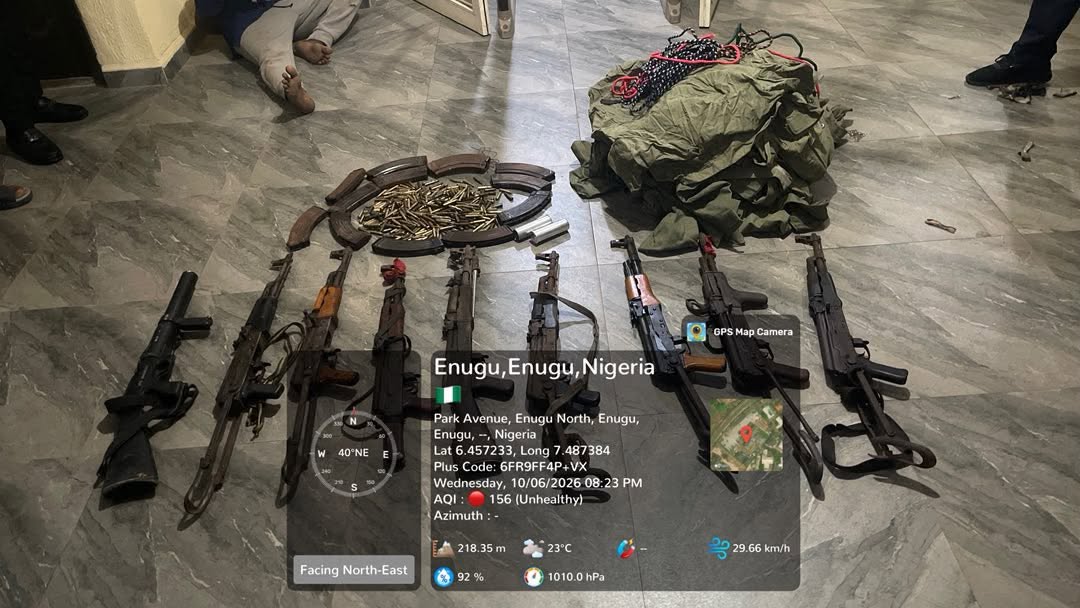
This culminated in a raid at Agbani in Nkanu West Local Government Area, where troops reportedly uncovered a concealed arms storage facility within a suspected safe house. The transition from an initial urban or semi-urban operation (Gariki) to a secondary target location (Agbani) is consistent with what security practitioners describe as a “link-node exploitation pattern,” where intelligence gathered from one site leads to subsequent targets.
The recovered items—AK-47 rifles, multiple magazines, 323 rounds of 7.62mm special ammunition, and alleged IPOB uniforms—point to a cache that could support sustained small-unit operations rather than isolated attacks.
From a security analysis perspective, the presence of standardized ammunition and multiple magazines suggests logistical preparation for repeated engagements, while the inclusion of uniforms indicates an attempt at identity structuring or operational branding, which is often used by non-state armed groups to project cohesion or facilitate impersonation during field operations.
While authorities have linked the materials to IPOB/ESN, such assertions are typically subject to further forensic verification and prosecutorial review. In complex conflict environments like the South-East, attribution of recovered weapons often relies on a combination of intelligence profiling, suspect interrogation, and material tracing.
In line with standard operating procedures, both recovered items and arrested suspects were handed over to the DSS Enugu State Command for further investigation. This reflects a joint-security architecture in which the military handles kinetic operations while the DSS leads on intelligence exploitation and prosecutorial coordination.
Such transfers are critical in ensuring evidentiary continuity, particularly in cases that may proceed to prosecution under Nigeria’s anti-terrorism and firearms legislation. However, the effectiveness of follow-on investigations often depends on the quality of intelligence documentation generated during the initial raid phase.
Beyond the immediate tactical success, the statement from Operation UDO KA reflects a broader strategic communication objective: reinforcing state control and signaling continued operational pressure on armed groups in the region.
The emphasis on “sustained offensive actions” and “peace-building efforts” aligns with a dual-track approach often adopted in internal security operations—combining kinetic disruption with stabilization messaging aimed at reducing local support networks for insurgent or separatist movements.
Security operations in the South-East have, in recent years, increasingly relied on this hybrid model, where military action is paired with intelligence policing and community engagement strategies. The effectiveness of such an approach is typically measured not only by seizures and arrests but also by long-term reductions in attack frequency and improved civilian security perceptions.
A recurring theme in the military’s communication is the call for public cooperation through credible intelligence sharing. In asymmetric security environments, local intelligence remains a decisive factor in identifying safe houses, supply routes, and recruitment nodes.
However, the success of such appeals often depends on trust between security agencies and local communities. Without that trust, intelligence flows can be inconsistent, limiting operational reach.
The Enugu arms cache discovery underscores both the operational reach and evolving intelligence capacity of Nigerian security forces in the South-East. While the immediate outcome reflects a tactical gain, the broader significance lies in the sustained pressure being applied under Operation UDO KA and the continued emphasis on intelligence-led disruption of suspected armed networks.
As investigations proceed under DSS custody, the eventual evidentiary findings will likely shape both the legal narrative and the strategic assessment of armed group capabilities in the region.