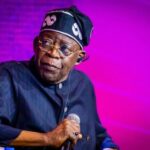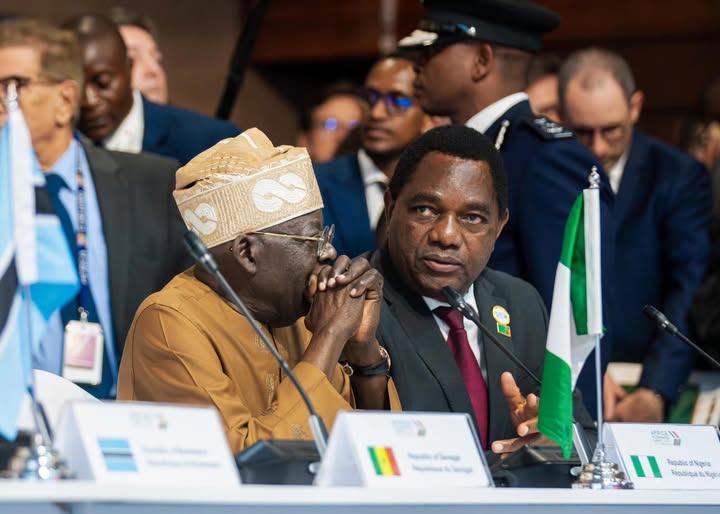
President Bola Ahmed Tinubu on Tuesday led Nigeria’s delegation to the Africa Forward Summit at the Kenyatta Convention Centre in Nairobi, Kenya, where he called for urgent reforms of the global financial architecture to support Africa’s economic transformation and industrial growth.
The summit, co-hosted by French President Emmanuel Macron and Kenyan President William Ruto, brought together leaders, policymakers and private sector stakeholders from more than 30 countries across Africa and beyond. Opening remarks were delivered by President Ruto, President Macron, United Nations Secretary-General António Guterres, and African Union Commission Chairperson Mahamoud Ali Youssouf.
According to his Special Adviser on Information and Strategy, Mr. Bayo Onanuga, President Tinubu held bilateral talks with Madagascar’s President Michael Randrianirina and met the President of the Confederation of African Football, Patrice Motsepe, during which Nigeria reaffirmed its readiness to host the 2026 CAF Awards.
Addressing the summit, Tinubu emphasised Africa’s untapped blue economy potential, noting that insecurity and policy neglect had long constrained growth in the maritime sector. He pledged stronger regional coordination and offered Nigeria’s Deep Blue maritime security infrastructure as a shared intelligence platform for Gulf of Guinea states.
He stressed that maritime sovereignty, coupled with secure sea lanes, predictable regulation and strengthened legal frameworks, would be key to attracting private investment and unlocking ocean-based economic opportunities.
“The oceans have no duplicate as a common heritage of mankind. For Africa, moving from sea blindness to ocean sovereignty is not a choice — it is a generational duty,” the President said, adding that Nigeria was committed to advancing climate-aligned port modernisation and digital transformation of the maritime sector.
Tinubu used the platform to reiterate Nigeria’s position on restructuring global financial systems, arguing that current arrangements hinder Africa’s industrialisation and economic competitiveness.
He noted that despite decades of independence, Africa accounts for less than 2 per cent of global manufacturing value added, a situation he attributed to structural constraints in international finance, trade, and investment systems.
Citing Nigeria’s recent economic reforms — including subsidy removal, exchange rate unification, banking recapitalisation, and exit from the FATF grey list — the President said these measures had strengthened macroeconomic stability and restored investor confidence.
He disclosed that Nigeria’s debt-to-GDP ratio is projected at 32.3 per cent in 2026, with external reserves at $45.5 billion, but warned that high debt servicing costs continue to constrain industrial investment.
“In 2026, Nigeria will spend about US$11.6 billion on debt service — nearly half of projected revenue,” Tinubu said, warning that such fiscal pressures limit investment in manufacturing, infrastructure and human capital development.
He described the current global financial system as structurally disadvantageous to African economies, arguing that high borrowing costs and risk perceptions undermine industrial competitiveness across the continent.
On migration, the President called for expanded legal pathways and deeper international cooperation to address root causes such as unemployment and insecurity in countries of origin.
He urged development partners to align aid with investments in climate resilience, digital skills and productive sectors that create sustainable jobs, particularly for young people.
Tinubu also advocated stronger global and regional frameworks for migration governance, noting that existing mechanisms remain insufficient and underfunded.
The President was accompanied by senior cabinet members including Bianca Odumegwu-Ojukwu, Taiwo Oyedele, Minister of Agriculture and Food Security Abubakar Kyari, Minister of Marine and Blue Economy Adegboyega Oyetola, Minister of Environment Balarabe Abbas Lawal, Minister of Industry, Trade and Investment Jumoke Oduwole, and Minister of Communications, Innovation and Digital Economy Bosun Tijani.
Prominent private sector leaders including Aliko Dangote, Abdulsamad Rabiu, Tony Elumelu and Aigboje Aig-Imoukhuede also attended the summit, alongside senior officials from investment, climate, intelligence and diplomatic institutions.
The delegation participated in plenary sessions and bilateral engagements focused on entrepreneurship, digital innovation, climate action, agro-industrial development, and the African Continental Free Trade Area (AfCFTA), with emphasis on translating policy discussions into practical industrial outcomes.
The Presidency said the engagements formed part of efforts to reposition Africa for competitive industrialisation and inclusive economic growth.