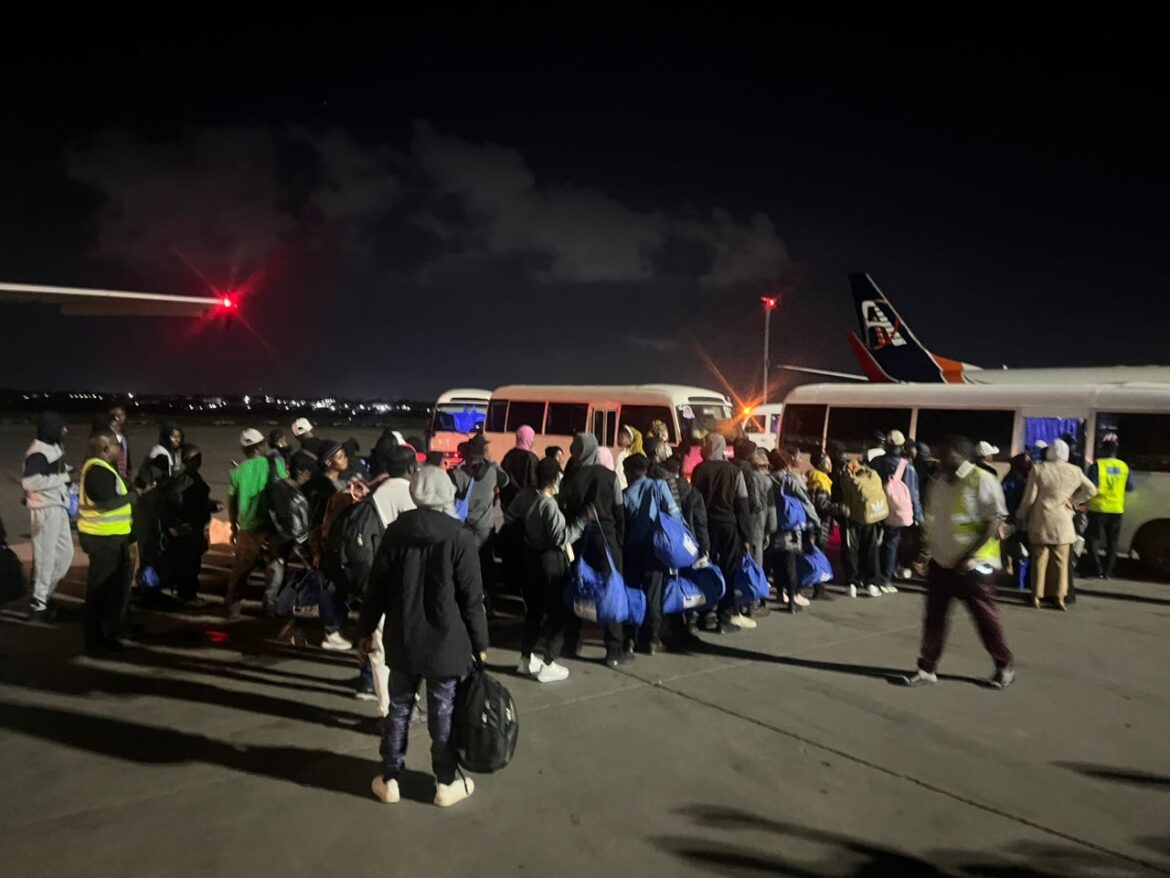
For many young Nigerians seeking better opportunities abroad, the journey through North Africa begins with hope but often ends in hardship, exploitation and shattered expectations, according to recent returnees evacuated from Libya.
Several migrants who recently returned to Nigeria have shared harrowing accounts of abuse, trafficking and years of uncertainty, offering a stark warning about the realities behind irregular migration routes.
One female returnee said she and her sister believed they were travelling to Cairo, Egypt, after being promised legitimate employment as hairdressers and makeup artists. Instead, they found themselves in Libya, where the promised jobs never materialised.
“We were told that we were going to Cairo. Unfortunately, we found ourselves in Libya,” she recalled.
Upon arrival, she said she was compelled to work as a domestic servant under an arrangement commonly referred to by migrants as “Shagala,” a system in which migrants perform household labour to repay travel debts owed to sponsors.
According to her, she spent months working to settle the debt that financed her journey, believing she would eventually gain her freedom after completing repayment.
However, after nearly 10 months of labour, she allegedly overheard her employer negotiating her transfer to another individual for 9,000 Libyan dinars, despite her nearing the completion of her debt obligations.
When she resisted, she said she was violently assaulted.
“Nine people beat me. They used a stick and shot me in my eye,” she recounted.
The woman said she remained stranded in Libya for six years before eventually returning to Nigeria, while her sister was able to return after one year and six months.
Her experience reflects the plight of many migrants who become trapped in trafficking networks, debt bondage arrangements and abusive labour conditions in Libya, a country that has faced prolonged instability since the 2011 uprising that led to the overthrow of former Libyan leader Muammar Gaddafi.
Not all returnees, however, reported identical experiences.
A male migrant who travelled to Libya shortly after completing secondary school said economic hardship and the inability to pursue further education motivated his decision to leave Nigeria.
“My father was already old and I didn’t have anybody to sponsor me in school, so I went there to work,” he said.
The returnee spent nine years in Libya and eventually secured employment at a car wash, which he described as financially rewarding. He was able to repay his sponsor and support himself during his stay.
Despite his relative success, he cautioned young Nigerians against unrealistic expectations about opportunities in Libya.
“Libya is not easy. It depends on who carries you there,” he said, warning that many migrants are lured by exaggerated promises that fail to reflect conditions on the ground.
His partner, who joined him in Libya and later gave birth there, described a life marked by persistent insecurity and uncertainty.
According to her, the family frequently struggled with accommodation and at times slept on the streets or inside their vehicle with their child.
She also recounted experiences of raids and property seizures, highlighting the vulnerability of migrants living in the country.
The testimonies underscore the complex realities of migration through Libya. While some migrants are able to secure employment and earn an income, many others encounter exploitation, abuse, detention and violence.
What unites their experiences is a common desire to improve their lives despite the considerable risks involved.
Meanwhile, efforts to support returning migrants continue through the Assisted Voluntary Return and Reintegration (AVRR) programme implemented by the International Organization for Migration (IOM).
The programme provides returnees with a range of reintegration assistance, including temporary accommodation, psychosocial support, medical care, vocational training, educational opportunities and small business grants.
Beneficiaries are also supported with skills acquisition programmes in areas such as tailoring, catering, information technology, welding and agriculture, while some receive start-up equipment and business development assistance to establish sustainable livelihoods.
According to IOM officials, the initiative is designed not only to help migrants recover from traumatic experiences abroad but also to address some of the economic factors that drive irregular migration.
For many of the returnees arriving home from Libya, the support offers an opportunity to rebuild their lives after years of hardship and uncertainty.
As they reunite with their families and begin a new chapter, their experiences serve as a powerful reminder of the human cost of irregular migration and the dangers that often lie behind promises of quick opportunities abroad.