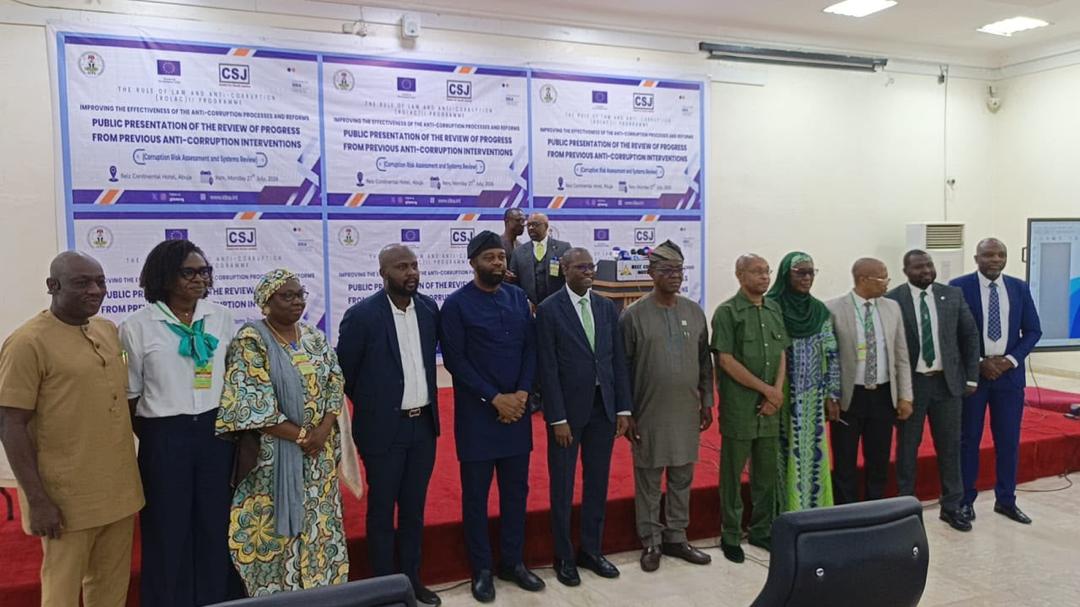
The Independent Corrupt Practices and Other Related Offences Commission (ICPC) has intensified its preventive anti-corruption drive with the unveiling of three follow-up assessment reports exposing persistent governance weaknesses in Nigeria’s health and education sectors, while calling for comprehensive institutional reforms to improve transparency, accountability and public service delivery.
The reports, presented in Abuja on Monday, assessed the implementation of earlier anti-corruption recommendations issued to the National Health Insurance Authority (NHIA), the National Primary Health Care Development Agency (NPHCDA), the Universal Basic Education Commission (UBEC) and selected State Universal Basic Education Boards (SUBEBs).
Speaking at the presentation, ICPC Chairman, Dr. Musa Aliyu (SAN), said the exercise reflected the Commission’s growing emphasis on preventing corruption by strengthening public institutions rather than relying solely on investigations and prosecutions.
Aliyu explained that the Commission’s mandate under the Corrupt Practices and Other Related Offences Act empowers it to identify systemic vulnerabilities in public institutions and recommend reforms capable of preventing corruption before it occurs.
According to him, the follow-up assessments evaluated the extent to which previous recommendations had been implemented, identified areas of progress, highlighted unresolved governance gaps and proposed additional reforms to improve institutional performance.
“The value of system studies and corruption risk assessments lies not merely in producing reports but in implementing their recommendations. Their true impact is measured by improvements in governance, accountability, transparency, operational efficiency and service delivery,” he said.
He stressed that the reviews were not intended to apportion blame but to encourage continuous institutional improvement and strengthen accountability across government agencies.
Aliyu noted that the NHIA, NPHCDA and UBEC were selected because of their strategic responsibility for delivering healthcare and education services to millions of Nigerians, adding that stronger governance frameworks within the institutions would safeguard public resources, improve service delivery and restore public confidence.
While acknowledging that the agencies had implemented several recommendations from previous assessments, he maintained that significant reforms remained necessary to address lingering systemic weaknesses.
He commended the leadership of the affected institutions for the progress made and urged them to sustain the reform momentum by fully implementing outstanding recommendations.
“The fight against corruption cannot be won through enforcement alone. Sustainable success depends on building resilient institutions with transparent systems, robust internal controls, effective oversight mechanisms and a culture of accountability,” Aliyu said.
He reaffirmed the Commission’s commitment to working closely with Ministries, Departments and Agencies (MDAs), oversight institutions, development partners and civil society organisations to ensure effective implementation and monitoring of the recommendations.
The ICPC chairman also acknowledged the support of the European Union-backed Rule of Law and Anti-Corruption (RoLAC II) Programme and the Centre for Social Justice (CSJ), which collaborated with the Commission throughout the review process.
Earlier, Lead Director of the Centre for Social Justice, Eze Onyekpere, warned that corruption risk assessments would have limited impact unless their recommendations translated into measurable institutional reforms.
He said the assessments formed part of the European Union-supported Rule of Law and Anti-Corruption Programme II aimed at strengthening anti-corruption systems at both the national and sub-national levels.
Onyekpere identified persistent corruption risks across the health and education sectors, including leakages in health insurance payments, diversion of medicines and vaccines, ghost workers in primary healthcare facilities, fraudulent enrolment practices, procurement irregularities, abandoned school projects and weak oversight of public funds.
He described corruption risk assessments as critical diagnostic tools that enable governments to detect and address systemic weaknesses before they undermine public service delivery.
“Our collective responsibility is to ensure that NHIA resources provide quality healthcare to beneficiaries, that medicines and vaccines reach intended patients, and that UBEC funds translate into better classrooms, improved learning outcomes and a brighter future for Nigerian children,” he said.
Onyekpere advocated the wider deployment of digital governance platforms to enable citizens monitor health insurance enrolment, primary healthcare services and education projects in real time.
He also recommended the institutionalisation of end-to-end electronic procurement systems, stronger whistleblower protection, improved staff welfare and capacity building, enhanced independent oversight mechanisms and greater use of technology to reduce human discretion in public administration.
Also speaking, Chairman of the Federal Civil Service Commission, Prof. Tunji Olaopa, said preventing corruption through institutional reforms offers a more sustainable solution than depending solely on law enforcement.
He commended the ICPC for prioritising system reviews and integrity plans, noting that transparent governance structures remain the strongest defence against corruption.
Olaopa urged public institutions to embrace technology-driven governance, transparent recruitment processes, conflict-of-interest declarations, stronger internal audit systems and ethical leadership, while challenging government agencies to move beyond compliance and institutionalise continuous reforms that promote prudent management of public resources.
The latest ICPC reports come amid growing calls for far-reaching public sector reforms as concerns persist over leakages, inefficiency and weak accountability in critical sectors responsible for healthcare and education delivery across the country.