Borno State Governor, Prof. Babagana Zulum, has called for stronger regional security cooperation among Nigeria and its Sahelian neighbours to confront Boko Haram, the Islamic State West Africa Province (ISWAP) and other terrorist groups destabilising the region.
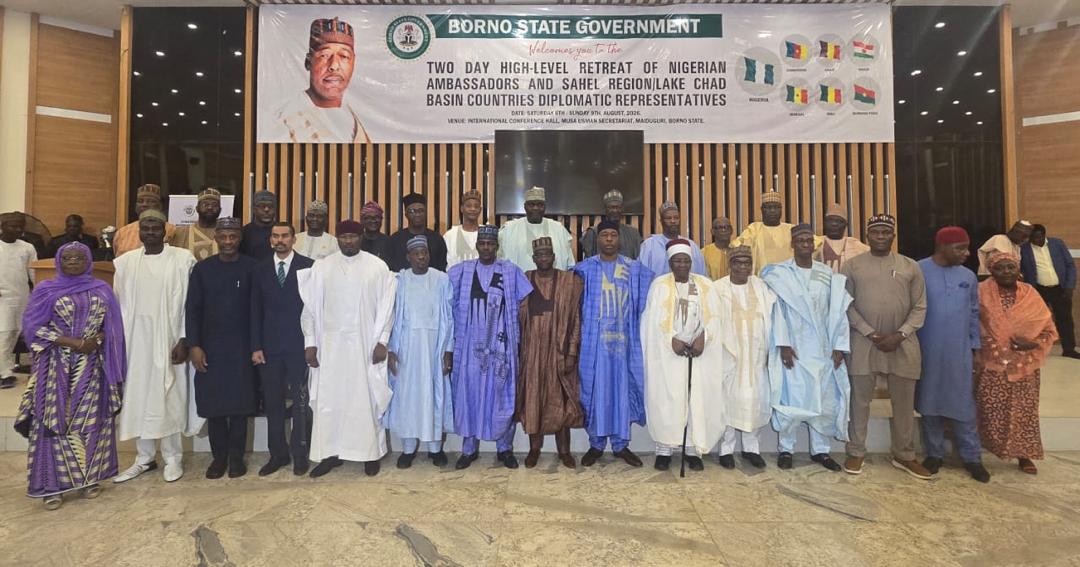
Zulum made the call on Saturday in Maiduguri at a high-level security retreat attended by representatives of Sahel countries, ambassadors and senior Nigerian foreign-policy officials.
The governor said the transnational nature of terrorism, porous borders, displacement and violent extremism required a coordinated regional response rather than isolated national security efforts.
The retreat, held at the conference hall of the Musa Usman Secretariat, placed Borno—at the centre of Nigeria’s more than decade-long battle against Boko Haram—at the heart of renewed efforts to develop a comprehensive security strategy for the Sahel.
Zulum, who has consistently advocated a combination of military action, humanitarian intervention, economic development and community-based measures, said military operations remained necessary but could not, on their own, deliver lasting peace.
“While our armed forces continue their brave operations, we must enhance intelligence sharing, community-based border management, and joint stabilisation initiatives alongside the Multinational Joint Task Force (MNJTF),” he said.

He warned that terrorists could continue to exploit gaps in border controls and differences among national security systems to move fighters, weapons and resources across countries unless regional cooperation was strengthened.
Drawing from Borno’s experience of the Boko Haram insurgency, Zulum stressed the need to complement military pressure with deradicalisation, rehabilitation and reintegration programmes, reconstruction, education, employment and humanitarian assistance.
He said sustainable peace would depend on rebuilding communities devastated by years of violence while restoring public confidence in government institutions.
Earlier, the Minister of State for Foreign Affairs, Sola Enikanolaiye, called for deeper regional cooperation to tackle terrorism and other security challenges confronting the Sahel.
Enikanolaiye said governments must look beyond military responses and address the socioeconomic conditions that create fertile ground for violent extremism, including poverty, unemployment, marginalisation and weak development structures.
He maintained that a coordinated regional strategy would strengthen the ability of affected countries to prevent terrorist organisations from exploiting borders and local grievances.
The Permanent Secretary, Ministry of Foreign Affairs, Dunoma Umara, also stressed the strategic importance of peace and stability in the Sahel to Nigeria’s national security and economic interests.

Umara noted that Nigeria’s historical, cultural, economic and geographical links with neighbouring countries meant that instability across the region would inevitably have consequences for Nigeria.
He consequently advocated sustained diplomatic and security engagement among countries in the region and stronger existing mechanisms for cooperation.
The Ambassador of Chad to Nigeria, Brah Mahamat, urged regional governments not to allow differences in institutional affiliations to weaken their collective response to terrorism.
He noted that terrorist organisations did not recognise the political and institutional boundaries separating countries.
“Although we belong to different institutional groupings, this should in no way impede our common security,” Mahamat said, stressing that terrorists could exploit operational limitations created by divisions among regional countries.
The retreat examined ways to improve intelligence sharing, border security, joint military operations and stabilisation programmes for communities affected by terrorism.
Participants also underscored the importance of the Multinational Joint Task Force, which brings together countries in the Lake Chad Basin to combat Boko Haram and associated terrorist organisations.
With terrorist networks increasingly operating across national boundaries, participants agreed that regional security mechanisms must evolve in line with the changing nature of the threat.
For Borno, hosting the retreat in Maiduguri carries particular significance. The city has endured years of Boko Haram violence and remains a major centre of Nigeria’s counter-insurgency operations in the Lake Chad Basin.
The gathering of senior regional and diplomatic stakeholders in the state signals an effort to position Borno not only as a frontline theatre in the fight against terrorism but also as a platform for regional dialogue on achieving lasting peace.
The retreat reinforced the emerging consensus that defeating terrorism in the Sahel will require more than battlefield victories. Intelligence cooperation, secure borders, resilient communities, economic opportunities, humanitarian assistance and coordinated political action will all be critical to containing the threat.
With terrorist groups continuing to exploit instability and weak border controls across the region, participants face an increasingly urgent task: building a common security architecture capable of confronting the transnational threat and preventing further deterioration of security across the Sahel.