The Federal Capital Territory Administration (FCTA) has commenced an investigation into the recent flooding along the Airport Road axis and Lokogoma District, with a view to identifying the underlying causes and implementing permanent measures to prevent a recurrence.
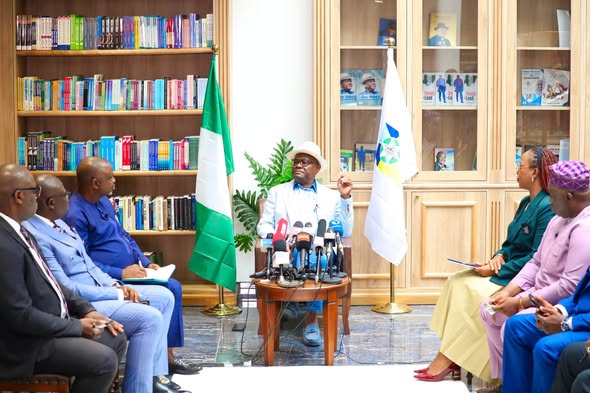
According to a statement by Assistant Director, Press Office of the Honourable Minister Ogaga Ikogho, the FCT Minister, Nyesom Wike, disclosed this on Tuesday during a media interaction, saying the Executive Secretary of the Federal Capital Development Authority (FCDA) and the Director of Development Control had been directed to inspect the affected areas, including Lugbe and Lokogoma.
Wike said the investigation would determine whether the flooding was caused by natural factors or human activities, particularly illegal development and obstruction of waterways.
“When I heard of the incident, the Executive Secretary of the FCDA and the Director, Development Control had to go to the place, not only at the airport road but also in Lokogoma,” he said.
“The one that is man-made, we can solve the problem; the one that is natural, there is nothing we can do—it becomes a natural disaster. So, it’s something that we have to investigate.”
The minister acknowledged the intensity of recent rainfall in Abuja but said preliminary observations indicated that violations of the Abuja Master Plan had worsened the situation in some locations.
According to him, buildings and other structures have been erected over natural waterways and along designated road corridors, obstructing drainage channels and altering established watercourses.
Wike specifically identified Lugbe as one of the areas where violations of the FCT Master Plan had persisted over the years.
“From our studies, Lugbe has always been violating the Abuja Master Plan. All over the years, you see people building without approval and blocking where is supposed to be a roadway,” he said.
He warned that the administration would enforce planning regulations strictly and demolish structures found to be obstructing waterways or occupying areas reserved for public infrastructure.
“We are not taking it lightly,” the minister added.
The FCTA, he disclosed, is also taking disciplinary action against officials accused of facilitating illegal developments and encroachments on green areas and waterways.
Wike said a government director had recently been suspended under civil service rules for issuing unauthorised “temporary approvals” to commercial operators on designated green areas, while another official was sanctioned for allegedly reallocating parkland under the guise of security clearing.
He further dismissed claims that structures located in prohibited areas would be protected because their owners obtained government approvals.
According to him, approvals issued in violation of established planning regulations would not prevent enforcement action.
“You got approval to do something wrong… sometimes, it’s under influence. Government policy is that nobody should do anything on green areas,” he said, stressing that such approvals would not be accepted as a defence against demolition.
76 of 107 FCT Roads Completed
On infrastructure development, Wike said the FCT Administration would complete all projects awarded by the present administration, as well as inherited projects, before the end of its tenure.
He disclosed that 107 road projects had been awarded in the FCT under President Bola Ahmed Tinubu’s administration, with 76 already completed and another 10 scheduled for completion before the forthcoming elections.
The minister also said 23 of the 25 projects inherited from the Muhammadu Buhari administration had been completed, alongside six of the eight projects inherited from the Goodluck Jonathan administration.
He added that the administration had also intervened in several long-abandoned projects dating back to the Olusegun Obasanjo administration.
“For the first time in the history of the FCT since 1999, no administration has awarded that number of projects and completed them,” Wike said.
He maintained that details of the projects and their execution had been made available to the public through national television networks.
Wike Defends Fuel Subsidy Reforms
The minister also defended the Federal Government’s decision to remove fuel subsidy, arguing that increased allocations to states and local governments had provided subnational administrations with greater resources to meet their financial obligations.
He urged citizens to demand accountability from state and local governments over the utilisation of the additional funds.
Wike cited the revival of the Abuja Rail Mass Transit system and expansion of the FCT road network among the infrastructure projects he said demonstrated the impact of increased government resources.
He also questioned former Vice President Atiku Abubakar’s recent comments on the possibility of restoring fuel subsidy, asking what states and other subnational governments had done with the additional revenue generated following its removal.
“The government has come to say the gains were shared among the subnational governments. Today, the states are paying salaries and pensions unlike before,” he said.
“Today, I can go on with projects. Today, the universities are going on without strikes. Having done that, it is now for states to account for what they have done with the money.”
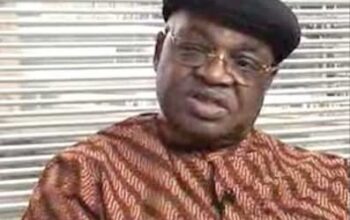
Wike Mourns Dan Orbih
The minister also paid tribute to his late political associate, Chief Dan Orbih, whom he described as a principled politician who remained steadfast despite political pressure.
Wike recalled his last encounter with Orbih, saying he visited him at the London Clinic while he was receiving medical treatment.
“Dan Orbih stood very firm in spite of pressure. That’s why I tell people that if you really know what you are doing and you are committed, no amount of pressure can sway you,” he said.
He expressed deep sadness over Orbih’s death, adding that it was difficult for him to come to terms with the loss.
Rivers Politics
On political developments in Rivers State, Wike said he remained actively engaged with the political process and his grassroots constituency.
He claimed that major political actors in the state had aligned under a “Rainbow Coalition” in support of President Tinubu’s administration, while dismissing the likelihood of a fragmented opposition posing a significant challenge in forthcoming elections.