Nearly seven decades after Shell drilled and abandoned oil wells in parts of Akwa Ibom State, communities in Ikono and Ibiono Ibom Local Government Areas are demanding environmental cleanup, compensation and accountability for what they describe as decades of pollution and livelihood losses.
Farmers, fishers, traditional rulers, women and youths from the affected communities made the demands at a capacity-sharing dialogue organised by the Health of Mother Earth Foundation (HOMEF) under its Fossil Politics project at Ikot Enua on September 9.
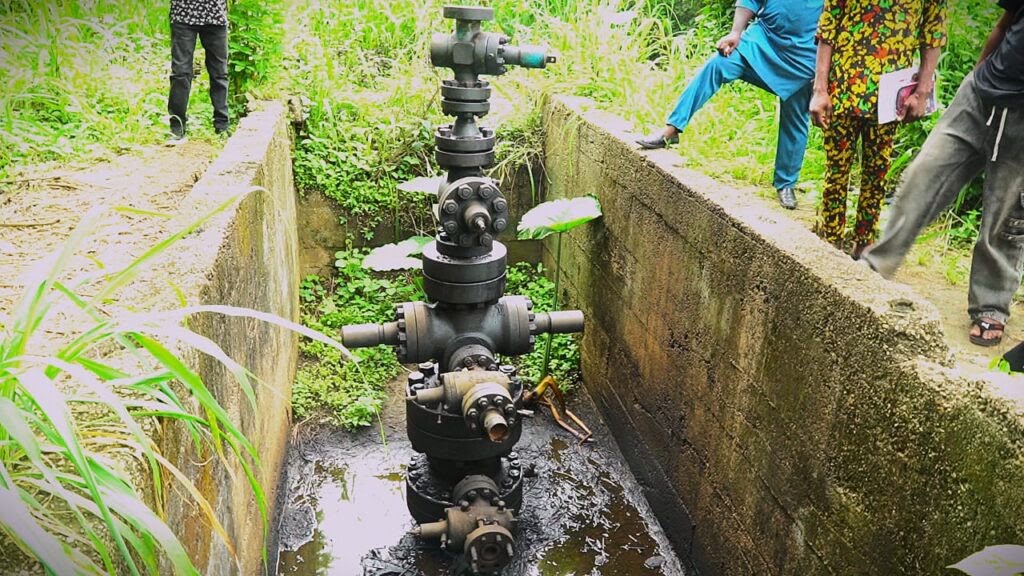
Residents alleged that abandoned oil infrastructure has contributed to declining agricultural yields, polluted streams, dying economic trees, disappearing fish and snails, deteriorating property, insecurity and loss of livelihoods.
They argued that although the wells may have ceased to hold commercial value for Shell, the environmental consequences of the company’s activities have remained part of their daily lives.
HOMEF Executive Director, Dr Nnimmo Bassey, said communities affected by abandoned oil infrastructure must be central to decisions concerning the future of their territories.
“Communities must speak for themselves. They live here and understand the issues better than outsiders,” Bassey said.
He also referenced continuing petroleum-related hazards elsewhere in the Niger Delta, including reports of gas bubbling and fire incidents in Bille, Rivers State, as evidence of the risks associated with abandoned or ageing oil infrastructure.
The Executive Director of Peace Point Development Foundation, Umo Isua Ikoh, criticised what he described as an unequal distribution of the benefits and environmental burdens of oil extraction.
“Oil can be a blessing to Abuja but never to the host communities,” he said, citing Ikot Ebidang in Onna Local Government Area, where he alleged that an ongoing flare had displaced members of the host community.
‘We can’t plant in our farms anymore’
Residents presented accounts of environmental and economic changes they attributed to decades of petroleum activity.
Chief Felix Vincent Udoh of Ikot Enua reported declining agricultural productivity and the death of oil palm seedlings, while cocoyam, snails and fish species previously common in the community were said to have disappeared.
He also raised concerns over declining soil fertility and insecurity around abandoned oil facilities.
Udoh further alleged that corrugated roofing sheets in the community now rust and deteriorate unusually quickly, with some reportedly lasting less than five years.
He claimed that Ikot Enua won a case against Shell at the High Court and Court of Appeal in 2013 but alleged that the company had yet to comply with the judgment.
In Adara Abom, Moses Udo said oil pollution had severely affected fishing, depriving residents of a major source of food and income.
Barrister Trust Udoh of Uyo Afaha Nkan similarly alleged that oil spills had contaminated water sources and damaged agricultural activities.
“We can’t plant in our farms anymore,” he said, while calling for the removal of the abandoned oil installation.
Residents of Ikot Idaha, Edem Udua and Ediene Atai also reported the destruction of economic trees and declining agricultural yields.
In Ntan Mbat, residents said crops including okra and cocoyam no longer produced adequately and sometimes died prematurely. They also complained about an abandoned road project reportedly initiated by the Niger Delta Development Commission.
Residents of Nkara Obio, meanwhile, reported polluted streams and declining crop yields.
According to HOMEF, the testimonies reflected a broader pattern of environmental and socioeconomic concerns across the affected communities, including reduced production of yam, cassava, cocoyam and okra; destruction of economic trees; disappearance of fish and snails; polluted water sources; insecurity and inadequate infrastructure.
Calls for decommissioning
HOMEF said the situation raises fundamental questions about responsibility for environmental liabilities after oil production becomes commercially unviable.
The organisation called on the Federal Government, Shell, regulatory agencies and the Akwa Ibom State Government to address outstanding claims relating to the abandoned Ikono 1 oil well.
It referenced the 2013 Court of Appeal decision in Eteidung Raymond F. Obot & Ors. v. Shell Petroleum Development Company Nigeria Limited (CA/C/70/2011), which, according to HOMEF, allowed environmental claims from 2006 onward to proceed.
The organisation demanded comprehensive assessment of abandoned wells and hazardous infrastructure, permanent decommissioning where production has ceased, removal of dangerous installations and environmental remediation.
It also called for investigations into reported health concerns, long-term environmental monitoring and compensation for losses involving farmland, crops, economic trees, fishing grounds, property and livelihoods.
Beyond compensation and remediation, the communities want improved security, employment and skills-development opportunities, as well as support for sustainable agriculture, fishing and other non-extractive livelihoods.
HOMEF also cautioned against treating renewed exploitation of abandoned wells as an automatic solution to community economic challenges, arguing that environmental restoration and sustainable livelihoods should take precedence.
The controversy has renewed broader concerns over the legacy of oil extraction in the Niger Delta, where communities have for decades raised disputes over pollution, compensation, land degradation and environmental responsibility.
For residents of Ikono and Ibiono Ibom, the central demand is that the end of commercial interest in an oil well should not signify the end of corporate or governmental responsibility.
They are seeking restoration of polluted land and water, rehabilitation of damaged ecosystems, redress for lost livelihoods and meaningful participation in decisions affecting their territories.
The communities’ message is ultimately about what happens after oil production ends: who bears the cost of environmental damage, who restores affected land and water, and whether communities can reclaim the resources on which their livelihoods depend.