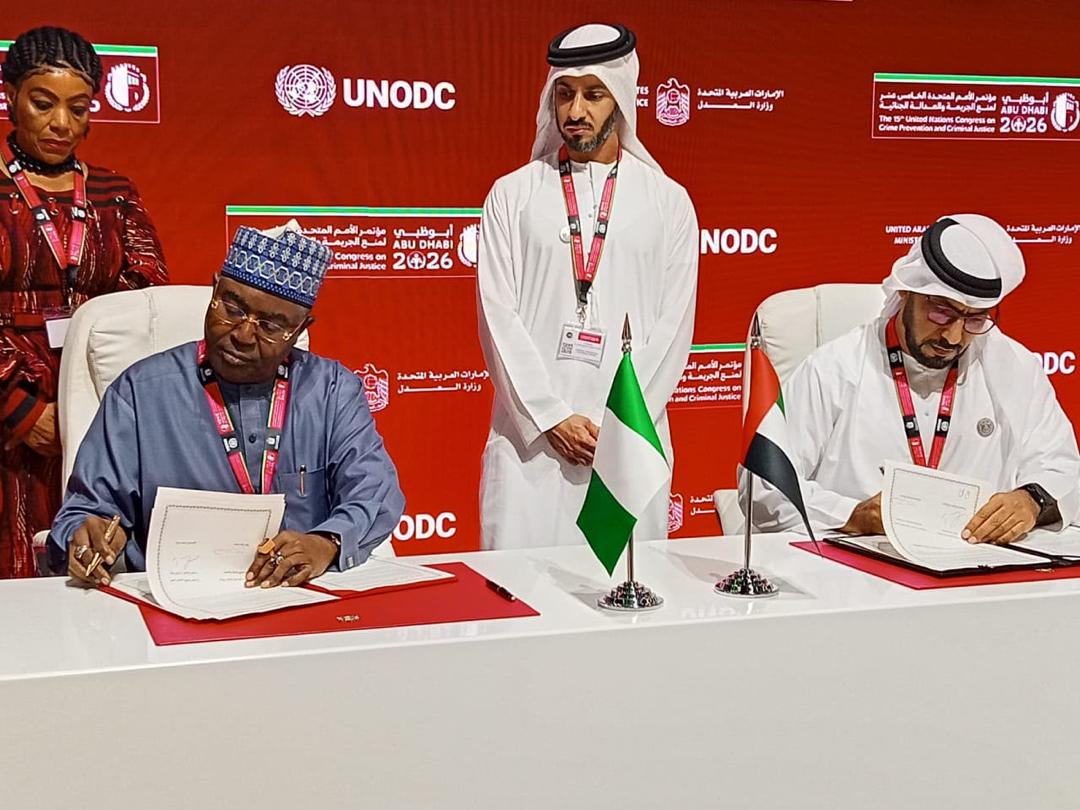
Nigeria and the United Arab Emirates have signed a new agreement to strengthen intelligence-sharing and joint operations against international drug trafficking networks operating along the Nigeria-UAE corridor.
The Memorandum of Understanding (MoU) between the National Drug Law Enforcement Agency (NDLEA) and the UAE’s National Drug Enforcement Authority (NDEA) was signed on Saturday in Abu Dhabi on the sidelines of the ongoing 15th United Nations Congress on Crime Prevention and Criminal Justice.
NDLEA Chairman and Chief Executive Officer, Brig. Gen. Buba Marwa (rtd), who signed the agreement on behalf of Nigeria, said the pact would provide a stronger framework for exchanging intelligence, operational information and technical expertise between the two agencies.
The agreement follows the interception by NDLEA operatives of 354.7 kilogrammes of illicit drugs concealed in consignments destined for the UAE between 2021 and 2026. The seizures resulted in the arrest and prosecution of 47 suspects.
The drugs recovered included cocaine, cannabis, tramadol, Rohypnol, ecstasy and khat.
Marwa said the volume of illicit drugs intercepted along the UAE route demonstrated the need for closer operational cooperation between both countries.
He said the new agreement would build on existing arrangements, including the exchange of liaison personnel, while facilitating greater coordination of enforcement operations.
He also disclosed that the UAE authorities would provide Nigerian travellers with a comprehensive list of prohibited items to help prevent travellers from inadvertently carrying substances or materials banned under UAE laws.
Giving an insight into NDLEA’s wider anti-narcotics campaign, Marwa said the agency arrested more than 91,000 suspects between January 2021 and July 2026, including 243 alleged drug barons.
During the same period, he said, NDLEA seized more than 15.5 million kilogrammes of illicit drugs and precursor chemicals and secured 16,469 convictions.
He added that more than 53,000 drug users received counselling, treatment and rehabilitation as part of the agency’s efforts to tackle both the supply and demand sides of the illicit drug trade.
Marwa further said the agency’s War Against Drug Abuse (WADA) campaign had reached nearly 5.9 million Nigerians through sensitisation programmes in communities and schools.
According to him, enforcement, intelligence-led operations and preventive interventions remain key components of the agency’s strategy against drug trafficking and abuse.
On the UAE side, NDEA Chairman, Sheikh Zayed bin Hamad Al Nahyan, reaffirmed his agency’s commitment to working closely with Nigeria to disrupt trafficking networks taking advantage of the strong economic and human links between both countries.
Al Nahyan described the MoU as a continuation of the productive relationship already established between the two agencies.
The agreement is expected to facilitate faster intelligence exchanges, improve operational coordination and enhance efforts to identify and dismantle transnational drug trafficking organisations operating through the Nigeria-UAE route.
Both agencies expressed confidence that the strengthened partnership would lead to more effective joint operations and greater disruption of international narcotics networks.