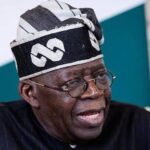
Vice President Kashim Shettima has called for urgent policy reforms, stronger public-private partnerships and innovative risk-sharing mechanisms to attract investment into Nigeria’s green infrastructure, saying the country requires about $410 billion in additional investment by 2060 to achieve its net-zero pathway.
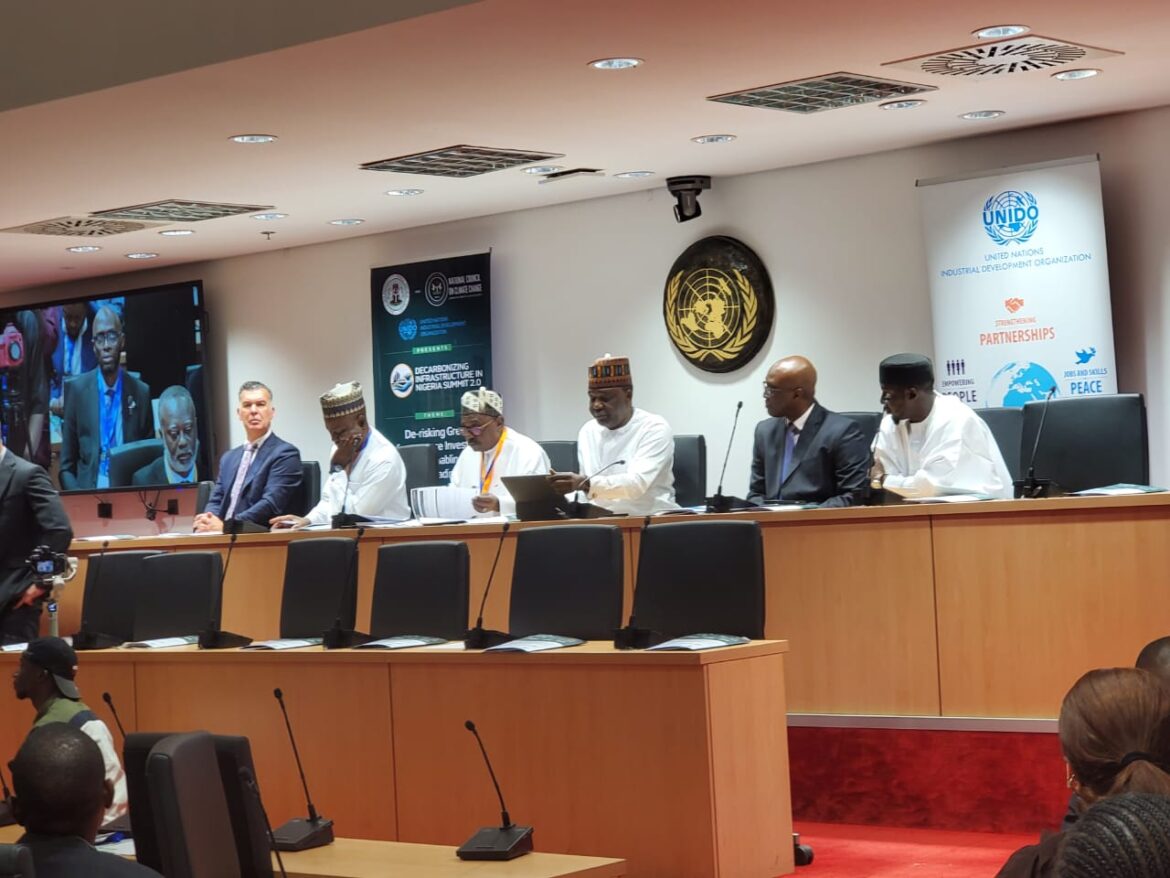
Shettima made the call on Tuesday at the second edition of the Decarbonising Infrastructure in Nigeria (DIN) Summit in Abuja, where policymakers, investors, development finance institutions, climate experts and members of the diplomatic corps examined strategies for closing the country’s green infrastructure financing gap.
Represented by his Deputy Chief of Staff, Senator Ibrahim Hadejia, the Vice President described the estimated $410 billion funding requirement as both a major challenge and a significant investment opportunity for domestic and international investors.
He said government could not provide all the capital required to finance Nigeria’s long-term energy transition and infrastructure development, stressing the need for greater private-sector participation and support from development and domestic financial institutions.
“We need the private sector. We need development finance institutions. We need domestic financial institutions and institutional investors,” Shettima said, adding that Nigeria also needed well-prepared projects capable of attracting investment.
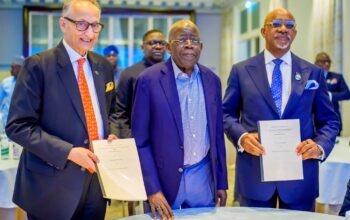
The summit, held at the United Nations House in Abuja, was organised by the Office of the Vice President with support from the National Council on Climate Change and the United Nations Industrial Development Organisation (UNIDO).
With the theme, “De-risking Green Infrastructure Investment in Nigeria: Enabling Policy, Project Readiness and Risk-Sharing Solutions,” the summit focused on transforming Nigeria’s climate and infrastructure ambitions into bankable projects.
Shettima said the central challenge was no longer a lack of policies or climate ambitions, but the ability to translate them into projects that investors could properly assess, finance and implement.
He said investors needed clarity on policy, credible revenue models, technical feasibility and the allocation of risks among government, financiers and project developers.
The Vice President noted that Nigeria’s Nationally Determined Contribution (NDC) 3.0 recognised the need to build a stronger pipeline of investment-ready projects, increase private-sector participation and improve access to climate finance.
He also highlighted the potential of blended finance and other risk-sharing mechanisms to mobilise private capital for green infrastructure.
The Personal Assistant to the President on Subnational Infrastructure, Musaddiq Adamu, said the DIN Summit was designed to answer a practical question: what would it take to move green infrastructure projects from ideas to investment?
Adamu said the initiative had expanded since its inaugural edition, with pre-summit workshops covering energy, transport, urban development and agriculture.
He recalled that the first summit attracted more than 400 stakeholders and contributed to engagements between project developers and potential investors.
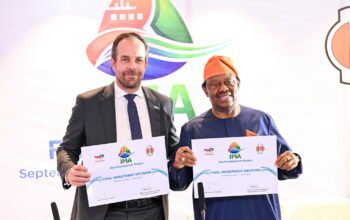
According to him, one outcome was an agreement between APM Terminals and the Nigerian Ports Authority valued at $60 million to advance the electrification of port operations, with Onne Port expected to become Nigeria’s first green port.
“For me, that is an important lesson. The objective is not simply to have a good conversation. The goal is to create real investment opportunity,” he said.
Also speaking, the UNIDO Sub-Regional Representative in Nigeria and ECOWAS, Ambassador Philbert Abaka Johnson, said Nigeria’s physical infrastructure investment needs were estimated at about $3 trillion by 2050.
Johnson said tracked climate finance flows into Nigeria averaged only $2.5 billion annually in 2021 and 2022, against estimated annual requirements of $29.7 billion, leaving an estimated financing gap of $27.2 billion annually.
He identified policy and regulatory uncertainty, fragmented approval processes, unclear institutional mandates and inadequate revenue or offtake arrangements as major obstacles to financing otherwise viable projects.
Johnson said projects needed to be developed to a stage where investors could properly assess their risks and financing prospects.
He disclosed that UNIDO would deploy its Computer Model for Feasibility Analysis and Reporting (COMFAR) software and Digital Investment Promotion Platform to support project development in Nigeria.
According to him, the tools are already being used by more than 11,000 practitioners across 160 countries.
Johnson said UNIDO’s support for Nigeria’s industrial transformation was anchored on its Programme for Country Partnership (PCP), 2024–2028, signed in Abuja in April 2025 and valued at approximately $175 million.
He said the programme covered industrial policy and strategic governance, enterprise development, special economic zones and industrial parks, agricultural and mineral value chains, sustainable energy and environmental management, as well as trade capacity building under the African Continental Free Trade Area (AfCFTA).
Johnson also called for the full operationalisation of the Climate Change Act and greater certainty around power purchase agreements to help unlock carbon finance in Nigeria and across Africa.
The Director-General of the National Council on Climate Change, Mrs Tenioye Majekodunmi, said green infrastructure had the potential to create more than 300,000 jobs.
Participants at the summit called for standardised public-private partnership agreement templates, dedicated early-stage project development funding and stronger institutional coordination to build a pipeline of bankable projects in areas including mini-grids, clean transportation and green buildings.
They also stressed the need for greater certainty around power purchase agreements, revenue structures, regulatory processes and contractual obligations as prerequisites for attracting long-term private capital.
The summit ultimately placed project readiness, policy certainty and risk-sharing at the centre of efforts to mobilise the hundreds of billions of dollars required to finance Nigeria’s green transition and translate its climate ambitions into investable infrastructure.