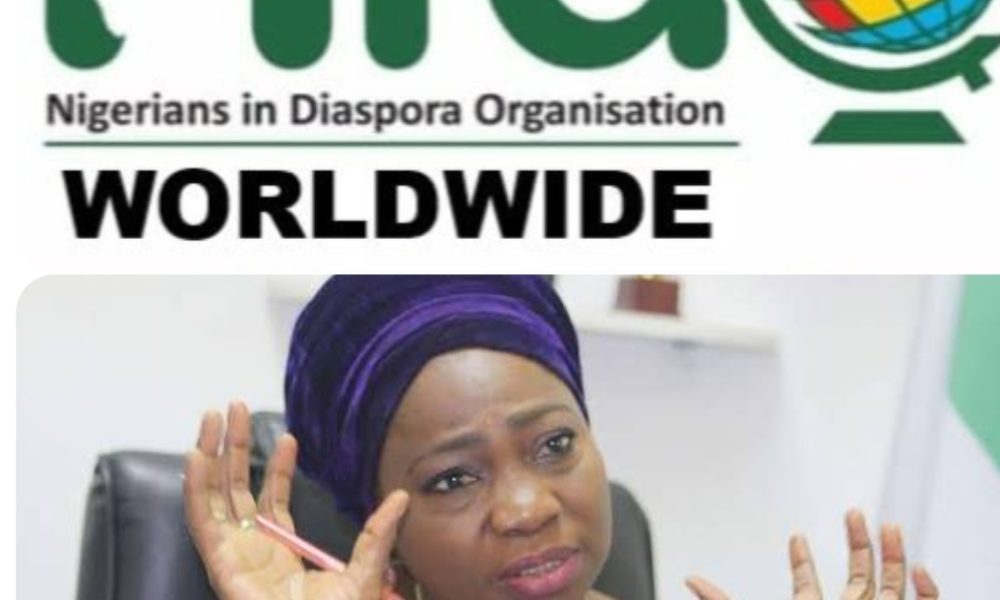
The Nigerians in Diaspora Commission (NiDCOM) has challenged individuals claiming leadership of a purported “NIDO Worldwide” structure to produce evidence of its legal registration, governing constitution and election, deepening its dispute with some leaders of the Nigerians in Diaspora Organisation (NIDO).
NiDCOM, in a statement signed by its Director of Media, Public Relations and Protocols, Abdur-Rahman Balogun, said it had requested three key documents from those presenting themselves as leaders of NIDO Worldwide but had yet to receive them.
The commission demanded evidence of NIDO Worldwide’s registration with the Corporate Affairs Commission (CAC) or an equivalent authority in the relevant jurisdiction, a constitution establishing the office of Chairman of NIDO Worldwide, and a certified report of a global election through which the purported leadership emerged.
The latest development followed a rejoinder issued by Collins Nweke in response to NiDCOM’s September 29, 2026 statement. The commission accused Nweke of allowing what it described as sentiments to obscure verifiable facts concerning NIDO’s organisational structure.
NiDCOM rejected allegations that it was seeking to undermine or eliminate NIDO, stressing that the commission itself emerged from advocacy by diaspora leaders seeking stronger institutional representation for Nigerians abroad.
It recalled that diaspora advocates supported the legislation establishing NiDCOM and said its Chairperson/CEO, Hon. Abike Dabiri-Erewa, worked with several NIDO leaders during her tenure in the House of Representatives between 2003 and 2015 to advance the legislation.
“NiDCOM has not, and will never seek to sideline or erase NIDO,” the commission said, maintaining that its position was aimed at reforming the organisation rather than abandoning it.
The commission said it agreed with Nweke’s position that institutions facing challenges should be reformed rather than abandoned, but insisted that meaningful reform required transparency, credible leadership structures and compliance with established constitutions.
NiDCOM said it had monitored NIDO elections over the years, intervened in disputes and provided platforms for diaspora engagement, while repeatedly urging the organisation’s various factions to resolve their differences.
It, however, questioned the measures NIDO had taken to reform its internal structures, arguing that effective diaspora organisations generally operate through identifiable constitutions, transparent leadership processes and legally recognised structures.
The commission said the issue had become particularly important because the Federal Government routinely engages thousands of Nigerian professionals and organisations abroad outside the NIDO framework.
It cited the recent Nigeria Diaspora Day and the Nigeria in Diaspora Economic Conference in Toronto as examples of engagements involving different diaspora organisations and professionals.
According to NiDCOM, the Diaspora Day brought together hundreds of Nigerian medical professionals who contributed through surgeries, training and other interventions, while President Bola Tinubu received the group.
The commission said such engagements demonstrated that Nigerians abroad could contribute to national development through multiple platforms without necessarily belonging to NIDO.
However, NiDCOM said its principal concern remained claims of a unified worldwide NIDO structure.
The commission said its records indicated disputes affecting some continental and regional structures, while NIDO was either absent or not functioning as a unified organisation in some countries.
It referred to what it described as a contested NIDO continental leadership structure in Europe, factional structures in Africa and America, and disorganisation in Asia.
NiDCOM also said NIDO did not operate as a unified organisation in countries including South Africa and Australia, while Canada had developed a different model involving multiple Nigerian diaspora associations working together.
The commission said it would therefore not recognise any individual or group that unilaterally presented itself as “NIDO Worldwide” without a transparent and verifiable electoral process involving relevant country and continental chapters.
It advised Federal Government ministries, departments and agencies, as well as Nigerian diplomatic missions abroad, to verify claims of NIDO Worldwide leadership with NiDCOM before engaging individuals presenting themselves in such capacity.
The commission, however, said it recognised duly registered and active NIDO country chapters whose status could be verified by Nigerian diplomatic missions in their host countries.
NiDCOM urged NIDO continental chapters to resolve their differences and proposed a bottom-up reorganisation beginning with properly constituted country chapters, followed by continental structures and, ultimately, a genuinely elected global body.
It proposed that any global election should be conducted under the supervision of an independent electoral committee rather than through self-declaration.
The commission cited Canada as an example of what it described as a more inclusive model, noting that the recent Nigeria in Diaspora Economic Conference in Toronto benefited from NiDCOM’s engagement with various registered diaspora organisations and leaders.
NiDCOM stressed that its mandate extended beyond NIDO to all Nigerians living abroad, regardless of whether they belonged to NIDO, NAPAC, ANPA, MANSAG, NNC, other associations or no organisation.
“Our allegiance is to the 20 million Nigerians abroad, not to acronyms or titles,” the commission said.
The commission said it did not intend to sustain what it described as endless media exchanges over the dispute and urged NIDO leaders and elders to return to dialogue aimed at resolving the organisation’s longstanding internal divisions.
It also cautioned against involving NIDO in partisan politics ahead of Nigeria’s general elections, stressing that the organisation was a non-political association.
NiDCOM further urged NIDO elders to focus on resolving what it described as more than two decades of factionalisation and internal disputes rather than prolonging public exchanges over leadership recognition.
The dispute highlights a broader challenge in Nigeria’s diaspora engagement framework: how to maintain credible channels for engaging millions of Nigerians abroad while accommodating the numerous professional, cultural, regional and community organisations through which the diaspora operates.
At the centre of the disagreement is the question of who possesses a verifiable mandate to speak for a global network of Nigerians abroad and what institutional process should confer that mandate.
NiDCOM said it remained willing to work with genuine diaspora initiatives and registered organisations but insisted that claims to represent Nigerians worldwide must be supported by transparent structures, verifiable records and credible leadership processes.