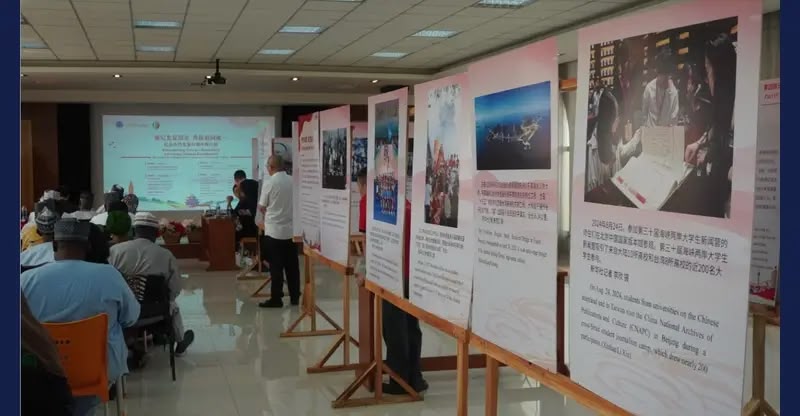
China has intensified efforts to promote African understanding of its position on Taiwan, using a historical exhibition in Abuja to draw parallels between Beijing’s reunification agenda and Africa’s struggles against colonialism and foreign domination.
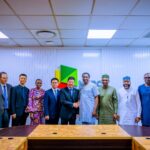
The exhibition, organised by Xinhua News Agency’s Africa Regional Bureau in collaboration with other organisations, brought together diplomats, researchers, business leaders and media practitioners on Friday to commemorate the 81st anniversary of Taiwan’s restoration to Chinese control in 1945.
Held under the theme, “Remembering Taiwan’s Restoration, Advancing National Reunification,” the exhibition featured more than 30 photographs arranged across four thematic sections, documenting historical events surrounding Taiwan’s return to Chinese control following Japan’s defeat in the Second World War.
Beyond the historical displays, the event provided a platform for Chinese representatives and Nigerian scholars to highlight Beijing’s position on sovereignty, territorial integrity and the eventual reunification of China and Taiwan.
Gui Tao, Deputy Editor-in-Chief of Xinhua News Agency’s Africa Regional Bureau, said the exhibition was part of a series of commemorative activities being held in Nigeria, Kenya, Tanzania, South Africa and Mozambique.
He said the initiative was designed to deepen African understanding of China’s historical experiences, arguing that the continent’s struggles against colonialism and its quest for independence offered a basis for understanding Beijing’s position on national unity.
Gui added that shared historical experiences underscored the importance of sovereignty, national dignity and respect for historical facts, stressing that greater knowledge of each other’s history could strengthen China-Africa relations through cultural engagement and people-to-people exchanges.
Yang Jianxing, Cultural Counsellor at the Chinese Embassy in Nigeria, described Taiwan’s restoration in 1945 as a significant outcome of China’s victory in the war against Japanese aggression.
He said the photographs and historical records demonstrated China’s determination to defend its sovereignty and territorial integrity, adding that the commemoration provided an opportunity to reflect on the historical significance of Taiwan’s restoration and Beijing’s commitment to reunification.
Similarly, Hu Jieguo, Secretary-General of the China Council for the Promotion of Peaceful National Reunification in Western Africa, highlighted the sacrifices made by millions of Chinese during the war against foreign aggression.
Hu said China’s historical experience and Nigeria’s own encounters with foreign domination provided common ground for discussions on sovereignty, national unity and territorial integrity.
Supporting the position advanced by the Chinese representatives, Sheriff Ibrahim, Head of the Centre for Contemporary China-Africa Research in Nigeria, said Nigeria had consistently reaffirmed its recognition of the one-China principle.
He drew parallels between China’s pursuit of national unity and Nigeria’s efforts to preserve its territorial integrity, expressing confidence that Beijing would eventually achieve peaceful reunification with Taiwan.
Charles Onunaiju, Director of the Centre for China Studies in Nigeria, also argued that Africa’s experiences of colonialism and foreign intervention provided a historical context for understanding China’s concerns about sovereignty and national unity.
The exhibition further highlighted economic and social connections between Taiwan and mainland China through accounts from Taiwanese businesspeople living and working in Chinese cities.
Chen Chi-An, Executive Vice President of the Guangzhou Taiwan-Funded Enterprises Association, said more than 2,900 Taiwan-funded companies operated in Guangzhou. He also highlighted the presence of Taiwanese students in the city and described his professional interactions with young people from mainland China as a rewarding aspect of his experience.
Wu Chun-Jui, President of the Taiwan Businessmen Association in Dongguan, said the city provided a favourable business environment for Taiwanese entrepreneurs. He disclosed that Taiwanese businesspeople had established privately funded hospitals and schools, contributing to local development.
Hsu Fu-hsien, President of the Taiwan Merchant Association in Shenzhen, said he had lived and worked in the city since 1990, building his career and family there.
Hsu expressed hope that the exhibition would help African audiences gain a better understanding of the experiences of Taiwanese businesspeople on the mainland and the economic and social connections they had established.
The event also featured the presentation of a book edited by Xinhua News Agency, while Taiwan businessmen associations in Guangzhou and Shenzhen donated books to Nigerian officials and experts.
The Abuja exhibition forms part of China’s broader public diplomacy efforts to promote its historical narrative, strengthen cultural engagement with African countries and encourage support for its position on Taiwan.
It also underscores Beijing’s efforts to frame the Taiwan question within the wider international discourse on sovereignty, territorial integrity and national unity, using historical comparisons and economic connections to reinforce its message among African audiences.