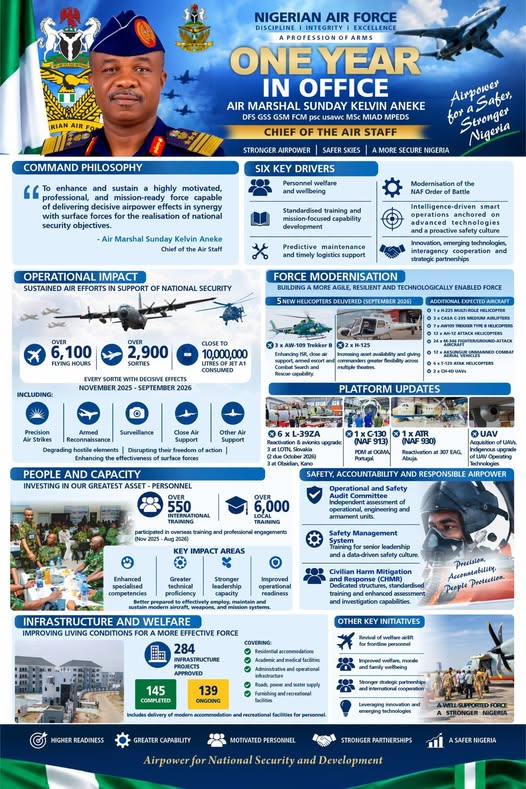
The Nigerian Air Force (NAF) has recorded more than 6,100 flying hours and 2,900 sorties between November 2025 and September 2026, highlighting the scale of its air operations as Chief of the Air Staff, Air Marshal Sunday Kelvin Aneke, approaches his first anniversary in office on October 30.
The figures reflect the Service’s operational tempo under Aneke’s leadership, with missions covering precision air strikes, armed reconnaissance, surveillance, close air support and intelligence-led operations aimed at degrading hostile forces and supporting ground troops.
However, the significance of the figures extends beyond the number of sorties flown. The effectiveness of airpower ultimately depends on the accuracy of intelligence, the operational impact of strikes, coordination with surface forces, aircraft serviceability and the ability to sustain missions without compromising civilian safety.
Under Aneke’s command philosophy of building a highly motivated, professional and mission-ready force, the NAF has placed emphasis on ensuring that each sortie serves a defined operational purpose and contributes to national security. The reported operations consumed nearly 10 million litres of Jet A-1 fuel, underscoring the logistical and financial demands associated with sustained air operations.
Modernisation and operational sustainability
A major component of the Service’s strategy has been the expansion and modernisation of its aircraft fleet. In September 2026, the NAF took delivery of five helicopters: three AW-109 Trekker Type B and two H125 helicopters.
The Service is also pursuing plans to acquire 12 AH-1Z attack helicopters, alongside other aircraft and unmanned aerial systems. These acquisitions are intended to expand its capabilities in combat operations, surveillance and intelligence gathering.
Maintenance remains another critical element of force readiness. The NAF has continued efforts to reactivate and upgrade six L-39ZA aircraft in Slovakia and Nigeria, while periodic depot maintenance is ongoing on a C-130 aircraft in Portugal.
These initiatives address a central challenge facing air forces: acquiring new platforms is only one part of modernisation. Aircraft availability, maintenance capacity, spare-parts supply, technical expertise and the timely delivery of equipment are equally important in translating procurement into operational capability.
The planned acquisition of additional platforms will therefore need to be matched by sustainable maintenance arrangements, adequate technical training and reliable logistics to ensure long-term operational value.
Personnel welfare and professional development
Aneke’s first year has also featured measures targeting personnel welfare, career progression and professional development under the principle of “Welfare for Enhanced Warfare.”
According to the Service’s performance report, 1,534 senior non-commissioned officers and 1,936 non-commissioned officers were promoted during the period. More than 550 personnel participated in international training and professional engagements, while over 6,000 received training locally.
The NAF has also pursued improvements in personnel allowances, medical services, accommodation and infrastructure, including the reactivation of welfare airlift services for personnel serving in frontline theatres.
These measures are relevant to operational effectiveness because airpower depends not only on aircraft and weapons systems but also on skilled pilots, engineers, technicians, intelligence personnel and ground-support teams.
Sustaining morale, retaining technical expertise and providing adequate welfare support will remain important as the Service expands its operational responsibilities and introduces more sophisticated platforms.
Infrastructure and local defence production
The NAF has approved 284 infrastructure projects, of which 145 have been completed and 139 remain ongoing, according to the report.
The projects cover accommodation, academic and medical facilities, operational and administrative buildings, roads, electricity, water supply and recreational infrastructure.
The scale of the programme indicates an effort to strengthen the institutional foundations required to support an expanding air force. Nevertheless, the ultimate value of these investments will depend on the quality of completed facilities, their maintenance and their contribution to operational readiness and personnel welfare.
The Service has also continued initiatives aimed at developing indigenous defence production capabilities.
These include Aircraft Release Device 863 impulse release cartridges and a 250-kilogram bomb-loading trolley. Locally produced 57-millimetre rockets are also undergoing development and ground testing.
Domestic production could reduce reliance on foreign suppliers, improve access to essential equipment and support the development of local technical expertise. However, the long-term benefits will depend on successful testing, quality assurance, certification and the capacity to manufacture equipment consistently at operational scale.
Safety, accountability and civilian protection
The NAF has identified flight safety, operational accountability and civilian harm mitigation as priorities during the period.
Measures include the establishment of an Operational and Safety Audit Committee, strengthening of the Safety Management System and development of structures for Civilian Harm Mitigation and Response.
The Service has also pursued standardised training and improved assessment and investigation capabilities.
These safeguards are particularly important as air operations expand in complex security environments where intelligence limitations, the proximity of civilians to armed groups and the risks associated with targeting can have serious consequences.
Operational success must therefore be assessed not only by sorties completed or targets engaged, but also by mission outcomes, compliance with applicable rules, protection of civilians and the effectiveness of post-operation investigations where incidents occur.
The test ahead
Beyond combat operations, the NAF has undertaken community healthcare, educational and other special projects intended to strengthen civil-military relations and public confidence.
As Aneke approaches his first anniversary, the Service’s reported achievements provide an indication of its operational activity, investments and institutional priorities. The more consequential test, however, will be whether these inputs translate into measurable improvements in security outcomes.
That assessment requires evidence of mission effectiveness, aircraft availability, reduced operational delays, stronger coordination with ground forces and sustained progress in personnel development and local defence production.
The coming period will also test the NAF’s ability to balance expanded operational demands with maintenance costs, infrastructure requirements, personnel welfare and accountability.
Ultimately, the first year provides a baseline against which subsequent performance can be measured. The durability of the gains will depend on how effectively the Service converts increased flying activity, modernisation programmes and institutional reforms into sustainable combat capability and improved security for Nigerians.