The Independent National Electoral Commission (INEC) has removed 1,609,553 records from the national register of voters following a comprehensive clean-up of the 2025/2026 Continuous Voter Registration (CVR) exercise, while identifying 54 staff members across 10 states allegedly involved in registration irregularities.
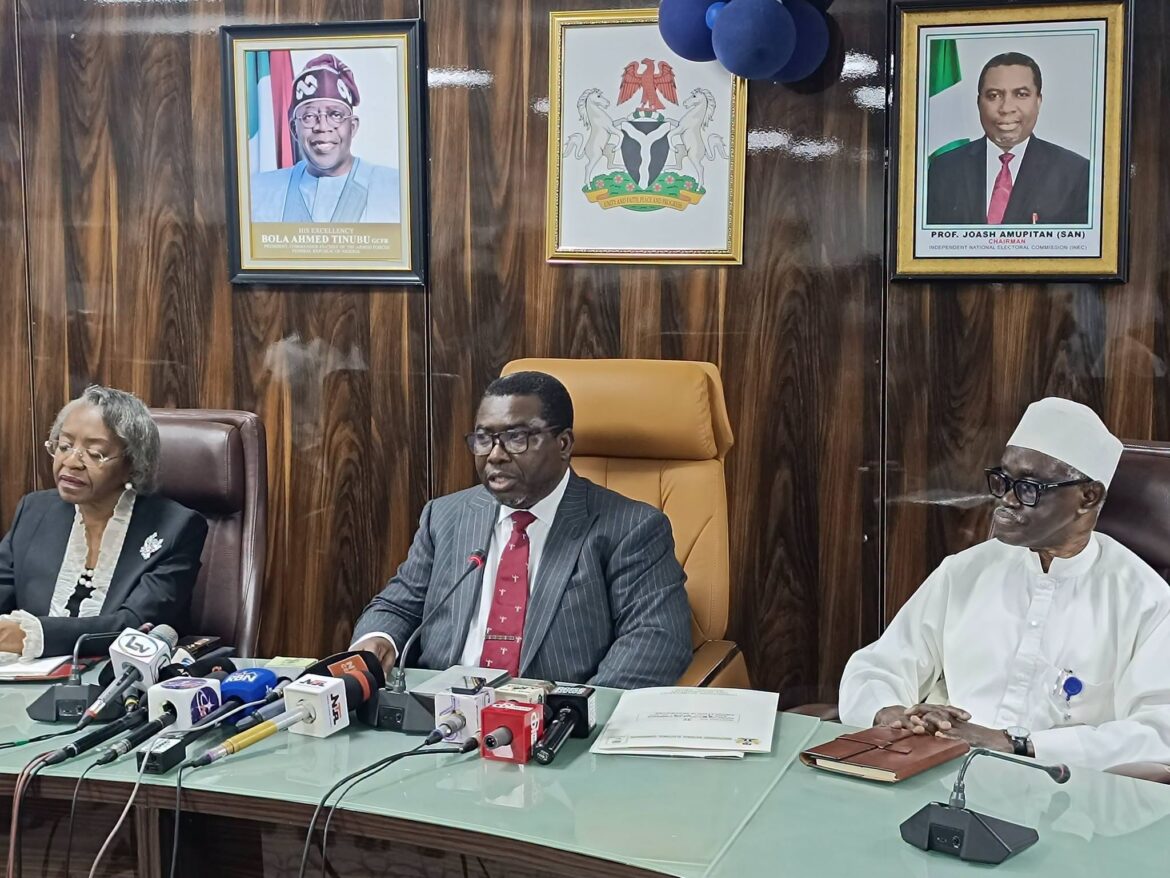
INEC Chairman, Prof. Joash Amupitan, SAN, disclosed this on Monday, November 9, 2026, during a press conference at the Commission’s headquarters in Abuja on the display and publication of the Preliminary Register of Voters.
Amupitan explained that the affected records comprised 1,608,660 confirmed invalid registrations and 873 entries belonging to verified deceased persons.
According to him, the Commission initially harvested 11,088,238 records from the three phases of the 2025/2026 CVR exercise, with its Automated Biometric Identification System (ABIS) flagging 1,545,052 records for further examination.
He, however, clarified that being flagged by the automated system did not automatically mean a registration was invalid, stressing that every case had to undergo proper review and adjudication.
The INEC chairman said 1,277,052 registrations were initially confirmed invalid and excluded before the publication of the Preliminary Register.
He added that following complaints, claims and objections received during the statutory display period, another 268,000 cases were subjected to adjudication. Of these, 217,722 were confirmed invalid and removed, while 50,278 were cleared and retained.
An additional screening exercise identified 113,886 invalid registrations, bringing the total post-display removals to 331,608.
Amupitan declared that the Commission had concluded the clean-up of the 2025/2026 CVR register, adding that the scale of the irregularities necessitated an investigation into their sources and those responsible.
He disclosed that the technical assessment uncovered suspected multiple registrations, unusual registration patterns, substituted photographs and irregularities in registration transactions.
The investigation, he said, established that some registration personnel deliberately circumvented established procedures and abused provisions designed to accommodate exceptional registration circumstances, including registration for persons with disabilities.
The chairman said 54 persons across 10 states had been identified as complicit in the irregularities and would face administrative and disciplinary measures, including possible prosecution.
He added that INEC was strengthening its registration procedures through enhanced biometric capture, authentication and verification safeguards to prevent a recurrence.
The development followed complaints and objections received during the display of the Preliminary Register at the ward level between October 9 and 15, 2026, as well as its subsequent online publication.
Some members of the public had raised concerns over allegedly manipulated photographs, duplicate registrations, unusual names and registration patterns, and the inclusion of deceased persons in the register.
Amupitan said the Commission waited for the expiration of the 14-day statutory period provided under Section 19(2) of the Electoral Act, 2026, before announcing the outcome of its review.

He disclosed that the Final Register of Voters would be published on December 15, 2026, following final reconciliation, quality assurance and publication checks.
However, the INEC chairman warned that cleaning up the 2025/2026 registration records alone would not address all the integrity concerns surrounding the national register.
He explained that most of the duplicate names and photographs circulating on social media related to the historical register covering registration exercises between 2011 and 2023.
According to him, the current register evolved through successive registration exercises conducted under different technologies, operational arrangements and quality standards, leaving historical integrity concerns that require a systematic national response.
Consequently, the Commission resolved at its meeting on Monday to address obvious and previously reported duplications in the older register, subject to proper verification.
INEC had earlier announced a nationwide voter revalidation exercise in February 2026 but postponed it until after the 2027 general elections following concerns from stakeholders about its proximity to the polls and the potential impact on voter participation.
Amupitan maintained that the postponement did not suspend the Commission’s existing mechanisms for safeguarding the register, including biometric screening and statutory claims and objections.
On complaints by voters who could not find their names in the register, he explained that many had registered between 2011 and 2023 but subsequently registered afresh instead of applying for a transfer to their new locations.
He said ABIS invalidated the second registrations, while their original records remained at their previous registration locations.
Regarding Permanent Voter Cards (PVCs), the chairman said distribution of cards from the first and second phases, alongside transferred PVCs, was ongoing at local government area offices nationwide.
He added that cards from the third and final phase were being delivered and would be dispatched to states by the following week, while distribution would return to Registration Areas from December 1, 2026.
Amupitan appealed for patience from affected registrants, explaining that the cards were produced outside Nigeria.
He also assured Nigerians that INEC’s Election Day procedures and the Bimodal Voter Accreditation System (BVAS) would prevent multiple voting, as every voter must be physically present at their designated polling unit and undergo biometric authentication through fingerprint or facial recognition.
INEC Awaits ADC Court Judgment, Bans Web Cameras in Voter Registration
In a related development, the Commission has said it is yet to receive and examine the court judgment concerning the African Democratic Congress (ADC), warning that it would not act on reports circulating on social media.
Amupitan, responding to questions at the same press conference, said the Commission would only take a position after officially receiving the judgment and obtaining expert legal advice from the relevant departments.
He recalled an earlier incident involving a purported Supreme Court judgment that circulated widely on social media but was subsequently disowned by the apex court.
On allegations of artificial intelligence-generated photographs being used to compromise voter registration, the chairman disclosed that INEC had identified access points through which unauthorised or manipulated images were introduced into the system.
He said the Commission had consequently directed its Director of Information and Communication Technology (ICT) to discontinue the use of web cameras during voter registration and introduce an application-based camera system.
The new arrangement, he explained, would ensure that photographs were captured directly through the approved application rather than imported from external websites or URLs.
Amupitan also announced that the Commission had approved a comprehensive Artificial Intelligence (AI) Governance Framework to regulate the responsible deployment of AI in electoral processes.
He said the framework was developed in collaboration with the International Foundation for Electoral Systems (IFES) and the British High Commission, subjected to peer review and aligned with relevant ECOWAS protocols.
According to him, the framework would establish safeguards to ensure that AI technologies were deployed for legitimate purposes and in accordance with established guidelines.
The chairman further disclosed that security agencies were conducting their own investigations into allegations of double registration, while INEC staff found culpable would face internal disciplinary measures and possible referral to law enforcement agencies for prosecution.
He said the Commission had also reviewed its ICT infrastructure and cybersecurity arrangements as part of preparations for the 2027 general elections, describing the recent registration irregularities as an early warning that required stronger institutional safeguards.
On early voting for journalists, electoral officials and other personnel who would be engaged in election duties, Amupitan said INEC had proposed the arrangement during the amendment of the Electoral Act, but the proposal did not receive the support of the National Assembly.
He maintained that early voting was not currently recognised under the electoral law but expressed optimism that continued advocacy could lead to its eventual adoption.
The INEC chairman reaffirmed the Commission’s commitment to protecting the integrity of the voters’ register, removing confirmed invalid entries and ensuring that eligible Nigerians were not wrongfully excluded from exercising their constitutional right to vote.