African parliamentary leaders are set to advance efforts to harmonise national laws, dismantle trade barriers and strengthen cross-border infrastructure at the fourth General Assembly of the Conference of Speakers and Presidents of African Legislatures (CoSPAL), scheduled to hold in Monrovia, Liberia, from December 9 to 11, 2026.
The summit is expected to strengthen calls for African governments to translate their commitments to continental economic integration into enforceable national legislation, amid persistent challenges posed by conflicting regulations, non-tariff barriers and inadequate infrastructure.
Chairman of CoSPAL and Speaker of Ghana’s Parliament, Alban Bagbin, said Africa’s economic integration remained hampered by decades of political and economic fragmentation, which had created divergent legal frameworks and regulatory obstacles to trade, investment and the movement of people across national borders.
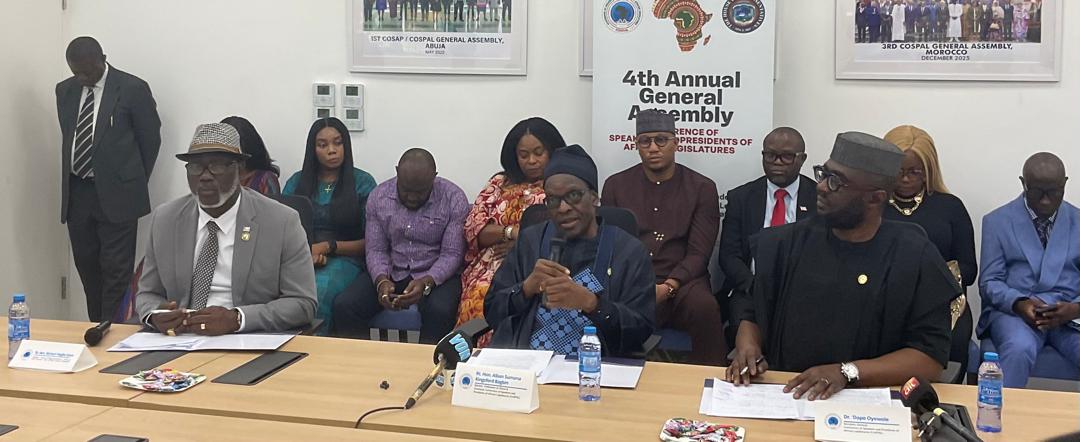
Bagbin, who spoke during a media briefing at the CoSPAL Secretariat in Abuja, maintained that Africa could not achieve a functional single market while national laws continued to obstruct the free movement of goods, services and capital.
He stressed that the African Continental Free Trade Area (AfCFTA) required more than political commitments and executive declarations, insisting that national parliaments must take the lead in harmonising legislation, eliminating conflicting regulations and establishing common standards to facilitate intra-African trade.
“The African Continental Free Trade Area cannot be delivered by executive declarations alone,” Bagbin said, advocating the adoption of common model laws by African legislatures to address legal inconsistencies and promote cross-border economic activities.
The AfCFTA, which became operational in 2021, seeks to progressively eliminate tariffs on most goods traded among participating African countries, reduce non-tariff barriers and establish a unified continental market to stimulate investment, industrialisation and regional value chains. However, regulatory differences, customs procedures and varying trade standards continue to impede its full implementation.
Bagbin also identified infrastructure connectivity as essential to the success of continental integration, noting that the free movement of goods and services would remain difficult without reliable regional transportation, energy and other cross-border networks.
Citing the West African Gas Pipeline and proposed regional gas and solar energy networks, he called for coordinated legislative action among participating countries to facilitate the implementation of such projects.
He said parliaments must provide the necessary legal frameworks, scrutinise public expenditure and ensure that investments in regional infrastructure deliver measurable benefits.
On parliamentary diplomacy, Bagbin highlighted CoSPAL’s intervention in Liberia during a legislative leadership impasse involving political parties and former Presidents Ellen Johnson Sirleaf and George Weah. He said the organisation’s mediation demonstrated the capacity of parliamentary engagement to resolve political disagreements and strengthen democratic institutions.
He also disclosed that CoSPAL was engaging on issues relating to parliamentary participation in Uganda.
Secretary-General of CoSPAL, Ambassador Dapo Oyewole, said the Monrovia assembly would examine broader issues, including security, transportation, aviation and connectivity, as part of efforts to strengthen Africa’s economic capacity and sovereignty.
Oyewole maintained that African countries must deepen regional partnerships and improve their capacity to harness domestic resources and markets rather than remain constrained by fragmented economies and dependence on external actors.
He disclosed that the meeting would culminate in the adoption of the Monrovia Declaration, following previous declarations at CoSPAL assemblies in Abuja, Rabat and Accra. The declaration is expected to outline further commitments towards strengthening legislative leadership and advancing Africa’s political, economic and institutional integration.
Oyewole also underscored the importance of parliamentary diplomacy in resolving disputes between African countries, recalling the 2020 trade disagreement between Nigeria and Ghana.
He said a three-day parliamentary mission to Accra, led by Femi Gbajabiamila, then Speaker of Nigeria’s House of Representatives, helped resolve the disagreement after diplomatic efforts at the executive level had stalled.
According to him, the intervention demonstrated how parliamentary leaders could provide alternative channels for dialogue and confidence-building when disagreements threaten trade and bilateral relations.
On institutional development, Oyewole said CoSPAL was implementing programmes to strengthen women’s representation, legislative capacity and leadership development across African parliaments.
He identified the Women’s Representation in African Parliaments (WRAP) initiative and the African Gender Legislative Agenda as key programmes aimed at promoting women’s participation in legislative institutions.
He also said the Legislative Mentorship Initiative, founded by Gbajabiamila, had expanded into a continental programme, with 50 fellows expected to graduate on Friday, bringing the total number of alumni to 268.
The initiative, he explained, was designed to develop a new generation of legislative professionals equipped with the expertise required for effective lawmaking, parliamentary administration and democratic governance.
Oyewole further disclosed that the CoSPAL Secretariat had established a legislative research and knowledge management network to facilitate the exchange of expertise and promote evidence-based lawmaking among African parliaments.
He added that the organisation had commenced work on artificial intelligence governance in legislatures, an emerging area with implications for parliamentary administration, legislative research, accountability and the regulation of new technologies.
Speaker of Liberia’s House of Representatives and host of the fourth CoSPAL General Assembly, Rt. Hon. Richard Nagbe Koon, said hosting the gathering would provide Liberia with an opportunity to showcase its investment potential, hospitality and commitment to continental cooperation.
Koon urged African countries to regard one another as strategic partners in trade, investment, innovation and development rather than merely neighbouring states.
He said the assembly would provide an important platform for strengthening relationships among African legislatures and creating opportunities for broader economic and institutional cooperation.
CoSPAL was established by Speakers of the parliaments of Nigeria, Senegal, Ethiopia, Kenya and Rwanda to provide a common platform for legislative leaders to exchange experiences, coordinate action and strengthen the contribution of parliaments to Africa’s development.
The organisation’s emergence reflects growing recognition that continental integration requires more than executive-level agreements, with national legislatures playing a critical role in translating regional commitments into domestic laws, providing oversight and holding governments accountable for implementation.
The Monrovia assembly is therefore expected to test the commitment of African parliamentary leaders to translating years of integration pledges into practical legislative reforms that will facilitate cross-border trade, improve infrastructure connectivity and deepen economic cooperation across the continent.