Russia and Nigeria have renewed efforts to deepen their economic, military, educational and diplomatic relations, with Moscow identifying investment, mineral exploration, technology transfer and local manufacturing as key areas for expanding bilateral cooperation.
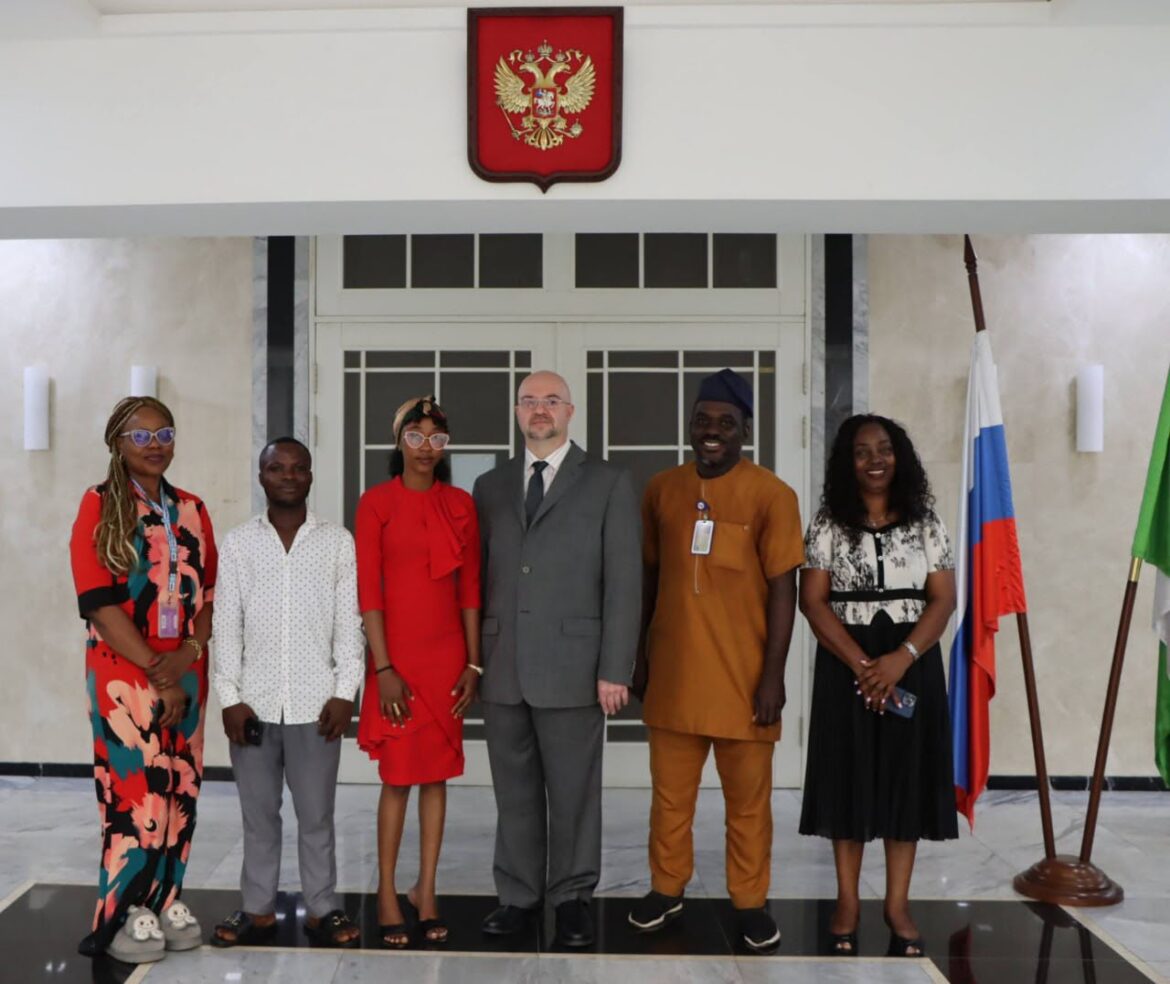
The Chargé d’Affaires of the Russian Embassy in Nigeria, Mr Igor Ivannikov, disclosed this during a press briefing in Abuja on the outcomes of the Third Russia-Africa Summit and activities marking the 66th anniversary of diplomatic relations between both countries.
Ivannikov said bilateral trade between Russia and Nigeria stood at between $1.2 billion and $1.4 billion in 2025, noting that economic relations remained below their full potential despite decades of diplomatic engagement.
He said both countries were exploring opportunities to expand cooperation in trade, geological exploration, rare earth minerals, industrial development, educational exchanges and security.
The briefing preceded the commemoration of 66 years of diplomatic relations on November 25, 2026, following the formal establishment of ties between both countries in 1960.
Reviewing the Third Russia-Africa Summit, held in Moscow on October 28 and 29, Ivannikov said the event attracted more than 3,500 participants from 48 African countries, including representatives of about 630 companies.
According to him, approximately 150 agreements were signed during the summit and its accompanying Economic and Humanitarian Forum, while participants adopted a Final Declaration, a Declaration on Cooperation in Artificial Intelligence and an Action Plan of the Russia-Africa Partnership Forum for 2027–2029.
He disclosed that Russia-Africa trade increased from approximately $18 billion in 2022 to more than $27 billion in 2025, representing an increase of about 50 per cent.
He added that Russian President Vladimir Putin had set a target of raising trade with African countries to $50 billion, stressing that Moscow was interested in supporting industrialisation through technology transfer, skills development, local manufacturing and domestic processing of natural resources.
Citing ongoing investments, Ivannikov mentioned the construction of Egypt’s El Dabaa Nuclear Power Plant by Rosatom, LUKOIL’s participation in African oil and gas projects and an agreement between Russian aluminium company RUSAL and Ghana’s GIADEC to explore opportunities in bauxite mining and processing.
He said such partnerships demonstrated Russia’s interest in promoting value addition and establishing production facilities within African countries rather than concentrating solely on extracting and exporting raw materials.
Food security and trade opportunities
On food security, the Russian diplomat said his country supplied more than 18 million tonnes of grain to African countries in 2025 and an additional 13 million tonnes in the first nine months of 2026.
He said Russia was also expanding fertiliser supplies and supporting food assistance programmes, including through the World Food Programme.
Ivannikov further highlighted opportunities for Nigerian exporters to access the Russian-led Eurasian Economic Union market, explaining that eligible Nigerian products could enjoy a 25 per cent reduction in standard customs duties.
Nigeria secures new cooperation agreements
On Nigeria’s participation in the summit, he said the country’s delegation was led by the Minister of State for Foreign Affairs, Ambassador Sola Enikanolaiye, and comprised approximately 250 participants.
He disclosed that several agreements and initiatives involving Nigeria were concluded or announced during the engagements.
Among them was an agreement on cooperation and mutual assistance in customs matters, covering information exchange, efforts to combat customs-related offences and professional training for customs personnel.
He also announced that the Roscongress Foundation signed an agreement with Abia State’s Ministry of Sports and Youth Development to strengthen cooperation between youth organisations, promote educational and entrepreneurial exchanges and facilitate participation in international events.
Additionally, Russian organisations Synergy and Innopraktika announced plans to establish 10 educational centres across Africa by the end of 2028, with Nigeria identified as one of the potential host countries.
2,481 Nigerians studying in Russia
On educational cooperation, Ivannikov disclosed that 2,481 Nigerians were enrolled in Russian universities during the 2025/2026 academic year.
He said Russia offered 220 government-funded university scholarship places annually to Nigerian students, covering tuition fees.
Across Africa, he said nearly 40,000 students were studying in Russian universities, while more than 300,000 Africans had graduated from Russian institutions over the years.
He added that Russia increased its scholarship allocation for African students from 4,800 in 2025 to 5,500 for the 2026/2027 academic year.
Russia seeks Nigerian investment in mining
Addressing economic relations, Ivannikov said Russia wanted to move beyond conventional commodity trading towards joint investment, technology transfer and local production.
He noted that the resumption of operations of the Russian Trade Representation in Abuja in 2024 had strengthened efforts to expand commercial relations.
According to him, geology and mineral exploration were emerging areas of cooperation, with Russian specialists already undertaking work on geological atlases of Nigerian regions.
He said discussions were also ongoing on opportunities in rare earth minerals, adding that Russia was interested in supporting Nigeria’s efforts to develop its mineral resources and industrial capacity.
Military and maritime security cooperation
The diplomat described military and military-technical cooperation as another important pillar of bilateral relations, identifying specialist training, professional exchanges and assistance in strengthening Nigeria’s security capabilities as priority areas.
He cited the recent visit of the Russian Baltic Fleet training ship, Perekop, to Lagos, during which Russian naval officials met with Nigerian Navy representatives and participated in joint manoeuvres with Nigerian forces.
He expressed hope that such engagements would continue, particularly in strengthening maritime security and safe navigation in the Gulf of Guinea.
Ivannikov also disclosed that Russia maintained military cooperation agreements with 45 African countries.
Russia supports stronger African representation
On international affairs, he reiterated Moscow’s support for greater African representation in the United Nations Security Council and other international institutions, including the World Bank and International Monetary Fund.
He said African countries should have a stronger voice in global decision-making, adding that regional crises should be addressed through solutions developed by African countries themselves.
He also identified Nigeria’s status as a BRICS partner country since January 2025 as another platform for strengthening cooperation between the two countries.
The diplomat also addressed allegations relating to the use of chemical weapons in the Ukraine conflict, rejecting accusations against Russia and calling for impartial investigations. He further raised concerns about reported Ukrainian activities in the Sahel, urging African governments to assess foreign partnerships based on their consequences for regional security.
66 years of diplomatic relations
Tracing the historical foundation of Russia-Nigeria relations, Ivannikov recalled that Soviet leader Nikita Khrushchev sent a congratulatory message to Nigeria’s Prime Minister, Tafawa Balewa, on October 1, 1960, welcoming the country’s independence and proposing diplomatic relations.
Formal diplomatic ties were subsequently established on November 25, 1960.
He noted that the Soviet Union supported Nigeria during significant national challenges, including the civil war, describing the historical relationship as an important foundation for mutual trust.
He also recalled high-level diplomatic engagements over the years, including former President Olusegun Obasanjo’s visit to Moscow, former Russian President Dmitry Medvedev’s visit to Abuja, former President Muhammadu Buhari’s participation in the First Russia-Africa Summit and Foreign Affairs Minister Yusuf Tuggar’s visit to Moscow in 2024.
Ivannikov expressed optimism that the 66th anniversary would provide fresh momentum for expanding trade, investment, educational opportunities, professional exchanges and humanitarian cooperation.
He commended individuals and institutions, particularly the media, for their contributions to strengthening understanding and promoting cooperation between Russia and Nigeria.