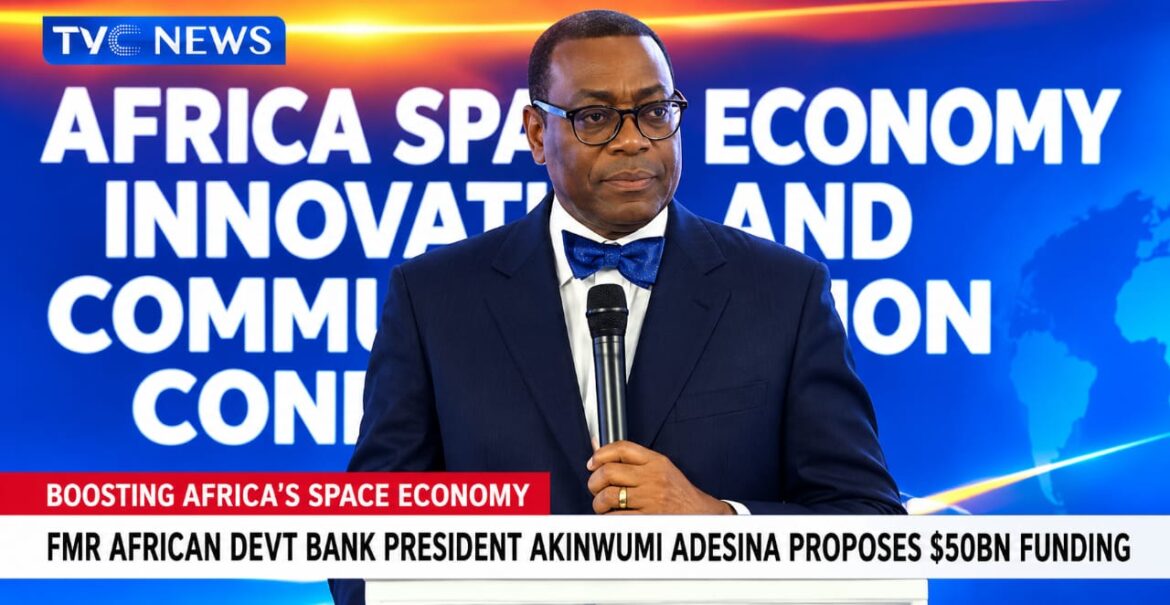
Former President of the African Development Bank (AfDB), Dr. Akinwumi Adesina, has urged President Bola Tinubu to spearhead a $50 billion continental investment initiative to develop Africa’s space economy and position the continent to benefit from the growing global space industry.
Adesina proposed the establishment of an Africa Space Future Fund, with an initial capitalisation target of $5 billion, to finance satellite infrastructure, scientific research, indigenous technology development and space-related businesses across the continent.
He made the proposal on Tuesday in Abuja while delivering a keynote address titled, “Financing Africa’s Space Future: Mobilising Capital for Space Science, Innovation and Technology,” at the Africa Space Economy, Innovation and Communication Conference organised by the Nigerian Space Research and Development Agency (NASRDA).
He called on Tinubu, alongside Rwandan President Paul Kagame and Egyptian President Abdel Fattah el-Sisi, to provide founding political leadership for the initiative by convening a presidential summit to secure investment commitments and establish an institutional framework for the proposed programme.
Adesina said Africa’s commercial space industry was gradually expanding, with 321 active commercial space companies operating across 36 African countries and generating approximately $373 million in revenue in 2024. However, he warned that the continent’s ambitions remained constrained by inadequate investment.
He compared the approximately $24.4 billion approved for the United States National Aeronautics and Space Administration (NASA) in 2026 with about $828 million in combined government space allocations across Africa, noting that the figures were not directly comparable but highlighted the continent’s significant investment deficit.
According to him, NASA’s funding alone was almost 30 times Africa’s combined public space allocation, underscoring the urgent need to mobilise capital for infrastructure, research and technological development.
The former AfDB president argued that Africa could not compete effectively in the global space industry while relying on fragmented national programmes and limited investment. He called for an integrated continental strategy capable of developing a commercially viable space ecosystem.
He commended Tinubu’s ambition to build a $1 trillion Nigerian economy and his approval of four new Nigerian satellites, describing the decision as evidence of the administration’s recognition of science, technology and innovation as drivers of economic transformation.
Adesina said the proposed fund would mobilise up to $50 billion in cumulative investments over 10 to 15 years, drawing contributions from African governments, sovereign wealth funds, development finance institutions, pension funds, insurance companies, private investors, international partners and the African diaspora.
The fund would prioritise satellite communications, low-Earth orbit broadband, Earth observation, ground stations and data infrastructure, while supporting scientific missions, university research and international partnerships.
It would also invest in African startups, satellite component manufacturers, artificial intelligence, robotics, sensors and emerging space businesses, with emphasis on African ownership, intellectual property development, technology transfer, indigenous innovation and local manufacturing.
Adesina stressed that the initiative must operate under independent governance, professional investment management, rigorous due diligence and transparent accountability to prevent political patronage and ensure sustainable returns.
“This is not a request for charity. It is an investment proposition,” he said, pointing to Africa’s growing demand for connectivity, agricultural intelligence, climate information, geospatial services and digital infrastructure as commercially viable opportunities.
He proposed that Tinubu, Kagame and el-Sisi convene a Founding Presidential Summit on Financing Africa’s Space Future to secure political endorsement, mobilise initial investment commitments and establish the institutional framework for the initiative.
The proposed partnership, he said, could leverage Nigeria’s growing commitment to space technology, Rwanda’s experience in technology-driven development and innovation, and Egypt’s established space infrastructure and role as host of the African Space Agency.
Adesina also called for the establishment of a high-level continental task force, working with the African Union and the African Space Agency, to develop the fund’s legal, institutional and financial framework, identify founding investors and prepare a roadmap for raising the initial $5 billion.
A key component of the proposed fund would be Africa Link, a flagship continental programme designed to aggregate demand across African markets, develop shared ground infrastructure and establish strategic partnerships with international satellite operators to expand affordable and reliable satellite connectivity.
He said pooling demand and coordinating infrastructure investments would enable African countries to reduce costs, achieve economies of scale and strengthen their participation in the global space economy.
However, he cautioned against a future in which Africa remained entirely dependent on satellite networks owned and controlled by foreign companies, insisting that international partnerships must promote technology transfer, skills development and greater African participation in satellite network operations.
“We must move from renting the infrastructure of the digital future to owning a meaningful share of it,” he said, adding that Africa did not need to immediately replicate existing global satellite constellations but must begin building the capacity to compete and collaborate.
Adesina highlighted the potential of space technology to transform agriculture, food security, telecommunications, climate resilience, disaster management, infrastructure development and natural resource management.
He recalled how satellite imagery, remote sensing and vegetation data helped the Nigerian government assess the impact of devastating floods and develop a national dry-season agricultural programme that helped avert a predicted food crisis during his tenure as Minister of Agriculture in 2012.
He said the experience demonstrated how space-generated information could protect livelihoods, strengthen food security and support evidence-based public policy.
The former AfDB president advocated blended finance, African Space Bonds, public-private partnerships, venture capital and international development finance to fund the continent’s space ambitions.
He said governments should use public investment strategically to attract private capital, while long-term contracts for agricultural monitoring, disaster management and connectivity services could provide predictable revenue streams for commercially viable space infrastructure projects.
Adesina maintained that Africa’s ambition must extend beyond launching satellites to building industries, businesses and technological capabilities that would generate long-term economic value.
He identified satellite manufacturing, sensors, communication equipment, ground systems, artificial intelligence, robotics, software development and data analytics as strategic areas in which African companies should develop indigenous capabilities.
Urging Tinubu to extend his economic vision to Africa’s aspirations in space science and technology, Adesina drew inspiration from former United States President John F. Kennedy’s commitment to landing a man on the Moon.
“Mr. President, like John F. Kennedy, dare to dream big,” he said.
He challenged Tinubu to take Nigeria’s ambitions beyond terrestrial economic transformation, declaring: “Mr. President, you conquered the Atlantic! With your vision and boldness, why stop there? Now, Mr. President, conquer space!”
Adesina expressed optimism that an African would one day walk on the Moon, adding that he hoped the historic achievement would be made by a Nigerian.
He called for sustained investment in universities, scientific research institutions, young innovators and technological infrastructure to develop a globally competitive African space industry.
He said Africa must move beyond consuming space technology to creating space wealth, importing technologies to developing and exporting them, and fragmented national programmes to building an integrated continental space economy.
He encapsulated the ambition in three words: “OWN. CREATE. EXPORT.” “The sky must be our starting point,” Adesina declared, insisting that the time for Africa to invest, collaborate and build its future in space was now.