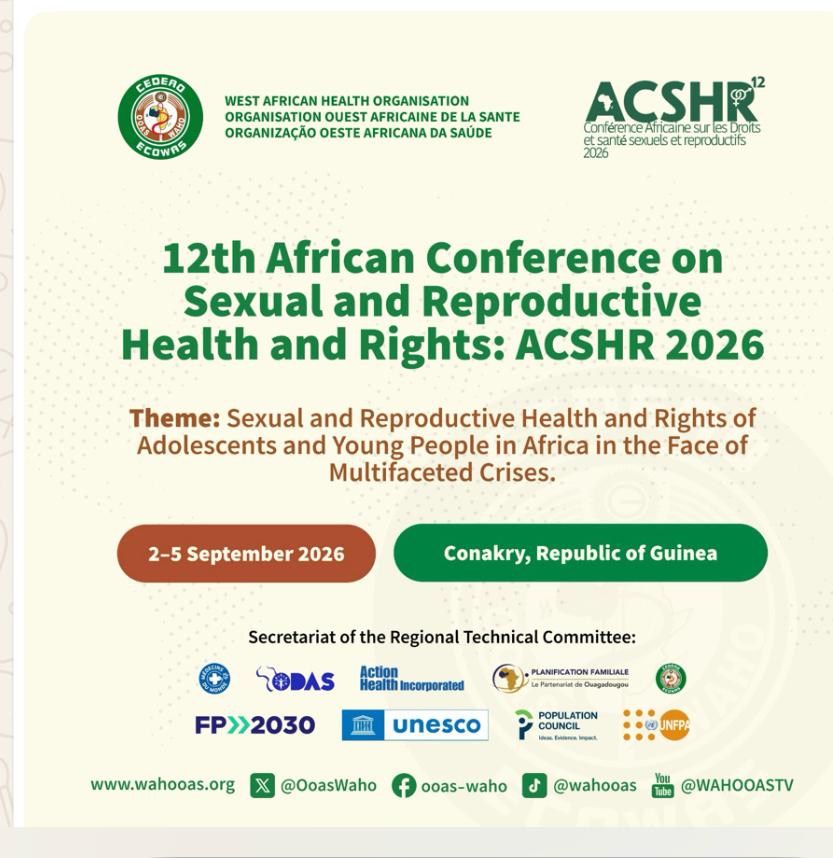
More than 500 policymakers, health experts, parliamentarians, youth leaders and civil society organisations from over 30 African countries will gather in Conakry, Guinea, this September for the 12th African Conference on Sexual and Reproductive Health and Rights (ACSHR 2026), as the continent confronts a worsening funding crisis threatening the health and wellbeing of millions of young people.
The four-day summit, scheduled for September 2 to 5, will serve as a high-level platform for governments, development partners, researchers, United Nations agencies and youth advocates to develop new strategies for strengthening sexual and reproductive health and rights (SRHR) across Africa amid shrinking donor support and growing humanitarian challenges.
Held under the theme, “Sexual and Reproductive Health and Rights of Adolescents and Young People in Africa in the Face of Multifaceted Crises,” the conference comes as many African countries struggle to sustain critical health programmes following significant cuts in international development assistance. The situation has been compounded by armed conflicts, climate change, disease outbreaks and economic instability, all of which continue to deepen inequalities affecting adolescents and young people.
Organisers said the conference would bring together ministers, legislators, public health institutions, researchers, international development agencies, women’s organisations, youth networks and community-based groups to develop practical solutions for protecting and expanding access to reproductive health services despite the continent’s multiple crises.
Central to the discussions will be strategies for securing sustainable financing for reproductive health programmes, expanding access to family planning and maternal healthcare, promoting comprehensive sexuality education, improving menstrual health management, preventing gender-based violence and strengthening youth participation in policy formulation and implementation.
Delegates are also expected to address growing concerns over anti-rights movements that threaten sexual and reproductive freedoms, while exploring ways to ensure uninterrupted delivery of essential health services during humanitarian emergencies, including armed conflicts and climate-induced disasters that have displaced millions of people across Africa.
According to the organisers, the steady decline in external funding has intensified pressure on African governments to increase domestic investment in healthcare and build resilient health systems capable of meeting the needs of the continent’s rapidly expanding youth population.
With Africa home to the world’s fastest-growing youth population, experts have repeatedly stressed that sustained investment in adolescent health, education and empowerment remains essential to unlocking the continent’s demographic dividend. They warn that failure to prioritise these investments could result in rising maternal mortality, increased teenage pregnancies, unsafe abortions, higher school dropout rates and worsening youth unemployment.
The Conakry conference will also highlight successful initiatives from across Africa that have expanded youth-friendly health services, strengthened community engagement and improved access to reproductive healthcare in fragile and hard-to-reach communities.
For more than two decades, the African Conference on Sexual and Reproductive Health and Rights has served as the continent’s leading platform for dialogue on reproductive health policy. Established under the auspices of the African Federation for Sexual Health and Rights, the conference rotates among African countries, bringing together governments, academia, civil society organisations and development partners to develop evidence-based policies and strengthen regional collaboration.
Previous editions have addressed issues including family wellbeing, demographic dividend, bodily autonomy, gender equality and universal access to reproductive healthcare, with recommendations contributing to policy reforms across several African countries.
As Africa grapples with unprecedented demographic growth alongside complex health, economic and humanitarian pressures, stakeholders are expected to use the Conakry summit to secure concrete commitments on domestic health financing, deepen regional cooperation and place young people at the centre of efforts to build healthier, more inclusive and sustainable societies.