President Bola Tinubu has voiced concerns over the escalating deforestation in Africa, primarily driven by subsistence and commercial agriculture. He emphasized the urgent need for ambitious regional actions to balance food security with sustainable forest management.
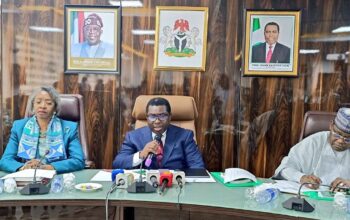
Speaking at the 1st International Conference on Afforestation and Reforestation in Brazzaville, Congo, President Tinubu, represented by the Minister of Environment, Balarabe Lawal, highlighted the significance of this historic gathering. “It gladdens my heart that the first ever International Conference on Afforestation and Reforestation is taking place right here in Africa where more than 15% of the world’s greenhouse gas emissions occur. This marks a significant milestone in our collective efforts to address one of the most pressing environmental challenges of our time,” Tinubu said. He stressed the importance of forests, which cover nearly 31% of the world’s land area, in maintaining ecological balance, preserving biodiversity, and supporting millions of livelihoods.
Quoting a report from the Food and Agriculture Organisation of the United Nations (FAO), Tinubu noted that nearly 4 million hectares of African forests are being cut down annually, almost double the world’s deforestation average. Factors contributing to this loss include increasing population, indiscriminate land expansion for agriculture, rapid urbanization, social needs, and illegal logging.
“About 70% of deforestation in Africa is due to subsistence and commercial agriculture. Therefore, urgent and ambitious regional action is needed to strike a balance between food security and sustainable forest management,” Tinubu added. He emphasized the appropriateness of Congo as the conference venue, considering Africa’s significant contribution to global deforestation.
The conference aims to bring together leading experts, policymakers, researchers, and practitioners to share knowledge, exchange ideas, and foster collaborations. The goal is to develop and implement innovative and scientific strategies for afforestation and reforestation, which will restore degraded lands, enhance biodiversity, and mitigate climate change impacts.
Tinubu also highlighted Nigeria’s progress in reversing forest cover loss through sustainable forest management and massive afforestation efforts. He announced the approval of $8.5 million under the Presidential Initiative on Afforestation for restoring degraded forests and critical landscapes. This is in addition to other programs like the Great Green Wall Pan African Program and Agro-Climatic Resilience Semi-Arid Landscape (ACReSAL), which have restored over 1.5 million hectares of degraded forests, established over 1,428.9 km of shelter belts, empowered more than 200,000 forest community members, and created over 3 million jobs.
Tinubu noted that Nigeria has strengthened its policy and legislative framework in response to current and emerging challenges. An interim suspension on the export of wood-based products has been placed to enable an adequate appraisal of the process and ensure sustainable forest management.
“Nigeria remains committed to global, regional, and sub-regional consensus to promote and accelerate progress on sustainable forest management. This includes the COP27 Africa and Global Decade of Afforestation and Reforestation and COP26 Glasgow Leaders’ Declaration on Forests and Land Use, as well as other key outcomes of COP28,” Tinubu stated. He called for collective efforts from governments, NGOs, corporate/private organizations, civil societies, and communities to achieve the common goal of increasing global forest cover.