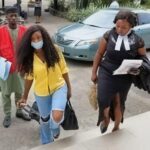
The Community Court of Justice, ECOWAS, has ruled that Nigeria violated the human rights of Obianuju Catherine Udeh and two others. The Court found Nigeria in breach of Articles 1, 4, 6, 9, 10, and 11 of the African Charter on Human and Peoples’ Rights (ACHPR), relating to the right to life, security of person, freedom of expression, assembly and association, prohibition of torture, duty of the state to investigate, and the right to effective remedy.
Applicants Obianuju Catherine Udeh, Perpetual Kamsi, and Dabiraoluwa Adeyinka alleged these violations occurred during peaceful protests at the Lekki Toll Gate in Lagos State on October 20 and 21, 2020. Justice Koroma Mohamed Sengu, delivering the judgment, dismissed the allegation of a violation of the right to life under Article 4 of the ACHPR. However, he ordered the Respondent to pay each Applicant N2 million as compensation for violations of their security of person, prohibition of torture and cruel, inhuman, and degrading treatment, rights to freedom of expression, assembly, and association, duty to investigate human rights violations, and right to effective remedy.
The Respondent must also adhere to its obligations under the ACHPR, investigate and prosecute its agents responsible for these violations, and report to the Court within six months on the measures taken to implement this judgment.
The Applicants detailed their experiences during the protests against the SARS Unit of the Nigerian Police Force. The First Applicant live-streamed the events, showing soldiers shooting protesters, resulting in deaths and injuries. She subsequently received threatening phone calls, forcing her into hiding and eventual asylum. The Second Applicant, responsible for protesters’ welfare, was hospitalized due to police tear gas after soldiers began shooting following a power cut. The Third Applicant narrowly escaped being shot and witnessed the refusal of ambulance entry by soldiers and inadequate hospital care for victims. She and her colleagues took over the victims’ care, facing ongoing threats and surveillance, allegedly by Respondent’s agents. They sought declaratory reliefs and compensation from the Court for these violations.
The Respondent denied all claims, asserting that the protesters unlawfully assembled at Lekki Toll Gate under the guise of protesting against SARS and that its agents followed strict rules of engagement. It argued that the First Applicant incited the crowd and that the Second Applicant’s logistical support indicated her backing for the protest. The Respondent maintained that soldiers were present to restore peace until police arrived, denying any harm to protesters and the refusal of ambulance access. It also denied that the Third Applicant’s presence was peaceful, asserting it was meant to escalate violence. The Respondent argued that the treatment and care of the injured were managed by the Lagos State government and that the Applicants did not provide credible evidence to support their claims or reliefs sought.
The Court found no violation of the right to life as the Applicants filed their claims in vitam. However, it held that several ACHPR articles were breached, resulting in fundamental human rights violations. The Court declared that the Applicants were denied the right to an effective remedy and ordered the Respondent to make reparations for the violation of their fundamental human rights.
The judgment was delivered by a three-member panel including Honourable Justices Dupe Atoki (presiding) and Ricardo Cláudio Monteiro Gonçalves.