
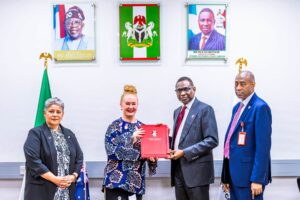
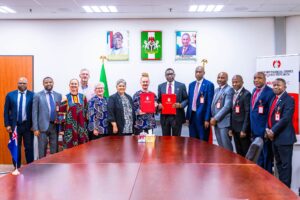
The Economic and Financial Crimes Commission (EFCC) and the Australian Federal Police (AFP) have signed a Memorandum of Understanding (MoU) to strengthen cooperation in combating cybercrime and other transnational financial crimes.
The agreement was signed on Wednesday, November 4, 2026, at the EFCC headquarters in Jabi, Abuja.
Speaking at the ceremony, Australian High Commissioner to Nigeria, Leilani Bin-Juda, commended EFCC Chairman, Ola Olukoyede, and officers of the commission for their longstanding cooperation with the Australian Federal Police.
She said Nigeria and Australia had maintained productive bilateral relations through the exchange of technology, intelligence and professional expertise, noting that the collaboration had contributed significantly to relations between both countries.
Bin-Juda described cybercrime as a global challenge requiring collective action, adding that Nigeria plays a strategic leadership role in addressing cyber-related threats across the region.
“Cyber matters are affecting many countries, and Nigeria is one of those leading countries in the region. Other African countries look to Nigeria for leadership in this aspect,” she said.
Also speaking, Assistant Commissioner of the Australian Federal Police, Sandra Booth, described the MoU as a significant milestone in strengthening the relationship between the two law enforcement agencies.
She disclosed that the partnership, which dates back to 2004, had recorded notable achievements in sensitive investigations, cyber-enabled crimes, business email compromise, financial investigations and scams.
Booth expressed optimism that the agreement would create fresh opportunities for collaboration, professional development and the exchange of expertise.
She said the MoU would provide a clearer framework for sustained cooperation and mutual support, describing it as the next phase in the evolving relationship between both institutions.
In his remarks, EFCC Chairman Olukoyede thanked the Australian Government and the AFP for their confidence in Nigeria and the commission.
He emphasised the importance of international cooperation in tackling financial crimes, noting that criminal networks increasingly operate across national borders.
“Financial crimes take a transnational dimension. What affects Nigeria inevitably affects Australia. That is why countries have to come together because criminals always work together,” he said.
Olukoyede stressed that effective law enforcement requires countries to establish collaborative networks capable of countering organised criminal networks operating across jurisdictions.
He explained that the MoU would formalise the existing relationship between the EFCC and AFP and provide a structured framework for cooperation in training, manpower development, mutual assistance, and information and intelligence sharing, subject to the domestic laws of both countries.
According to him, the partnership would benefit both countries regardless of where criminal activities originate or where perpetrators operate.
The ceremony also featured the presentation of awards by the Australian Federal Police to four EFCC officers in recognition of their investigative skills, professionalism and dedication during a complex and prolonged investigation.
The award recipients were Assistant Commander of the EFCC II, Abba Sambo Usman; Assistant Commander of the EFCC II, Olufemi Olukinni; Assistant Commander of the EFCC II, Omewa Pius Nnaemeka; and Inspector of the EFCC I, Owolabi Jude Oyarekhua.