The Economic and Financial Crimes Commission (EFCC) on Wednesday presented its seventh prosecution witness in the ongoing trial of Mr. Friday Audu, alleged ringleader of a 792-member cryptocurrency investment and romance scam syndicate, before the Lagos State Special Offences Court sitting in Ikeja.
Mr. Audu is standing trial alongside Genting International Ltd on an amended eight-count charge bordering on forgery, impersonation, possession of fraudulent documents and computer-related fraud. The case is being heard by Justice Rahman Oshodi.
At the resumed proceedings on January 14, 2026, the EFCC called Rasheedah Chindaya, an operative of the commission attached to the Eagle Flush Committee Operations, as Prosecution Witness Seven (PW7). Led in evidence by EFCC counsel, Bilikisubl Buhari, the witness detailed investigations that allegedly uncovered a sophisticated cybercrime network coordinated by Audu, culminating in the arrest of 792 suspects in December 2024.
Chindaya told the court that Genting International Ltd was initially incorporated with Nasiru Barau and Yakubu as directors, contributing ₦10 million and ₦18 million in share capital respectively. She said both were removed in 2025 and replaced by Ifeanyi, who held ₦12 million in shares, and Matthew, with ₦18 million.
According to the witness, Genting was presented as a gaming company, but investigations revealed that the Bank Verification Number (BVN) linked to its bank accounts matched that of Audu. She added that the same BVN was connected to about 10 corporate accounts involving multiple vendors.
The witness further testified that Genting had financial links with other companies, including YENGJIEPENG, BT8 Housing Nigeria Limited and BNN Construction Limited. Letters of investigation to banks, she said, confirmed that Genting operated accounts with balances running into billions of naira, at one point peaking at about ₦34 billion.
“Some inflows were traced to Bureau De Change operators and entities such as Truly Reality and Garuba,” Chindaya told the court. She added that Truly Reality was linked to one Chukwuemeka Okeke, who was also connected to Audu, noting that Audu was the sole signatory to Genting’s bank accounts.
She identified several documents obtained from banks, including a request for an increase in Genting’s transaction limit and a board resolution appointing Audu as sole signatory. According to her, funds from Genting’s accounts were routinely transferred to BDC operators for conversion into USDT cryptocurrency through digital wallets.
“One such wallet, created in May 2024 and last used in October 2024, allegedly received about ₦97 million traced to proceeds of earlier fraud and later transferred to Genting’s Union Bank account,” she said. She also testified that Audu personally received about ₦74 million, which was paid into his personal account and traced to his FCMB account, adding that the funds were allegedly used to furnish his office, purchase furniture and diesel, and cover other expenses.
Chindaya also gave evidence concerning another gaming company, Anhongs, whose account was opened in August. She stated that Audu was the sole signatory and that Genting’s email address was used for its operations. The company, she said, was linked to a suspect arrested at an address on Jolayemi Street, Lagos.
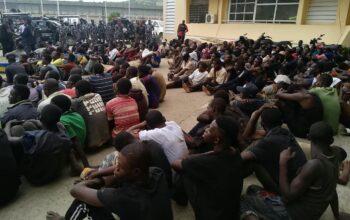
Describing the scale of the December 2024 operation, the witness told the court that 792 suspects were arrested, including 193 foreigners—comprising 145 Chinese nationals, about 40 Filipinos, a Tunisian and others—and 599 Nigerians, mostly youths aged 27 and above. She said Nigerians and foreigners were recruited separately, with Nigerians sourced through social media advertisements requiring fast typing skills.
According to her testimony, recruits were trained as scammers, marketers and supervisors using prepared scripts to defraud victims, primarily through dating platforms such as Tinder. Victims were persuaded to make payments on fake websites and subsequently blocked, while those willing to pay more were handed over to foreign operators.
She said Nigerian recruits earned between ₦200,000 and ₦800,000 monthly, while foreign recruits earned between $500 and $1,000. Accommodation and transportation were allegedly provided, and some Nigerians who attempted to withdraw from the scheme were threatened with non-payment of salaries.
Chindaya told the court that several properties linked to Genting were discovered across Lagos, including offices in Victoria Island, Lekki and Bishop Oluwole Street. One of the properties, a six-unit building on Oniru Island, was allegedly paid for in two tranches at Genting’s instance, with Audu acting as guarantor using a Banana Island address later traced to one of the alleged syndicate kingpins.
She identified the alleged kingpins as Ken, Sentu (currently at large), Sim (also at large) and Friday Audu. The witness further stated that investigations revealed meetings held before Genting’s incorporation to plan its operations, adding that documents purportedly signed by former directors Yakubu and Nasiru did not bear their genuine signatures.
She also disclosed that investigators uncovered 384 pre-registered SIM cards traced to individuals in Northern Nigeria who denied any knowledge of the registrations. Describing the case as unprecedented in the history of the EFCC, Chindaya said officers were mobilised from multiple zonal offices, with some offices converted into temporary holding facilities to accommodate suspects.
Justice Oshodi adjourned the case to February 24 and 26, 2026, for continuation of trial.