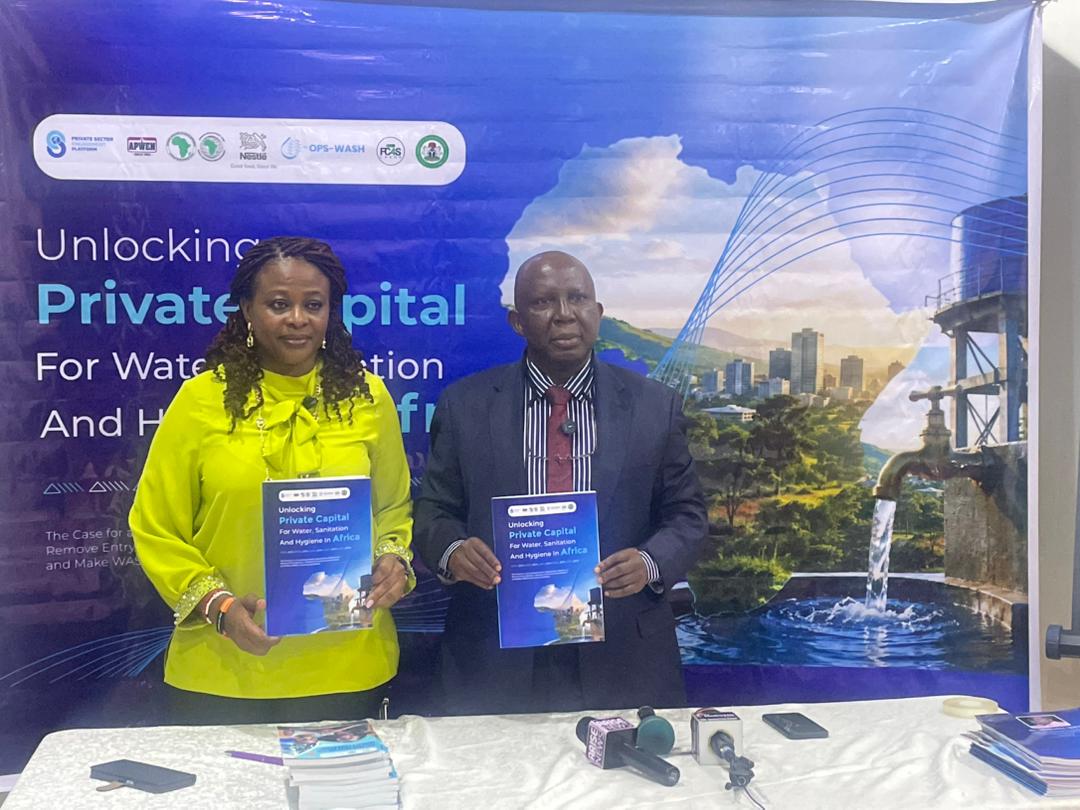
Development experts and stakeholders in Africa’s Water, Sanitation and Hygiene (WASH) sector have called for a comprehensive restructuring of the financing framework governing water and sanitation services, arguing that the continent’s infrastructure challenges stem more from institutional weaknesses than from a lack of funding.
The position is outlined in a concept note proposing the creation of a Private Sector Engagement Platform (PSEP) under the WASH Finance Foundation. The initiative is designed to strengthen collaboration between governments, investors and technical partners while facilitating greater private sector participation in the delivery of water and sanitation infrastructure.
According to the document, despite significant progress in technology, engineering and development financing, more than 600 million people across Africa still lack access to safe and reliable water supplies, while nearly twice that number remain without basic sanitation services.
The authors contend that the sector’s shortcomings are not primarily the result of insufficient capital or technical expertise, but rather the absence of effective institutional structures capable of converting available resources into sustainable and bankable infrastructure projects.
“The gap is not a funding problem. It is an architecture problem,” the concept note stated, noting that capital, technology and political will often remain disconnected by weak regulatory systems, inadequate investment frameworks and the lack of commercially viable market conditions.
The report emphasized that achieving Sustainable Development Goal 6 (SDG 6), which seeks universal access to safe water and sanitation by 2030, will require an estimated $114 billion in annual global investment—an amount far beyond the capacity of traditional donor funding and official development assistance.
As a result, the document argues that mobilising private investment has become essential if African nations are to meet growing demand for water and sanitation services.
Nigeria was highlighted as one of the continent’s most promising yet underutilised markets, with its sanitation economy projected to reach $26 billion by 2030. However, the report noted that regulatory uncertainty, weak revenue systems and limited risk mitigation mechanisms continue to deter investors.
To address these challenges, the proposed Private Sector Engagement Platform would serve as an independent coordinating institution focused on developing bankable projects, standardising investment frameworks and facilitating partnerships among governments, financiers and private operators.
The concept note draws parallels with sectors such as telecommunications, energy, healthcare and affordable housing, where clear regulatory policies and commercially viable business models have successfully attracted substantial private capital.
Africa’s telecommunications sector was cited as a notable example of successful reform-driven investment. According to the report, governments enabled private participation not by building networks directly, but by creating transparent regulatory environments, predictable licensing systems and enforceable contractual arrangements.
“Governments did not build the networks. They built the conditions within which private capital built the networks,” the document observed.
The report also referenced South Africa’s renewable energy programme, which attracted billions of dollars in investment through standardised contracts and transparent procurement processes, demonstrating how institutional reforms can unlock long-term infrastructure financing.
By contrast, the WASH sector continues to depend heavily on donor-funded interventions, many of which struggle to remain sustainable after external funding cycles end.
The authors warned that without significant reforms, communities across Africa would continue to face a recurring cycle in which water and sanitation facilities deteriorate once donor support is withdrawn.
Among the key obstacles discouraging private sector participation, the report identified weak utility finances, unreliable revenue streams, politically controlled water tariffs, regulatory uncertainty and the absence of effective risk-sharing mechanisms.
It noted that investors are often reluctant to commit capital to water and sanitation projects because of the lack of reliable off-takers capable of guaranteeing predictable returns over the long investment periods typically associated with infrastructure development.
The report concluded that the future of Africa’s water and sanitation sector will depend less on securing additional donor funding and more on building the institutional and regulatory architecture required to attract and sustain private investment.
According to the authors, failure to establish commercially viable investment frameworks could undermine efforts to achieve universal access to safe water and sanitation across the continent.
“The engineering is ready. The political commitments exist. The financial instruments are available. The private sector is willing. What has been missing is the institution that connects them,” the document stated.