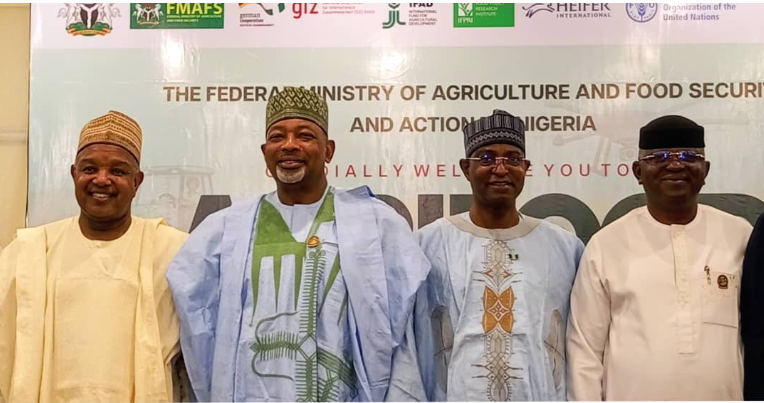
The Federal Government has launched an ambitious 10-year Agrifood System Strategy and Action Plan aimed at transforming Nigeria’s agricultural sector into a resilient, value-driven and inclusive engine of economic growth, food security and job creation.
The strategy, unveiled in Abuja on July 23, 2026, provides Nigeria’s framework for implementing the African Union’s Comprehensive Africa Agriculture Development Programme (CAADP) Kampala Declaration (2026–2035), with government officials describing it as a major shift from production-focused agriculture to a comprehensive agrifood system that promotes value addition, investment and sustainable development.
Speaking at the Agrifood System Working Group Meeting, the Minister of Agriculture and Food Security, Senator Abubakar Kyari, said the new roadmap was designed to tackle the structural challenges that have long constrained Nigeria’s agricultural potential.
He described the agrifood sector as the backbone of the nation’s economy, supporting the livelihoods of more than 70 per cent of Nigerians, driving rural economies, contributing significantly to the Gross Domestic Product (GDP), and offering vast opportunities for employment, foreign exchange earnings and inclusive growth.
“When our agrifood system thrives, Nigeria thrives,” Kyari said, stressing that the country must move beyond conventional agricultural interventions to build a modern, competitive and resilient food system.
The minister said President Bola Ahmed Tinubu directed the development of the 10-year strategy in recognition of food security as a national security priority, adding that the plan seeks to replace fragmented agricultural programmes with a coordinated, bankable and implementable roadmap for long-term transformation.
According to him, the strategy aligns with the CAADP Kampala Declaration, which builds on the African Union’s earlier Maputo and Malabo Declarations but places greater emphasis on value chain development, resilience, governance, inclusivity and sustainable food systems.
Kyari identified governance as the cornerstone of the new framework, noting that sustainable agricultural development depends on strong institutions, effective coordination, policy consistency, reliable data and accountability.
He said strengthening governance would enable Nigeria to improve production, attract investment, enhance food security and build resilience against emerging challenges, including climate change.
The International Fund for Agricultural Development (IFAD) described Nigeria’s adoption of the strategy as a landmark achievement, noting that the country had become the first in Africa to develop a national strategy and action plan for domesticating the CAADP Kampala Declaration.
According to IFAD, the achievement demonstrates Nigeria’s commitment to translating continental agricultural commitments into concrete national action while providing a model that other African countries can emulate.
The development agency commended the Federal Ministry of Agriculture and Food Security, development partners, private sector stakeholders, research institutions, farmers’ organisations, women and youth groups for their contributions to the development of the strategy.
A key pillar of the framework is its emphasis on inclusive agricultural development, with smallholder farmers, women, young people and rural communities identified as central beneficiaries of future investments and policy interventions.
The strategy also integrates climate resilience, nutrition, gender equality, youth empowerment, disability inclusion and support for internally displaced persons as critical components of Nigeria’s long-term agricultural development agenda.
Another major focus is digital transformation, with IFAD highlighting the role of digital technologies in improving agricultural productivity through farmer registration systems, climate advisory services, electronic extension platforms, digital finance, market information systems and data-driven decision-making.
The Federal Government also outlined ongoing initiatives aimed at strengthening agricultural value chains, including financing support for smallholder farmers through the Bank of Agriculture’s Smallholder Financing and Value Chain Fund, distribution of improved seeds and fertilisers, implementation of a Guaranteed Minimum Price mechanism and expanded farmer support programmes.
Other interventions include the establishment of Special Agro-Industrial Processing Zones to promote agro-processing closer to production centres, agricultural mechanisation programmes involving tractors and modern equipment, and renewed efforts to revive Nigeria’s cocoa industry through improved seedlings.
The government believes that expanding agro-processing and value addition will enable Nigeria to reduce exports of raw agricultural commodities, increase farmers’ incomes and enhance the sector’s contribution to economic growth.
Despite the optimism surrounding the initiative, stakeholders acknowledged that implementation will determine the success of the ambitious roadmap.
Kyari said the Agrifood System Working Group would provide strategic oversight, monitor implementation, identify policy gaps and strengthen collaboration among government agencies, development partners, academia, farmers’ associations and civil society organisations.
IFAD also stressed that the strategy’s success would depend on sustained political commitment, adequate financing, coordinated implementation, strong accountability mechanisms and continuous stakeholder engagement.
With the launch of the 10-year Agrifood System Strategy and Action Plan, the Federal Government is seeking to position agriculture as a major driver of food security, industrial development, employment and economic diversification, while the coming decade is expected to test the country’s ability to translate ambitious policy into measurable results.