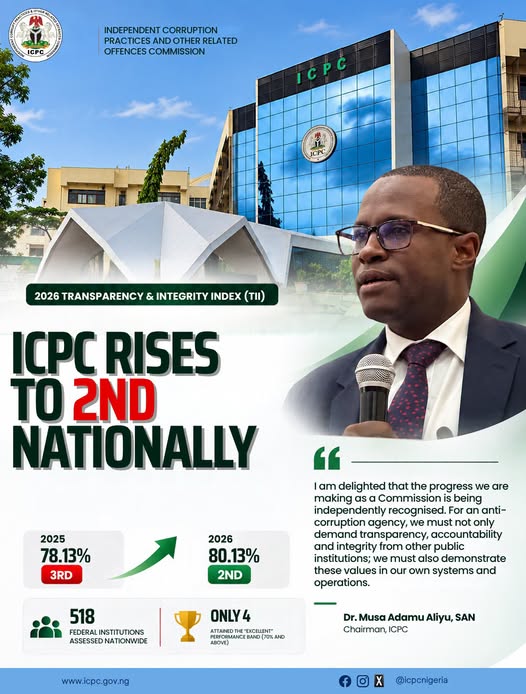
The Independent Corrupt Practices and Other Related Offences Commission (ICPC) has emerged as Nigeria’s second-most transparent federal public institution in the 2026 Transparency and Integrity Index (TII), recording a score of 80.13 per cent.
The assessment, conducted by the Centre for Fiscal Transparency and Public Integrity (CeFTPI), ranked the anti-corruption agency second among 518 federal institutions evaluated nationwide. ICPC was also among only four institutions that attained the Index’s “Excellent” performance band of 70 per cent and above.
The latest result represents an improvement on the Commission’s 2025 performance, when it scored 78.13 per cent and ranked third among 575 institutions assessed. Its score increased by two percentage points in 2026, moving it up one position nationally.
Reacting to the assessment, ICPC Chairman, Dr Musa Adamu Aliyu, SAN, said the result was an encouragement to sustain and deepen the institutional reforms and transparency measures being implemented by the Commission.
Aliyu said anti-corruption agencies must demonstrate the standards of transparency, accountability and integrity they demand from other public institutions.
“I am delighted that the progress we are making as a Commission is being independently recognised. For an anti-corruption agency, we understand that we must not only demand transparency, accountability and integrity from other public institutions; we must also demonstrate these values in our own systems and operations,” he said.
The ICPC chairman, however, said the Commission would not become complacent, stressing that management would examine its performance across the various thematic areas covered by the Index and strengthen areas requiring further improvement.
“This rating is an encouragement for us to do more. We will carefully examine our performance across all the thematic areas, identify where improvements are required and strengthen the necessary systems,” Aliyu said.
He added that the Commission’s objective was to achieve an even stronger performance in the 2027 assessment while maintaining high standards of transparency and integrity in its operations.
Aliyu commended ICPC management and staff for their contribution to the achievement and urged them to regard the rating as an incentive to further strengthen accountability, professionalism and ethical conduct in the discharge of the Commission’s mandate.
The 2026 assessment also highlighted the generally low level of transparency across the federal public sector. Of the 518 institutions assessed, only eight scored above 50 per cent, while just four attained the “Excellent” benchmark of 70 per cent and above.
The Transparency and Integrity Index evaluates public institutions on several indicators, including disclosure of financial information, procurement and contracting processes, human resources, anti-corruption measures and mechanisms for citizen engagement.
It also examines the availability of budget and financial records, recruitment and staff information, anti-corruption and whistleblowing policies, as well as mechanisms through which citizens can access information and participate in public processes.
ICPC’s latest performance continues an upward trajectory in the annual assessment. In 2025, the Commission ranked third with 78.13 per cent, behind the National Oil Spill Detection and Response Agency (NOSDRA) and the Nigerian Investment Promotion Commission (NIPC). Its improved 80.13 per cent score in 2026 elevated it to second position.
The result also reinforces the Commission’s emphasis on leading by example in the fight against corruption through strong internal systems, transparency, accountability and ethical institutional practices.
The 2026 Transparency and Integrity Index was unveiled in Abuja on Monday, September 28, 2026, in the presence of the Secretary to the Government of the Federation, Senator George Akume; Director-General of the Bureau of Public Service Reforms, Dasuki Ibrahim Arabi; and representatives of government institutions and civil society organisations.
CeFTPI established the Transparency and Integrity Index in 2021 as an annual evidence-based assessment of public institutions, focusing on proactive disclosure, accountability, citizens’ access to information and institutional mechanisms for preventing corruption.