The International Labour Organization (ILO), in partnership with the Federal Government and the Government of France, has launched the second phase of the Social Dimension of Ecological Transition Project, an ambitious programme aimed at translating Nigeria’s climate commitments into tangible action by creating green jobs, protecting workers and driving inclusive economic growth.
The initiative, unveiled on Thursday at the United Nations House in Abuja, marks a transition from policy formulation to implementation as Nigeria intensifies efforts to align climate action with employment generation, social protection and sustainable development.
Scheduled to run until 2029, the project brings together government ministries, labour unions, employers’ organisations, climate institutions and development partners to implement Nigeria’s Just Transition Guideline and Action Plan while accelerating the country’s shift to a low-carbon, climate-resilient economy.
Speaking at the launch, ILO Country Director for Nigeria, Ghana, Liberia and Sierra Leone, Vanessa Phala-Moyo, said the second phase builds on significant milestones achieved since the project’s inception in 2020.
She explained that the first phase focused on strengthening the capacity of government institutions and social partners to understand and adopt the principles of a “just transition,” ensuring that workers and vulnerable communities are not left behind as economies move towards cleaner energy systems.
Phala-Moyo described the integration of just transition principles into Nigeria’s updated Nationally Determined Contributions (NDC 3.0) under the Paris Agreement as one of the programme’s landmark achievements.
“For us at the ILO and for Nigeria, this was a major milestone because it was the first time just transition had been integrated into the NDC. Nigeria also demonstrated strong leadership in this regard, being one of the few countries to do so,” she said.
She added that the first phase also produced Nigeria’s Just Transition Guideline and Action Plan, while the new phase would focus on translating those policy frameworks into practical interventions that support the country’s Energy Transition Plan, Energy Efficiency Plan, Economic Sustainability Plan and broader climate commitments.
Permanent Secretary of the Federal Ministry of Labour and Employment, Dr. Kamil Shoretire, said lessons from the first phase underscored the need for evidence-based planning and stronger collaboration among stakeholders.
“As we move into Phase II, we hope that the objectives we have set for ourselves—providing greener jobs and transitioning from conventional to sustainable energy—will be pursued with greater synergy, stronger cooperation, increased support and additional funding,” he said.
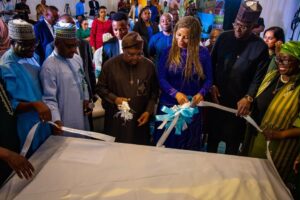
Launching the project, Director-General of the National Council on Climate Change, Mrs. Nkiruka Maduekwe, represented by the Council’s Director of Finance and Accounts, Mrs. Tenioye Majekodunmi, stressed that the initiative’s success would depend on effective implementation rather than policy declarations.
She urged stakeholders to convert climate commitments into investments, policies into impactful programmes and aspirations into measurable outcomes capable of improving the lives of Nigerians.
Majekodunmi also emphasised that climate action must remain firmly anchored on human dignity, economic resilience and social justice.
She reaffirmed Nigeria’s commitment to expanding renewable energy, increasing access to clean cooking technologies and implementing ambitious climate policies capable of reducing greenhouse gas emissions while improving public health and energy access.
Minister of Labour and Employment, Muhammad Maigari Dingyadi, described the launch as timely, noting that climate change is already affecting livelihoods, food production, energy systems and labour productivity across the country.
He said the first phase had strengthened national capacity through evidence generation, social dialogue and inclusive policy engagement, culminating in the validation of Nigeria’s Just Transition Guidelines and Action Plan.
According to the minister, the second phase will focus on identifying green employment opportunities, addressing skills gaps, supporting enterprise development, expanding social protection measures and promoting workplace reforms needed to facilitate Nigeria’s transition to a sustainable economy.
“The promise of just transition should be reflected in new skills for workers, resilient enterprises, sustainable livelihoods and expanded opportunities for youths and women,” Dingyadi said.
The Trade Union Congress of Nigeria (TUC) also endorsed the initiative, insisting that ecological transition can only succeed if it guarantees fairness and protection for workers.
The labour centre maintained that workers should not bear the social and economic costs of climate policies and pledged to support the programme through social dialogue, skills development and the promotion of decent green jobs.
It further called for workers to play an active role in shaping climate policies, industrial restructuring and the development of green job frameworks.
The launch comes as Nigeria intensifies efforts to meet its climate commitments while balancing environmental sustainability with economic growth and employment creation.
As Africa’s largest economy and one of the continent’s leading oil producers, Nigeria faces the complex challenge of reducing carbon emissions while safeguarding the livelihoods of millions of workers and communities dependent on fossil fuel industries.
The ILO said the second phase of the project is designed to ensure that climate action serves as a catalyst for decent work, inclusive economic growth and social justice rather than a source of economic disruption.