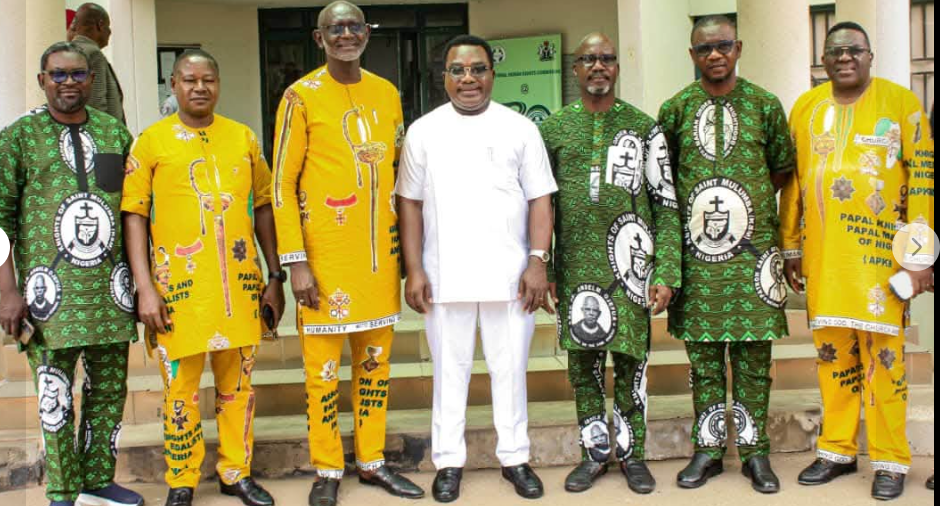
The National Human Rights Commission (NHRC) has forged a strategic partnership with the Knights of St. Mulumba (KSM) and the Papal Knights and Medalists of Nigeria to address prison congestion, secure the release of indigent detainees and strengthen the protection of inmates’ rights across correctional centres nationwide.
The collaboration, formalised during a courtesy visit to the Commission’s headquarters in Abuja by a delegation led by the National President of the Papal Knights and Supreme Knight of the Knights of St. Mulumba, Steve Adehi, will focus on reducing the growing population of Awaiting Trial Persons (ATPs), particularly those detained for minor offences or unable to meet bail conditions.
The initiative comes against the backdrop of persistent concerns over overcrowded correctional facilities, where thousands of inmates remain in custody for years without conviction due to delays in the judicial process, prolonged court proceedings and inability to perfect bail granted by the courts.
Speaking during the meeting, Adehi decried the continued detention of many Nigerians over minor, bailable offences, noting that numerous inmates remain behind bars solely because they lack the financial resources to secure their freedom.
Responding, the Executive Secretary of the NHRC, Tony Ojukwu, reaffirmed the Commission’s constitutional mandate to protect the rights of vulnerable and marginalised persons, describing the prolonged detention of individuals over trivial offences and insignificant sums as a serious indictment of Nigeria’s criminal justice system.
He cited documented instances of citizens detained over debts or disputes involving as little as ₦5,000, stressing that such cases represent a grave violation of human dignity and the fundamental principles of justice.
“Every intervention which secures liberty and restores dignity constitutes a meaningful contribution to society,” Ojukwu said.
Under the partnership, the NHRC and its faith-based partners agreed to pursue joint interventions aimed at reviewing the cases of inmates detained for minor offences and facilitating the release of those who remain in custody solely because they cannot satisfy bail conditions.
Beyond securing their freedom, the partners also resolved to establish reintegration support mechanisms, including halfway homes, vocational skills acquisition programmes, counselling services and welfare assistance to help former inmates rebuild their lives and reduce the risk of reoffending.
As part of efforts to strengthen institutional reforms, the partnership will also provide specialised human rights training for correctional officers to enhance compliance with Nigeria’s legal framework, including the Constitution, the Administration of Criminal Justice Act, 2015, and international standards such as the United Nations Standard Minimum Rules for the Treatment of Prisoners.
The Head of the NHRC’s National Preventive Mechanism, Kabiru Elayo, stressed that successful rehabilitation must extend beyond incarceration, warning that many former inmates return to prison because they lack structured support after regaining their freedom.
To institutionalise the collaboration, the Commission will develop a Memorandum of Understanding with the Knights of St. Mulumba and the Papal Knights and Medalists of Nigeria, with implementation expected to be extended to NHRC offices across the 36 states of the federation.
The Commission said the partnership reflects a growing consensus that Nigeria’s prison congestion crisis requires coordinated action involving government institutions, civil society organisations and faith-based groups.
Human rights advocates have consistently expressed concern over the high number of awaiting trial inmates in the country’s correctional facilities, arguing that prolonged pre-trial detention undermines the constitutional presumption of innocence while placing additional pressure on an already overstretched correctional system.
According to the NHRC, the partnership marks a significant step towards addressing structural weaknesses within Nigeria’s criminal justice system while promoting the rule of law, protecting human dignity and ensuring equitable access to justice irrespective of an individual’s financial status.