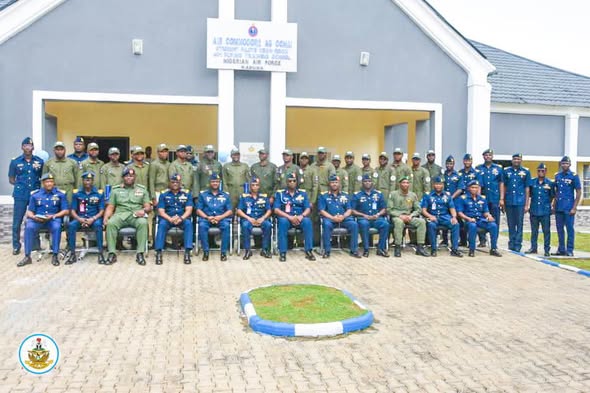
The Nigerian Air Force (NAF) has strengthened Nigeria’s joint intelligence, surveillance and reconnaissance capability with the graduation of the pioneer Defence Space Administration (DSA) Unmanned Aerial Vehicle (UAV) Flying Course 1/2026 at the 401 Flying Training School (401 FTS), Kaduna.
Speaking as the Special Guest of Honour at the graduation ceremony, the Chief of Training, Air Vice Marshal Ahmed Yusuf Dari, commended the 401 FTS for its sustained contribution to aviation training over more than five decades.
Dari described the pioneer course as a practical demonstration of the Chief of the Air Staff’s Command Philosophy, particularly its emphasis on “Standardized Training and Mission-Focused Capacity Development.”
He urged the training school to maintain realistic, relevant and technology-responsive training programmes capable of preparing personnel for the evolving demands of modern military operations.
The Air Vice Marshal also charged the graduands to uphold the highest standards of professionalism, operational safety and discipline as they assume responsibilities in the deployment of UAV technology.
Representing the Chief of Defence Space Administration, the Deputy Chief of Defence Space Administration, Air Vice Marshal John Laoye, underscored the growing strategic importance of UAVs to contemporary security operations.
According to him, UAV capability provides commanders with timely surveillance, enhanced situational awareness and critical intelligence needed to support effective operational decision-making.
Laoye stressed that the effectiveness of the technology would depend significantly on the availability of highly trained personnel capable of operating and exploiting UAV systems professionally.
He therefore called for sustained collaboration between the DSA and NAF to develop the human capacity required to effectively deploy emerging technologies in support of Nigeria’s national security objectives.
The graduation of the pioneer DSA UAV operators marks a significant milestone in strengthening cooperation between the two institutions and expanding Nigeria’s indigenous capacity in unmanned aviation.
The initiative also reinforces the NAF’s commitment to standardised training, technological innovation and mission-focused capability development, while deepening inter-agency cooperation in intelligence, surveillance and reconnaissance.
The enhanced capability is expected to support ongoing counter-insurgency and other joint security operations across the country, providing commanders with improved intelligence and greater situational awareness in increasingly complex operational environments.