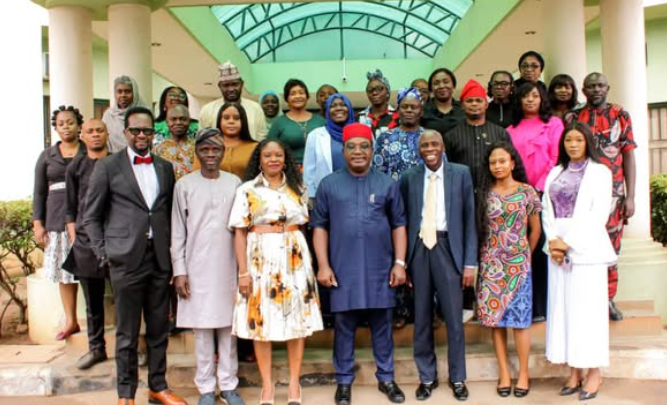
The National Human Rights Commission (NHRC) has concluded a two-day capacity-building workshop aimed at strengthening the ability of its staff to enforce economic, social and cultural (ESC) rights through the effective application of United Nations, African Union and ECOWAS human rights treaties.
The training, organised by the Commission’s Economic and Social Rights Department at its headquarters in Abuja, focused on enhancing participants’ understanding of sub-regional, regional and international human rights frameworks, with particular emphasis on the International Covenant on Economic, Social and Cultural Rights (ICESCR) and the African Charter on Human and Peoples’ Rights.
Speaking at the opening of the workshop, the Executive Secretary of the NHRC, Chief Tony Ojukwu, OFR, SAN, said the training was essential to strengthening the Commission’s mandate of protecting and promoting human rights in Nigeria.
According to him, while Nigeria has ratified and domesticated several international human rights treaties, the challenge remains ensuring that those legal obligations translate into meaningful protection for citizens.
“Nigeria has ratified and domesticated several human rights treaties. Our task now is to translate those legal obligations into practical action for citizens through investigation, monitoring and advocacy,” Ojukwu said.
The workshop featured sessions on leveraging African Union mechanisms to advance economic, social and cultural rights, the United Nations human rights protection system, and the application of international human rights jurisprudence within Nigeria’s legal framework.
The sessions were facilitated by international human rights experts, Mr. Harry Ogwuche Obe, Esq., FICMC, and Mr. Abdulrahman Yakubu, Esq., who guided participants through practical approaches to integrating regional and international legal instruments into complaint handling and rights enforcement.
Participants described the training as both timely and practical, noting that the case studies and interactive sessions provided valuable tools for applying international and regional human rights standards in their daily work.
One participant said the workshop had equipped staff with clearer strategies for invoking regional and international legal frameworks in protecting economic, social and cultural rights.
The Commission reaffirmed its commitment to continuous professional development for its workforce, stressing that enhanced institutional capacity would help ensure Nigeria’s treaty obligations translate into effective protection of citizens’ rights to health, education, housing, work and an adequate standard of living.